


"Soviet athletes are the pride of our country. For a healthy, cheerful generation, ready to work and defend the socialist homeland!" So reads a 1935 propaganda poster by Victor Koretsky. He depicts a Utopian scene, dominated by three beaming athletes, mid-stride in different coloured kits, symbolic of the athleticism found in all corners of the Soviet Union. In the background, comrades row, run and play football. The message is clear: physical activity is key to maintaining a harmonious, strong socialist idyll.
Good for the mind and body, sport, which should rise above international politics, is also supposed to be good for the world. This was not the case throughout the Cold War. US-USSR sporting competitiveness easily matched the intensity of the space race, from Olympic rivalry to Rocky IV, in which an all-American boxing hero fights Ivan Vasilyevich Drago, a comically threatening, almost bionic character who summed up the strength of Soviet elite athletes.

After the Russian invasion of Ukraine last week, sport is taking on renewed geopolitical significance, and the shadow of the USSR is looming large. Joining the ranks of the underdog Ukrainian military are four of the country's boxing greats, Wladimir and Vitali Klitschko, Oleksandr Usyk and Vasiliy Lomachenko, alongside professional tennis players and competitors that have only just returned from the Beijing Winter Olympics.
The four boxers have very different international allegiances to Koretsky's model Soviet athletes. The Klitschko brothers spent most of their careers in Germany where they drew record viewing figures, built fortunes and became fluent in German. Born in the USSR, they are now among the most internationally recognisable Ukrainians asking for western support against Russia and in favour of Ukrainian membership of the EU.
Usyk, despite threatening the global dominance of British star Anthony Joshua, is a favourite among UK fans for more than his graceful technique in a heavyweight division that so often sees more brawn than brains. He is the subject of a meme, having once been asked by a reporter how he felt after a fight. Unfamiliar with English, he replied "I am very feel". To the delight of British audiences, he now repeats the phrase in any English-language interview. When a video emerged of him singing along to Neil Diamond's Sweet Caroline, a cult-favourite among UK crowds, he practically became a citizen.
-
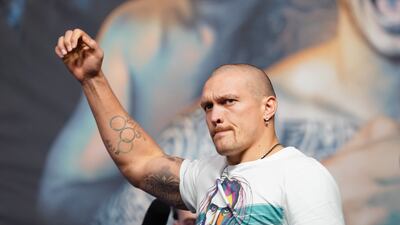
World heavyweight champion Oleksandr Usyk says he has absolutely no fear after taking up arms in Kyiv to defend his native Ukraine against Russian forces. PA -

Mayor of Kyiv Vitaly Klitschko, left, a former heavyweight boxing champion, and his brother, heavyweight boxing world champion Wladimir Klitschko, speak at the opening of the first Ukrainian Territorial Defence Forces recruitment centre in central Kyiv. Reuters -
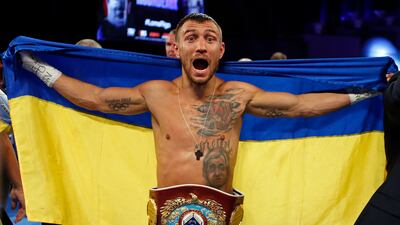
Two-time Olympic boxing champion Vasiliy Lomachenko rushed back to Ukraine to take up arms against the Russians. AP -
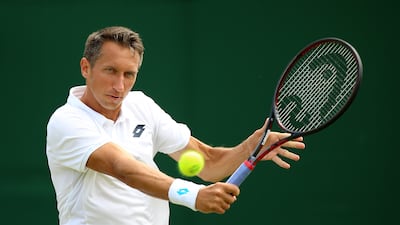
Former tennis player Sergiy Stakhovsky, who has joined the fight against the Russian invasion, says sporting sanctions alone will not stop Vladimir Putin. PA -
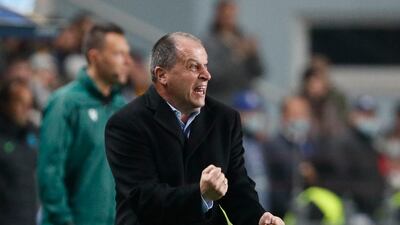
Sheriff Tiraspol coach Yuriy Vernydub has joined Ukraine's fight against the Russian invasion. Reuters


It is a less wholesome outlook for Russians involved in sport. Israeli-Russian billionaire Roman Abramovich confirmed on Wednesday that he is selling London football club Chelsea. Mr Abramovich is arguably the best-known owner in the world, so it is an astonishingly quick decision that ends a 19-year tenure mere days into the invasion. A similar situation is unfolding at Everton. As more and more players don Ukraine shirts before matches, the era of anonymous Russian billions in international football could be over.
But it is not just those in the background that are losing out. Russia and Belarus have been told they cannot compete in the Winter Paralympics, and Russian footballers will not be going to the World Cup. By going back to Ukraine, both Usyk and Lomachenko risk missing career-defining fights.
It is understandable that all manner of punishments be explored, including in sport, as Moscow continues its aggression. But it is tragic that the short careers of Russian athletes are being sacrificed in the process. They have already had a tough few months. Kamila Valieva, a figure skater and gold-medal hopeful at this year's winter Olympics, never recovered after testing positive for an illegal substance before the competition. Eventually allowed to participate, her performance suffered under the immense stress of so much media scrutiny.
Now, all Russian figure skaters have been banned from the upcoming world championships. The huge risk of disappointment after so much sacrifice is something no propagandist would ever reference, and a side to sport that we too often forget. One historic USSR poster depicts a female skater competing in front of thousands with the caption: "Youth, go skating!" Valieva did just that; it ended in her crying while being berated by her coach, footage that was beamed across the world. She is just 15.

Even when Russian athletes do return to the global stage, they will be representing a country that has never been so isolated, and the world will be watching. While sport should rise above political acrimony, the backdrop of violence has given us some of the most famous athletic moments of all time. The marathon comes from a 490 BCE battle between Ancient Greeks and Persians, when the messenger Pheidippides ran 25 miles back to Athens to deliver news of victory. A key example from the Soviet era is the only famous water polo match in history, the 1956 USSR-Hungary "blood in the water" game. It took place as Soviet forces were putting down an uprising in Budapest. The match was so violent that five players were sent out by the referee and the pool turned red from all the spilt blood.
Ukraine might well become Russia's new Hungary. But for now, the young in both, who were once the pride of the same country, are locked only in war, the most terrible competition of all. If only they could return to sport.

