Ahmed Ali Al Sayegh is UAE Minister of State and UAE Sherpa for the G20
February 20, 2022
This week has been a historic moment for the UAE and India. By inaugurating the new year with the signing of the Comprehensive Economic Partnership Agreement (CEPA) between the UAE and India, our two countries and peoples have solidified a truth we have known for many years: through increased co-operation, we will continue enjoying the immense prosperity and opportunity that await us as partners.
CEPA is as much an economic partnership agreement as it is a testament to the brotherly relations our two countries have enjoyed since the establishment of our diplomatic relationship in 1972. In fact, the start of our bilateral relations predates our diplomatic engagement, with a history of commerce dating back centuries.
As our ancestors traded goods and traversed the ocean seeking contacts and cultural exchange, they set the stage for the flourishing relationship that we see today. In fact, India – the world’s fifth largest economy – is the UAE’s largest trading partner in terms of exports, comprising $26.8 billion or 10.8 percent of its total exports in 2019. That same year, India was the ninth largest recipient of foreign direct investment from the UAE with an inflow of $51bn. Moreover, the UAE and India signed a Comprehensive Strategic Partnership Agreement in January 2017 to set out an ambitious roadmap for political and economic co-operation.
Now, the UAE is taking bold steps to strengthen its economy and that of the wider region by improving and expanding bilateral relations with key partners. We aim to double the size of our economy in the coming decade and continue to attract some of the world’s top human capital, and foreign trade will be an integral pillar of this development.
The entire world is an open market linked by logistics and the free flow of trade. To further widen these economic channels, CEPA boosts market access and facilitates the movement of talent around the world.
The CEPA model is central to the UAE’s efforts to build our economy over the next 50 years and solidify our position as a global economic hub. It also reflects our aim to further develop partnerships that are mutually beneficial to both the UAE and trade partners that are equally invested in shaping tomorrow’s economy.
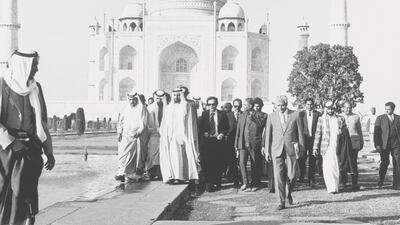
The Founding Father, Sheikh Zayed, during a visit to the Taj Mahal in Agra, India, in 1975. Photo: National Archives
A gulf rupee, the currency of the Gulf until the mid 1960s. Amy Leang / The National
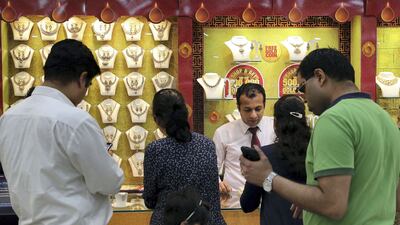
People visit the Joyalukkas Jewellery shop in Bur Dubai. Pawan Singh / The National
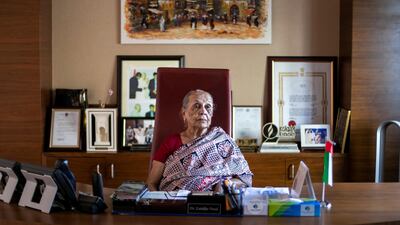
Dr Zulekha Daud, chairwoman of the Zulekha Healthcare Group. Reem Mohammed / The National
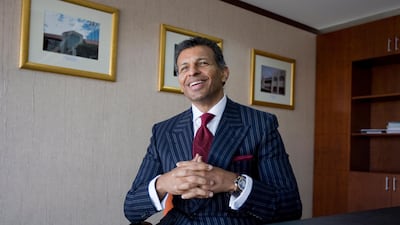
Sunny Varkey, founder and chairman of GEMS Education. Philip Cheung / Abu Dhabi Media Company
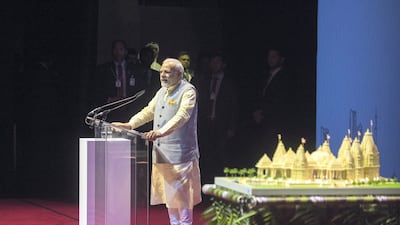
Narendra Modi, Prime Minister of India, at the unveiling of the Abu Dhabi Hindu temple model in 2018. Photo: BAPS Swaminarayan Sanstha
Pooja Singh, Nilam ghorpade and Monika Sharma during Diwali celebrations at the India pavilion at Expo 2020 Dubai. Victor Besa/The National
As such, CEPA represents a turning point in our country’s economic trajectory. Having recently celebrated 50 years since our founding as a nation, the UAE is now eager to begin the next chapter of international engagement. With India in particular, such co-operation is a logical step forward in building upon our bond. The UAE is already one of the top 10 investors in India, and the agreement will help stimulate our partnership while unlocking the new Asian future and driving progress for the south-south corridor.
What tangible benefits will CEPA offer for businesses and people in our two countries? First, it will trigger increased investment flows, lower tariffs and create enormous new opportunities for key sectors in both India and the UAE, including air transport, environment, investment, digital trade and more.
Second, CEPA will make it easier than ever for small and medium enterprises in our countries to go global by granting them access to new customers, networks and avenues of collaboration. The private sector will benefit enormously from these economic privileges as it remains at the forefront of innovation and economic growth.
Third – and perhaps most incredibly – through CEPA, the UAE and India aim to increase bilateral non-oil trade to over $100bn within five years.
Prior to concluding CEPA, our two countries had already signed a number of key economic agreements to boost trade and investment in recent years, including an Agreement on Avoidance of Double Taxation, an Agreement on the Protection and Promotion of Investment and an Air Services Agreement. These agreements came in addition to the establishment of a joint committee and the UAE-India High-Level Taskforce Group on Investment, which have exerted significant efforts exploring opportunities of mutual benefit and strengthening economic co-operation across industry, commerce, and trade.
Economic co-operation, as embodied by CEPA, forms only one part of the deep friendship that our nations share. Today, millions of Indian nationals living and working in the UAE form a vibrant community that has become an inseparable part of our national fabric. In fact, the Indian diaspora in the UAE makes up the largest expatriate community in the country. More than 200 weekly direct flights connect India and the UAE and ensure our peoples continue to engage in trade, study and tourism.
Through this interaction, we have celebrated each other’s festivals and honoured our respective heritage, practiced our religious traditions side-by-side in harmony and learned about each other’s diverse languages, popular culture, food and families. In 1975, the UAE and India signed a Cultural Agreement that set the framework for cultural co-operation and later led to the development of the Executive Programme for Cultural Co-operation in 2016. The heart of the UAE would not be the same without the immense contributions of its Indian community.
In this vein, we are truly proud of India’s participation in Expo 2020 Dubai under the theme “the future is in India.” It is no coincidence that the UAE’s National Day was recently named by UNESCO as World Futures Day, as both our countries look to invest in advanced industries that will reshape our world and enhance prospects for a comprehensive recovery from the Covid-19 pandemic, including through agri-tech, artificial intelligence, green infrastructure and renewables.
The future-oriented vision that our countries share – one of economic prosperity, cultural richness and people-to-people exchange – forms the basis of our enduring partnership, one that will propel us into the next stage. CEPA is only the bright beginning of this coming era of co-operation.

Mercer, the investment consulting arm of US services company Marsh & McLennan, expects its wealth division to at least double its assets under management (AUM) in the Middle East as wealth in the region continues to grow despite economic headwinds, a company official said.
Mercer Wealth, which globally has $160 billion in AUM, plans to boost its AUM in the region to $2-$3bn in the next 2-3 years from the present $1bn, said Yasir AbuShaban, a Dubai-based principal with Mercer Wealth.
“Within the next two to three years, we are looking at reaching $2 to $3 billion as a conservative estimate and we do see an opportunity to do so,” said Mr AbuShaban.
Mercer does not directly make investments, but allocates clients’ money they have discretion to, to professional asset managers. They also provide advice to clients.
“We have buying power. We can negotiate on their (client’s) behalf with asset managers to provide them lower fees than they otherwise would have to get on their own,” he added.
Mercer Wealth’s clients include sovereign wealth funds, family offices, and insurance companies among others.
From its office in Dubai, Mercer also looks after Africa, India and Turkey, where they also see opportunity for growth.
Wealth creation in Middle East and Africa (MEA) grew 8.5 per cent to $8.1 trillion last year from $7.5tn in 2015, higher than last year’s global average of 6 per cent and the second-highest growth in a region after Asia-Pacific which grew 9.9 per cent, according to consultancy Boston Consulting Group (BCG). In the region, where wealth grew just 1.9 per cent in 2015 compared with 2014, a pickup in oil prices has helped in wealth generation.
BCG is forecasting MEA wealth will rise to $12tn by 2021, growing at an annual average of 8 per cent.
Drivers of wealth generation in the region will be split evenly between new wealth creation and growth of performance of existing assets, according to BCG.
Another general trend in the region is clients’ looking for a comprehensive approach to investing, according to Mr AbuShaban.
“Institutional investors or some of the families are seeing a slowdown in the available capital they have to invest and in that sense they are looking at optimizing the way they manage their portfolios and making sure they are not investing haphazardly and different parts of their investment are working together,” said Mr AbuShaban.
Some clients also have a higher appetite for risk, given the low interest-rate environment that does not provide enough yield for some institutional investors. These clients are keen to invest in illiquid assets, such as private equity and infrastructure.
“What we have seen is a desire for higher returns in what has been a low-return environment specifically in various fixed income or bonds,” he said.
“In this environment, we have seen a de facto increase in the risk that clients are taking in things like illiquid investments, private equity investments, infrastructure and private debt, those kind of investments were higher illiquidity results in incrementally higher returns.”
The Abu Dhabi Investment Authority, one of the largest sovereign wealth funds, said in its 2016 report that has gradually increased its exposure in direct private equity and private credit transactions, mainly in Asian markets and especially in China and India. The authority’s private equity department focused on structured equities owing to “their defensive characteristics.”
A widely accepted definition was made by the All Party Parliamentary Group on British Muslims in 2019: “Islamophobia is rooted in racism and is a type of racism that targets expressions of Muslimness or perceived Muslimness.” It further defines it as “inciting hatred or violence against Muslims”.
Stage result
1. Jasper Philipsen (Bel) Alpecin-Fenix 4:42:34
2. Sam Bennett (Irl) Bora-Hansgrohe
3. Elia Viviani (Ita) Ineos Grenadiers
4. Dylan Groenewegen (Ned) BikeExchange-Jayco
5. Emils Liepins (Lat) Trek-Segafredo
6. Arnaud Demare (Fra) Groupama-FDJ
7. Max Kanter (Ger) Movistar Team
8. Olav Kooij (Ned) Jumbo-Visma
9. Tom Devriendt (Bel) Intermarché-Wanty-Gobert Matériaux
Family: Wife, Pom; and daughters Kate, 18, and Ciara, 13, who attend Jumeirah English Speaking School (JESS)
Favourite book or author: “That’s a really difficult question. I’m a big fan of Donna Tartt, The Secret History. I’d recommend that, go and have a read of that.”
Dream: “It would be to continue to have fun and to work with really interesting people, which I have been very fortunate to do for a lot of my life. I just enjoy working with very smart, fun people.”
Funding: $12.9m from Kuwait-based Faith Capital Holding
The Vile
Starring: Bdoor Mohammad, Jasem Alkharraz, Iman Tarik, Sarah Taibah
Director: Majid Al Ansari
Rating: 4/5
match info
Southampton 0
Arsenal 2 (Nketiah 20', Willock 87')
Red card: Jack Stephens (Southampton)
Man of the match: Rob Holding (Arsenal)
Which honey takes your fancy?
Al Ghaf Honey
The Al Ghaf tree is a local desert tree which bears the harsh summers with drought and high temperatures. From the rich flowers, bees that pollinate this tree can produce delicious red colour honey in June and July each year
Sidr Honey
The Sidr tree is an evergreen tree with long and strong forked branches. The blossom from this tree is called Yabyab, which provides rich food for bees to produce honey in October and November. This honey is the most expensive, but tastiest
Samar Honey
The Samar tree trunk, leaves and blossom contains Barm which is the secret of healing. You can enjoy the best types of honey from this tree every year in May and June. It is an historical witness to the life of the Emirati nation which represents the harsh desert and mountain environments
Our legal columnist
Name: Yousef Al Bahar
Advocate at Al Bahar & Associate Advocates and Legal Consultants, established in 1994
Education: Mr Al Bahar was born in 1979 and graduated in 2008 from the Judicial Institute. He took after his father, who was one of the first Emirati lawyers
Results
Light Flyweight (49kg): Mirzakhmedov Nodirjon (UZB) beat Daniyal Sabit (KAZ) by points 5-0.
Flyweight (52kg): Zoirov Shakhobidin (UZB) beat Amit Panghol (IND) 3-2.
Stop all transactions and communication on suspicion
Save all evidence (screenshots, chat logs, transaction IDs)
Report to local authorities
Warn others to prevent further harm
Courtesy: Crystal Intelligence
ICC Intercontinental Cup
UAE squad Rohan Mustafa (captain), Chirag Suri, Shaiman Anwar, Rameez Shahzad, Mohammed Usman, Adnan Mufti, Saqlain Haider, Ahmed Raza, Mohammed Naveed, Imran Haider, Qadeer Ahmed, Mohammed Boota, Amir Hayat, Ashfaq Ahmed
Fixtures Nov 29-Dec 2
UAE v Afghanistan, Zayed Cricket Stadium, Abu Dhabi
Hong Kong v Papua New Guinea, Sharjah Cricket Stadium
Ireland v Scotland, Dubai International Stadium
Namibia v Netherlands, ICC Academy, Dubai
Friday's schedule at the Etihad Airways Abu Dhabi Grand Prix
GP3 qualifying, 10:15am
Formula 2, practice 11:30am
Formula 1, first practice, 1pm
GP3 qualifying session, 3.10pm
Formula 1 second practice, 5pm
Formula 2 qualifying, 7pm
The biog
Title: General Practitioner with a speciality in cardiology
Previous jobs: Worked in well-known hospitals Jaslok and Breach Candy in Mumbai, India
Education: Medical degree from the Government Medical College in Nagpur
How it all began: opened his first clinic in Ajman in 1993
Family: a 90-year-old mother, wife and two daughters
Remembers a time when medicines from India were purchased per kilo