The Red Square in Moscow last week. EPA


Will Russia risk getting sanctioned like Iran?


  • English
  • Arabic

January 30, 2022

US President Joe Biden, it seems, has been forced to address the limitations in his “maximum diplomacy” approach to foreign affairs, which he sought to pursue as an alternative to his predecessor Donald Trump’s “maximum pressure” policy. Mr Biden has in recent weeks wielded the sword of sanctions and military response to dissuade Russia from sending its troops into neighbouring Ukraine – at least thus far.

The Russian leadership seems divided on the Ukraine crisis. There are those who want Moscow to accept western overtures as a path to de-escalation and, thereby, avoid sanctions. Others warn against falling for what they view to be diplomatic stalling from the US and European powers, and seize the opportunity to stop Nato’s eastward expansion for the foreseeable future.

Russia’s allies are also closely watching.

China reportedly doesn’t want any escalation to affect the Beijing Winter Olympics, which gets under way on Friday. Iran, while feeling emboldened by the strategic pact it recently signed with Russia, feels anxious about the indirect impact sanctions against its ally might have on Tehran’s expansionist projects in the Middle East.

The regime is also worried that the possible collapse of its nuclear talks with the permanent members of the UN Security Council, plus Germany, would scuttle its hopes of getting crippling sanctions lifted. Additionally, Iran is concerned that it may have slid down the list of western priorities as an outcome of the Ukraine crisis. Meanwhile, it has to contend with the political and diplomatic support being mobilised around the UAE after the recent attacks on Abu Dhabi carried out by Yemen’s Houthi rebels, to whom Iran provides all kinds of support.

Tehran has watched with concern as the ice has begun to thaw between the Gulf countries and Turkey in recent months. It is also unhappy about the possibility of improving Gulf-Lebanon relations after the visit of Kuwait’s foreign minister, Sheikh Ahmad Nasser Al Mohammad Al Sabah, to Beirut earlier in the month. The trip follows a diplomatic rift that emerged between Lebanon and the GCC last year, after a senior Lebanese minister made controversial comments relating to the conflict in Yemen.

Lebanon’s Arab partners have proposed a set of prescriptions to rebuild the country. But with a corrupt governing class in charge in Beirut, the likelihood of any of these proposals being approved and implemented is next to none, at least for now. Moreover, Hezbollah remains a factor in the country’s politics. The Iranian-backed proxy answers only to Tehran, specifically the Islamic Revolutionary Guard Corps, which seeks to export Iran’s theocratic model of government to the Arab world, from Yemen to Lebanon via Iraq and Syria, through the destruction of their national sovereignty.

Hossein Salami, centre, attends military exercises conducted by Iran's Islamic Revolutionary Guard Corps in December. AFP

Russia understands Iran’s need to spread its influence in the Middle East, and it is a model that may even suit Moscow’s interests. But the Biden administration, which has so far paid little more than lip service to its Arab allies on this issue, may be having a policy rethink following the Abu Dhabi attacks.

But with its focus squarely on Ukraine, the Iran nuclear issue has, to Tehran’s chagrin, been moved to the backburner. The Iranian regime is worried that, with the US midterm elections scheduled to be held later this year, Washington may kick this can further down the road.

The sanctions, a key instrument in Mr Trump’s maximum pressure policy, have now become a key instrument for the Biden administration. This is why it is using it as a threat to Russia.

Moscow understands the devastating impact western sanctions could have on Russia’s economy and society. Cutting the country off from the “Swift” system – which serves as an intermediary and executor of financial transactions between banks worldwide – will mean it won’t be able to receive transactions from outside to pay for its exports, or to transfer funds to pay for its imports. The inability to use credit cards will make it very difficult for Russians to travel. Try explaining that to the approximately five million Russians who travel annually to Turkey.

Moscow finds itself with two options.

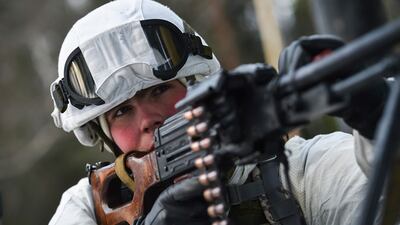
  • A Russian soldier attends a military exercise at the Golovenki training ground in the Moscow region, Russia. AP Photo
    A Russian soldier attends a military exercise at the Golovenki training ground in the Moscow region, Russia. AP Photo
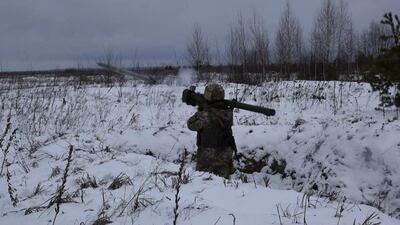
  • A member of the 14th Separate Mechanised Brigade of the Ukrainian Armed Forces takes part in anti-aircraft military drills in the Volyn region, Ukraine. Reuters
    A member of the 14th Separate Mechanised Brigade of the Ukrainian Armed Forces takes part in anti-aircraft military drills in the Volyn region, Ukraine. Reuters
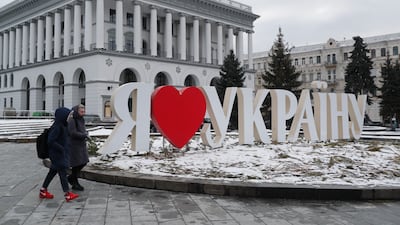
  • People walk past a sign reading 'I Love Ukraine' in the central square in Kiev. EPA
    People walk past a sign reading 'I Love Ukraine' in the central square in Kiev. EPA
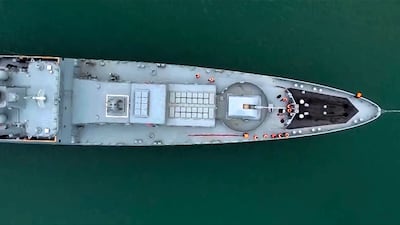
  • Russian naval frigate 'Admiral Essen' sails during an exercise in the Black Sea. AP
    Russian naval frigate 'Admiral Essen' sails during an exercise in the Black Sea. AP
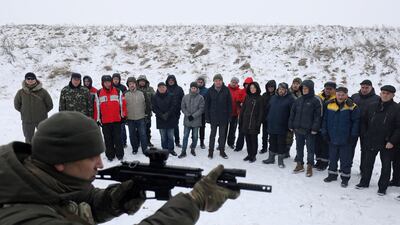
  • Employees of essential city industries and services attend a military training session outside Lviv, Ukraine. Reuters
    Employees of essential city industries and services attend a military training session outside Lviv, Ukraine. Reuters
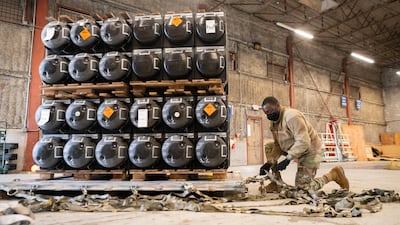
  • Airman 1st Class Olabode Igandan organises ammunition, weapons and other equipment bound for Ukraine during a foreign military sales mission at Dover Air Force Base, Delaware. AP
    Airman 1st Class Olabode Igandan organises ammunition, weapons and other equipment bound for Ukraine during a foreign military sales mission at Dover Air Force Base, Delaware. AP
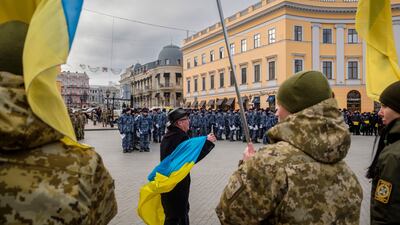
  • A member of the public waves a Ukrainian flag at a rally attended by soldiers and police in Odessa, Ukraine. Bloomberg
    A member of the public waves a Ukrainian flag at a rally attended by soldiers and police in Odessa, Ukraine. Bloomberg
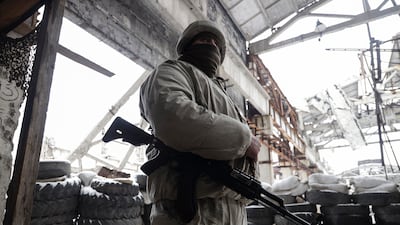
  • A Ukrainian serviceman patrols the front line near Avdiivka village, not far from the pro-Russian militant-controlled city of Donetsk, Ukraine. EPA
    A Ukrainian serviceman patrols the front line near Avdiivka village, not far from the pro-Russian militant-controlled city of Donetsk, Ukraine. EPA
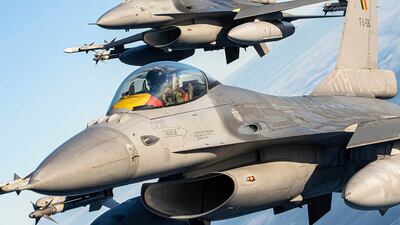
  • A Belgian Air Force F-16 fighter jet participates in Nato's Baltic Air Policing Mission in Lithuanian airspace. AP
    A Belgian Air Force F-16 fighter jet participates in Nato's Baltic Air Policing Mission in Lithuanian airspace. AP

One is to quietly roll back its military measures and pivot to diplomatic talks led by Sergey Lavrov. The Russian foreign minister is adept at turning failure into a success. He has stated that the escalation of tensions in Europe’s east and the subsequent diplomatic attempts pursued by the West are exactly what Russia sought from the get-go. A strong claim to have forced negotiations with Nato could provide a face-saving way out of a confrontation.

The other view, led by the brass, is that military action may be necessary to avoid Ukraine being absorbed into Nato. They argue that the West has categorically rejected Moscow’s demands and ignored its proposals, which leaves the latter with few options.

The military, it seems, seeks to escalate matters in Donbass – the region in south-eastern Ukraine that’s been occupied by pro-Russian groups since 2014 – which could lead to a broader conflict.

It won’t be an easy decision for Moscow to make. But while its weighs its options, it will do well to remind itself that when Estonia, Latvia and Lithuania – all former Soviet republics, like Ukraine – joined Nato, this had little bearing on Russian security. Will Ukraine’s addition to the western security alliance – highly unlikely though it is at this stage – really change its fortunes?


Company profile

Company: Rent Your Wardrobe 

Date started: May 2021 

Founder: Mamta Arora 

Based: Dubai 

Sector: Clothes rental subscription 

Stage: Bootstrapped, self-funded 

A%20Little%20to%20the%20Left
%3Cp%3E%3Cstrong%3EDeveloper%3A%20%3C%2Fstrong%3EMax%20Inferno%3Cbr%3E%3Cstrong%3EConsoles%3A%3C%2Fstrong%3E%20PC%2C%20Mac%2C%20Nintendo%20Switch%3Cbr%3E%3Cstrong%3ERating%3A%20%3C%2Fstrong%3E4%2F5%26nbsp%3B%3C%2Fp%3E%0A
Classification of skills

A worker is categorised as skilled by the MOHRE based on nine levels given in the International Standard Classification of Occupations (ISCO) issued by the International Labour Organisation. 

A skilled worker would be someone at a professional level (levels 1 – 5) which includes managers, professionals, technicians and associate professionals, clerical support workers, and service and sales workers.

The worker must also have an attested educational certificate higher than secondary or an equivalent certification, and earn a monthly salary of at least Dh4,000. 

The Abu Dhabi Awards explained:

What are the awards? They honour anyone who has made a contribution to life in Abu Dhabi.

Are they open to only Emiratis? The awards are open to anyone, regardless of age or nationality, living anywhere in the world.

When do nominations close? The process concludes on December 31.

How do I nominate someone? Through the website.

When is the ceremony? The awards event will take place early next year.

In-demand jobs and monthly salaries
  • Technology expert in robotics and automation: Dh20,000 to Dh40,000 
  • Energy engineer: Dh25,000 to Dh30,000 
  • Production engineer: Dh30,000 to Dh40,000 
  • Data-driven supply chain management professional: Dh30,000 to Dh50,000 
  • HR leader: Dh40,000 to Dh60,000 
  • Engineering leader: Dh30,000 to Dh55,000 
  • Project manager: Dh55,000 to Dh65,000 
  • Senior reservoir engineer: Dh40,000 to Dh55,000 
  • Senior drilling engineer: Dh38,000 to Dh46,000 
  • Senior process engineer: Dh28,000 to Dh38,000 
  • Senior maintenance engineer: Dh22,000 to Dh34,000 
  • Field engineer: Dh6,500 to Dh7,500
  • Field supervisor: Dh9,000 to Dh12,000
  • Field operator: Dh5,000 to Dh7,000
GAC GS8 Specs

Engine: 2.0-litre 4cyl turbo

Power: 248hp at 5,200rpm

Torque: 400Nm at 1,750-4,000rpm

Transmission: 8-speed auto

Fuel consumption: 9.1L/100km

On sale: Now

Price: From Dh149,900

What can victims do?

Always use only regulated platforms

Stop all transactions and communication on suspicion

Save all evidence (screenshots, chat logs, transaction IDs)

Report to local authorities

Warn others to prevent further harm

Courtesy: Crystal Intelligence

Mercer, the investment consulting arm of US services company Marsh & McLennan, expects its wealth division to at least double its assets under management (AUM) in the Middle East as wealth in the region continues to grow despite economic headwinds, a company official said.

Mercer Wealth, which globally has $160 billion in AUM, plans to boost its AUM in the region to $2-$3bn in the next 2-3 years from the present $1bn, said Yasir AbuShaban, a Dubai-based principal with Mercer Wealth.

Within the next two to three years, we are looking at reaching $2 to $3 billion as a conservative estimate and we do see an opportunity to do so,” said Mr AbuShaban.

Mercer does not directly make investments, but allocates clients’ money they have discretion to, to professional asset managers. They also provide advice to clients.

“We have buying power. We can negotiate on their (client’s) behalf with asset managers to provide them lower fees than they otherwise would have to get on their own,” he added.

Mercer Wealth’s clients include sovereign wealth funds, family offices, and insurance companies among others.

From its office in Dubai, Mercer also looks after Africa, India and Turkey, where they also see opportunity for growth.

Wealth creation in Middle East and Africa (MEA) grew 8.5 per cent to $8.1 trillion last year from $7.5tn in 2015, higher than last year’s global average of 6 per cent and the second-highest growth in a region after Asia-Pacific which grew 9.9 per cent, according to consultancy Boston Consulting Group (BCG). In the region, where wealth grew just 1.9 per cent in 2015 compared with 2014, a pickup in oil prices has helped in wealth generation.

BCG is forecasting MEA wealth will rise to $12tn by 2021, growing at an annual average of 8 per cent.

Drivers of wealth generation in the region will be split evenly between new wealth creation and growth of performance of existing assets, according to BCG.

Another general trend in the region is clients’ looking for a comprehensive approach to investing, according to Mr AbuShaban.

“Institutional investors or some of the families are seeing a slowdown in the available capital they have to invest and in that sense they are looking at optimizing the way they manage their portfolios and making sure they are not investing haphazardly and different parts of their investment are working together,” said Mr AbuShaban.

Some clients also have a higher appetite for risk, given the low interest-rate environment that does not provide enough yield for some institutional investors. These clients are keen to invest in illiquid assets, such as private equity and infrastructure.

“What we have seen is a desire for higher returns in what has been a low-return environment specifically in various fixed income or bonds,” he said.

“In this environment, we have seen a de facto increase in the risk that clients are taking in things like illiquid investments, private equity investments, infrastructure and private debt, those kind of investments were higher illiquidity results in incrementally higher returns.”

The Abu Dhabi Investment Authority, one of the largest sovereign wealth funds, said in its 2016 report that has gradually increased its exposure in direct private equity and private credit transactions, mainly in Asian markets and especially in China and India. The authority’s private equity department focused on structured equities owing to “their defensive characteristics.”

Dengue%20fever%20symptoms
%3Cul%3E%0A%3Cli%3EHigh%20fever%3C%2Fli%3E%0A%3Cli%3EIntense%20pain%20behind%20your%20eyes%3C%2Fli%3E%0A%3Cli%3ESevere%20headache%3C%2Fli%3E%0A%3Cli%3EMuscle%20and%20joint%20pains%3C%2Fli%3E%0A%3Cli%3ENausea%3C%2Fli%3E%0A%3Cli%3EVomiting%3C%2Fli%3E%0A%3Cli%3ESwollen%20glands%3C%2Fli%3E%0A%3Cli%3ERash%3C%2Fli%3E%0A%3C%2Ful%3E%0A%3Cp%3EIf%20symptoms%20occur%2C%20they%20usually%20last%20for%20two-seven%20days%3C%2Fp%3E%0A
The specs

Engine: 1.5-litre 4-cylinder petrol

Power: 154bhp

Torque: 250Nm

Transmission: 7-speed automatic with 8-speed sports option 

Price: From Dh79,600

On sale: Now

Updated: January 30, 2022, 2:00 PM