


With an estimated 100,000 Russian troops camped on the Ukrainian border, there has never been a more urgent need for Russian and Nato leaders to find a way to resolve their differences.
Even though the Kremlin has consistently denied that it has any plans to invade Ukraine, and that the troops massed on its southern neighbour’s border are undertaking a routine military exercise, concerns persist as to the Russian force’s ultimate objectives.
Speculation has been mounting that Russia is preparing to launch a full-scale invasion of Ukraine since Moscow first began deploying its forces near Ukraine in November, with some analysts predicting that the offensive would take place this month.
Washington is now warning that the operation has only been delayed because the region has experienced an unusually mild winter, prompting US President Joe Biden to order a team of meteorologists to help forecast when a possible Russian invasion might take place. US officials have reported that the relatively mild weather makes a January invasion now unlikely, with large areas across the border and near the frontline constituting a muddy quagmire, providing less-than-ideal conditions for fighting.
Hopes of de-escalating tensions in the area have not been helped, though, by the Russian decision earlier this week to move helicopters and fighter jets towards the Ukrainian border.
The move follows Russia’s recent military intervention in Kazakhstan, labelled a "peacekeeping" mission by Moscow, which is being seen as a clear demonstration of the Kremlin’s willingness to act in decisive fashion when it comes to defending what it believes to be its overseas interests.
The increased activity on the Ukrainian border has certainly increased tensions at a time when intensive diplomatic efforts are underway to de-escalate the situation, with Russian and Western officials engaging in a series of high-level talks throughout the week.
-
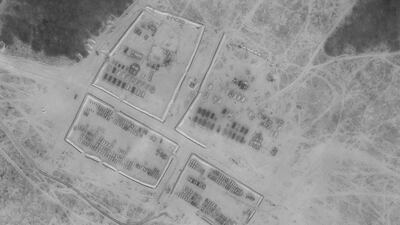
A satellite image shows a Russian battle group deployment in the Kursk Training Area, Russia, on December 21, 2021. Reuters -
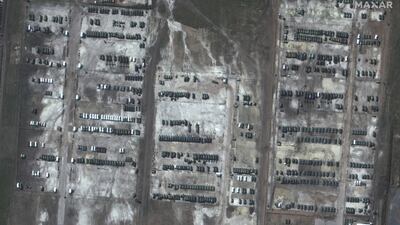
Russian forces in Soloti, Russia, on September 7, 2021. Reuters -
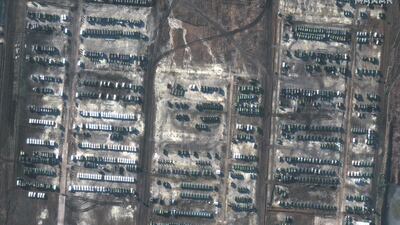
A satellite image shows Russian forces in Soloti, Russia, on December 5, 2021. Reuters -
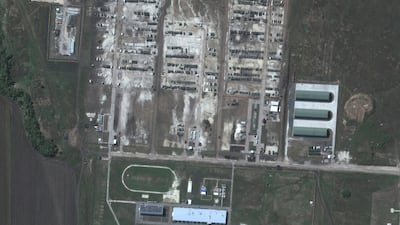
Russian forces in Soloti, Russia, on September 7, 2021. Reuters -

A satellite image released by Maxar Technologies shows Russian armoured units training in the Pogonovo Training Area near Voronezh, Russia, on November 26, 2021. Reuters -
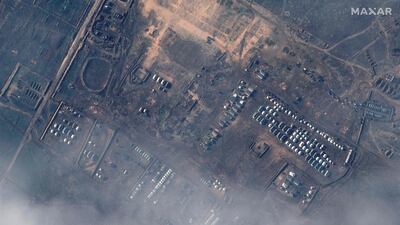
A satellite image released by Maxar Technologies reportedly shows Russian ground forces deployed at the Opuk Training Area on December 22, 2021. AFP -
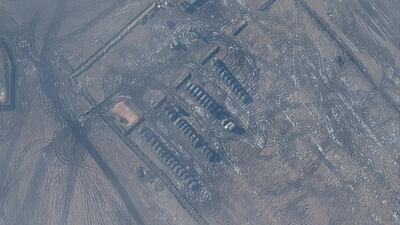
Russian ground forces deployed at the Opuk Training Area on December 22, 2021. AFP -
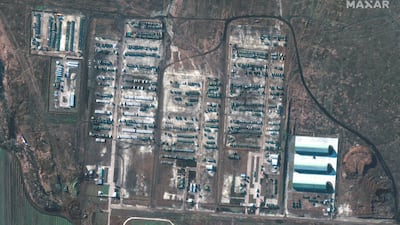
A satellite image of a Russian troop location in Soloti, Russia, provided by Maxar Technologies and taken on December 5, 2021. AP -

A Russian troop location in Bakhchysarai, Russia. AP


The talks have been convened after Russia set out a contentious set of demands at the end of last year, which sought to limit any extension of Nato influence in nations, such as Ukraine, that were formerly members of the Soviet Union.
Top of Moscow’s demands was that Nato provide a commitment that the likes of Ukraine and Georgia – another former Soviet state – would never be allowed to join the Nato alliance. In addition, Russia is calling on Nato to limit its military operations in eastern Europe, which Moscow views as a direct threat to its own security.
Tensions between Russia and the West have been steadily on the increase since Moscow’s 2014 military action against Ukraine, which resulted in the capture and annexation of Crimea, a move that has resulted in Moscow being subjected to wide-ranging sanctions.
Ukraine currently enjoys partner status with Nato, and Ukrainian President Volodymyr Zelenskiy has expressed interest in becoming a full Nato member, a move which would commit the alliance to protecting Ukraine’s sovereign integrity.
Another important factor in the dispute is that, under the terms of the 1994 Budapest Memorandum that Ukraine, together with Belarus and Kazakhstan, signed with the Organisation for Security and Co-operation in Europe (OSCE), the West agreed to provide the country with security guarantees in return for Kiev giving up its nuclear weapons.

But any attempt by Ukraine to press for Nato membership will be fiercely resisted by Mr Putin, who regards Ukraine as historically falling within Moscow’s sphere of influence and is bitterly opposed to the move.
Nor is the Ukraine issue the only one driving the recent increase in tensions between Moscow and the West. Apart from seeking to limit Nato from continuing its expansion in eastern Europe, a process that began with the fall of the collapse of the Soviet Union, Western diplomats believe Russia’s conduct on Ukraine’s border is also aimed at getting sanctions on its economy lifted. Moscow is also pressing for Europe to give approval for the controversial Nord Stream 2 gas pipeline, which runs from Russia to Germany, to become operational.
Hopes of any immediate breakthrough in the stand-off, though, have so far failed to materialise following four hours of talks between Nato and Russian officials in Brussels which ended on Wednesday with Western leaders flatly rejecting Moscow’s demands for no further expansion of alliance membership and the withdrawal of Nato forces from Eastern Europe.
Following the meeting, which followed a previous session of bilateral talks between the US and Russia, Nato Secretary-General Jens Stoltenberg said the allies were adamant they would not accede to Russia’s demand for a guarantee that Ukraine and Georgia never join the alliance, nor would they allow Moscow to dictate where allied countries choose to position their forces.
“We can discuss many issues but we cannot discuss some core principles,” he said. “There is a real risk of a new armed conflict in Europe,” Mr Stoltenberg said. “We are clear-eyed. So we also conveyed a message to Russia that if they use military force there will be severe consequences; economic sanctions; political sanctions.”
During the talks at Nato headquarters in Brussels, Nato officials proposed a series of additional meetings, but the Russians neither accepted nor rejected the offer, Stoltenberg said.
For the moment, diplomatic efforts to resolve the crisis are set to continue, with the dispute topping the agenda at Thursday’s OSCE meeting in Vienna, where the permanent council of the world’s largest security body, constituting 57 member states, will seek to break the impasse.
In an interview with the independent Russian TV channel Dozhd, Michael Carpenter, US ambassador to the OSCE, played down any immediate prospects of a breakthrough.
"I don't think there will be any concrete results this week," he said. "Our main goal is, in principle, to establish a dialogue. Yes, our positions are polar, but this does not mean that there are no elements and areas on which we cannot agree."
Nevertheless, with so much at stake, it is clearly in the interests of both sides to resolve their differences if a potentially disastrous conflict in Ukraine is to be avoided.

