


Last week marked the anniversary of the January 6 attack on the US Congress. It was commemorated by Democrats, including a hard-hitting speech by President Joe Biden. Republicans, except for the brave but isolated Rep Liz Cheney, were nowhere to be found.
Democrats compare January 6 to 9/11 or Pearl Harbour, while mainstream Republicans such as Senator Lindsey Graham largely dismissed it as overblown. But as we now know for certain, it was the culmination of a concerted effort over many weeks by Donald Trump and his supporters to overthrow the election and perpetrate the first coup d'état in US history.

History teaches that a failed coup, especially when essentially unpunished, invariably gives rise to subsequent coups, and that successful coups usually build upon earlier, unsuccessful ones.
What's crucial about the failed coup, the January 6 violence and the apparent comfort of most Republicans with them, is that they are the logical culmination of a long-developing but rapidly sharpening attack on the US state by the political right.
Mr Trump and his followers are often characterised as nationalists. They are certainly nativists and many are white supremacists. Though they call themselves patriots, they are bitterly opposed to the US government, the actual Constitution, and most aspects of current US society and culture.
The so-called patriots attacking the American state expressed the same irrational double-think when they attacked the Capitol police on January 6, while waving pro-police and "thin blue line" banners, used to show solidarity with the police.
Many among the January 6 mob even claimed they were attacking Congress to "defend the Constitution". Yet they sought to intimidate and frighten elected officials into abandoning the law and the Constitution.
Mob attacks are the exact antithesis of democracy and the rule of law, which are established precisely to prevent the assertion of power through organised violence.
The underlying premise of the failed coup and attack on Congress is the myth, now apparently accepted by most Republican voters, that the 2020 election was a fraud. This “big lie” means the US government is illegitimate and fraudulent and democracy is a cruel joke. It is hard to imagine a more unpatriotic or anti-American stance. Alarmingly, a “big lie” upends worldviews and insidiously persists long after its initial proponents have vanished.
-
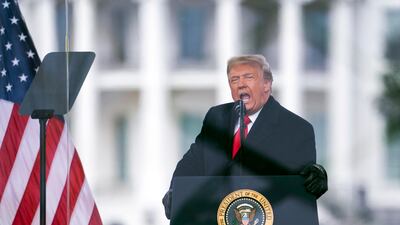
Donald Trump, the president at the time, speaks during a rally protesting the electoral college certification of Joe Biden as president in Washington on January 6, 2021. AP -
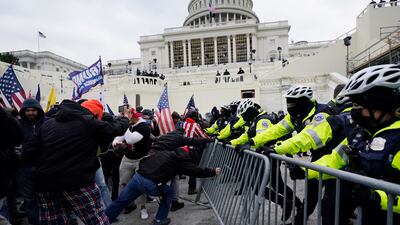
A mob loyal to Mr Trump tries to break through a police barrier at the Capitol. AP -
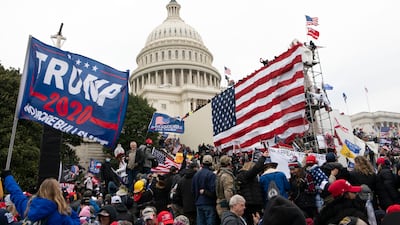
The mob waves pro-Trump flags in front of the Capitol building. AP -
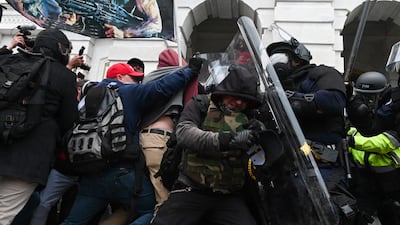
Riot police push back a crowd of rioters at the Capitol building. AFP -
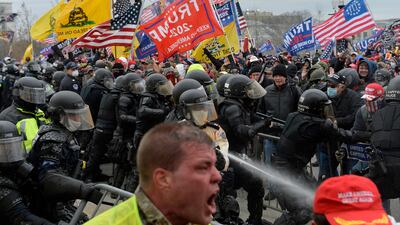
Trump supporters clash with police and security forces as people try to storm the US Capitol building. AFP -
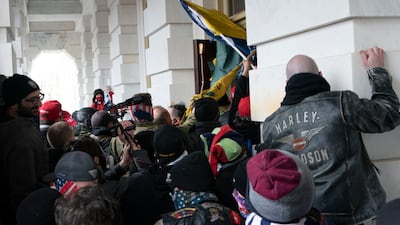
Insurrectionists loyal to Mr Trump try to open a door of the US Capitol building as they riot in Washington. AP -
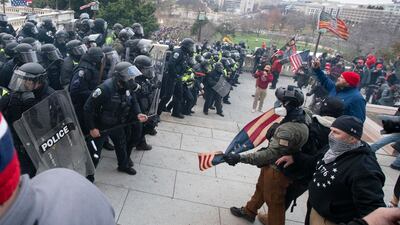
US Capitol Police push back rioters trying to enter the US Capitol. AP -
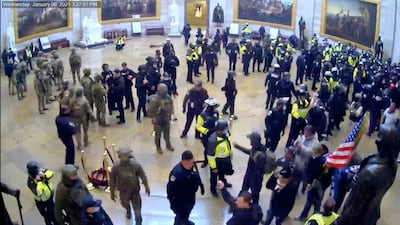
Police and rioters confront each other in the Rotunda of the Capitol. US Capitol Police via AP -
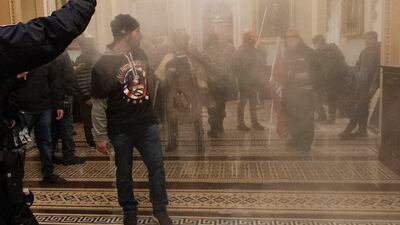
Smoke fills the hallway outside the Senate chamber of the Capitol. AP -
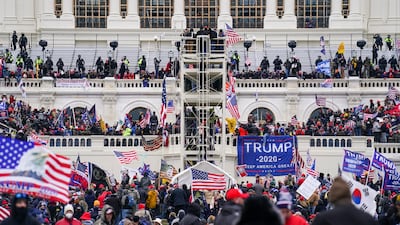
Insurrectionists loyal to Mr Trump breach the Capitol in Washington. AP -

Trump supporters, including Doug Jensen, centre, confront US Capitol Police in the hallway outside the Senate chamber at the Capitol. AP -
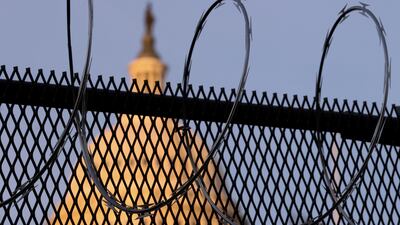
Newly installed razor wire tops the fence surrounding the US Capitol following the January 6 riot. Reuters -
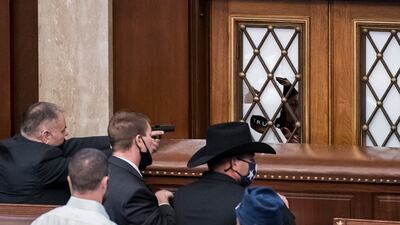
Security agents and members of Congress barricade the door to the House chamber as the violent mob breaches the Capitol. AP -
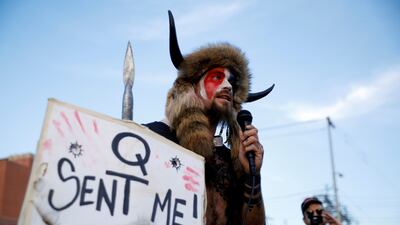
Rioter Jacob Chansley holds a sign referencing QAnon as supporters of Mr Trump gather to protest the early results of the 2020 presidential election. Reuters


Anti-state rhetoric was a mainstay of the Trump era. The former president attacked almost all core American institutions, not just elections, but also the FBI, CIA, the justice department and military leadership. His terrible relations with these “power ministries” was arguably a fatal weakness.
His fans, including some radical members of Congress and television manipulators such as Tucker Carlson, insist the January 6 attack was somehow orchestrated by the FBI.
This offensive, not aimed against political opponents but at the state itself, is the key to comprehending how dangerous and pernicious the current right-wing agenda in the US has become.
Both right-wing extremists like fascists and left-wing radicals like Leninists share the tactic of attacking, tearing down or hollowing out state institutions as they accumulate power. They then create a set of parallel institutions that operate outside state structures and beyond the rule of law, through which most real power is projected into society.
In addition to the obvious Nazi and Bolshevik historical examples, this pattern can be seen today in countries like Iran and Venezuela. When Mr Trump's close ally and campaign manager Steve Bannon described himself as a "Leninist", this is exactly what he meant.
Mr Trump is a master of anti-state rhetoric. He denounces anything he doesn't like as the work of "the deep state", even though the US does not have a deep state, just a government. Mr Bannon constantly boasts about planning to "dismantle the administrative state", even though administration constitutes almost everything any state does.
Familiar slogans of Mr Trump's movement – “build that wall”, “drain the swamp”, “lock her up” – identify no protagonist. It is not that the state should act on these demands, (none of which will ever actually be accomplished, as both demagogue and followers fully understand), but that somebody should somehow deal with them.
These slogans were largely concocted by firms like Cambridge Analytica, the British data analysis company hired by Mr Trump's 2016 US presidential campaign. And being performative without agency, the chants point to the loss of power by the state rather than government action. Such mantras in their sinister aspirations and warnings of crises communicate that the state is incapable of meeting their demands. Emergencies are the key tactic. Mr Trump loved emergencies, frequently declaring them where they didn’t exist. He even tried to postpone the 2020 election due to a public health emergency.
The Nazi political theorist Carl Schmitt noted that a lawless and authoritarian movement can transform a rule-of-law state by declaring emergencies, putting in place supposedly temporary and exceptional measures to deal with them, and extending them indefinitely.
The rise of armed white supremacist militias in US society, often strongly supportive of Mr Trump, creates the prospect of such parallel sources of power. Two of the largest and most dangerous gangs, the Proud Boys and Oath Keepers, were key participants in the January 6 insurrection. By attacking Congress and the police, they were effectively challenging state authority, seeking to use violence to replace the rule of law with their own will.
The insurrection failed, and with it the final gambit in the attempted coup. Mr Trump and his allies failed to create the constitutional crisis they hoped would somehow allow him to stay in power. Instead, Congress ratified the election results later that day.
Yet the response of the state thus far has been woefully inadequate. Many foot soldiers of the insurrection have received mainly light prison sentences. But none of the planners and authors of the insurrection, and, more importantly, the attempted coup, have been held to account in any meaningful way.
As Ms Cheney put it, Mr Trump has “gone to war with the rule of law” and if he's not winning, he's not exactly losing either.
All this surely invites another such attempt. Unfortunately, the past year suggests that the Trump movement has correctly identified a set of major structural and constitutional weaknesses in the US system, and although they failed in their coup attempt, they also completely got away with it.
The American state does not appear particularly effective in asserting the rule of law and acting decisively to ensure there is no repetition of the coup attempt – especially not one that, building on the lessons of the past, might have a much better chance of success.

