


The massive revolt by British Conservative Party Members of Parliament against Prime Minister Boris Johnson’s plans to introduce new anti-Covid-19 measures this week reflects the growing unease throughout Europe over the re-introduction of restrictions against the virus.
Mr Johnson’s bruising encounter with his own MPs this week stemmed from his government’s attempts to introduce a measure that legally required attendees at large events, such as nightclubs and football matches, to provide either proof of vaccination or a negative test before entering.
Opponents of the move accused Mr Johnson of attempting to introduce so-called vaccination passports, a measure civil liberties campaigners argue unfairly discriminates against those who have not received jabs.
Even though Mr Johnson personally sought to reassure MPs that the requirement was a temporary measure, almost 100 Tory MPs voted against the new rule when it was presented to the Commons, and the legislation only passed due to the support it received from opposition Labour MPs.
Moreover, the difficulties Mr Johnson experienced in seeking to reintroduce measures last used during last winter’s lockdown in England are symptomatic of the growing resistance governments throughout Europe are encountering as they struggle to contend with the spread of the new Omicron variant.
Opposition to the imposition of new measures essentially appears to stem from two fundamental issues. The first concerns complaints that governments are seeking to impose unnecessary restrictions on personal liberties in their drive to tackle the virus.
-
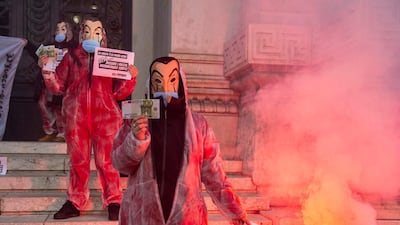
Protesters gather for a flashmob demonstration to demand emergency income and financing in front of the Milan branch of the Bank of Italy. EPA -
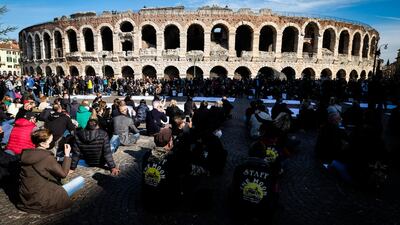
Owners of restaurants and event organisers gather to protest at rally in front of the colosseum in Verona. EPA -

Italian chefs and restaurant owners gather near place settings positioned on the street as they participate in a protest at Pantheon Square in Rome. AFP -
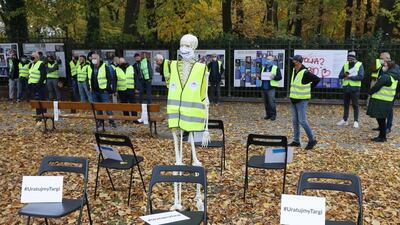
People take part in a protest organised by fairs and events workers in Warsaw, Poland. EPA -
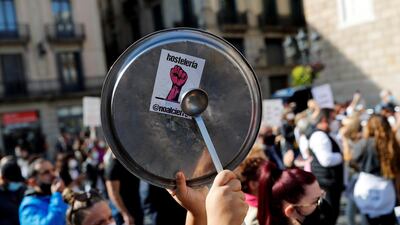
A sticker reading "Hospitality not at closing" is pictured during a protest in Barcelona, Spain. Reuters -
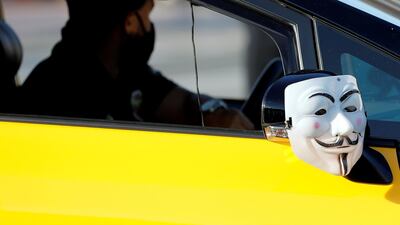
A Guy Fawkes mask hangs on a wing mirror as taxi drivers protest in Barcelona, Spain. Reuters -
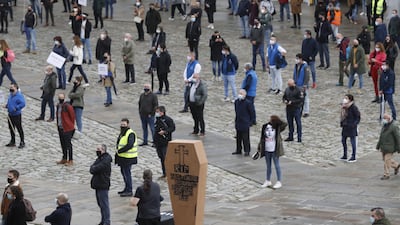
Owners of bars and restaurants in Santiago de Compostela, Spain, protest against the new restrictions imposed to stop the coronavirus spread. EPA -
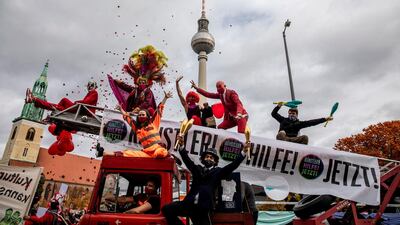
Artists and employees of events companies protest at Alexanderplatz in Berlin, Germany. Getty Images -
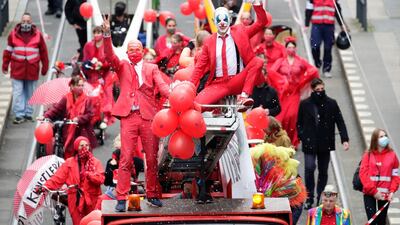
Protesters demonstrate in support of the event sector in Berlin, Germany. Reuters -
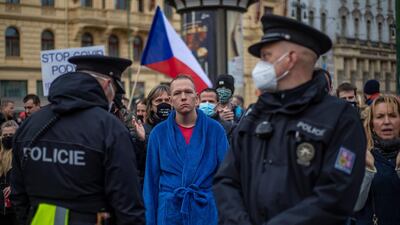
Demonstrators protest against the Czech government's measures in Prague, Czech Republic. EPA -
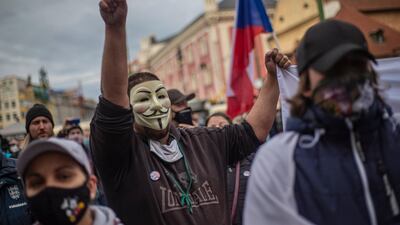
The Czech Republic recorded a rise in Covid-19 cases, resulting in the government imposing a series of new restrictive measures. EPA


The other, more worrying, dissent comes from anti-vaxxer groups who are fundamentally opposed to receiving anti-Covid-19 jabs for a variety of ideological reasons.
Anti-vaxxers mainly seem to consist of supporters of populist and far-right parties, although some are adherents of alternative medicine, hippies and libertarians. Others object to the jabs on religious grounds.
Not being vaccinated certainly has its risks. In Britain, where more than 80 per cent of the adult population has received at least two jabs, the majority of those who have been hospitalised with the virus in recent weeks are those who remain unvaccinated.
In Europe, opposition to vaccinations means that around one third of the EU’s total population still have not received their jabs.
Moreover, their failure to do so is increasingly becoming a source of friction with those who have had their jabs, who accuse the refuseniks of prolonging the pandemic by failing to act in the public interest.
By far the most dramatic incident in Europe relating to anti-vaxxer groups took place in Germany this week when police in the eastern state of Saxony launched a series of raids after death threats were made against a prominent politician for backing coronavirus measures.
The death threats were made against Premier Michael Kretschmer who has publicly declared his support for the introduction of new coronavirus measures. A German television documentary accused far-right anti-vaccination activists of making threats against the state premier, prompting German anti-extremist officers to raid a number of locations in Saxony, which has the lowest vaccination take-up in the country. Far-right activists in the state are also suspected of plotting violence with crossbows or other "piercing weapons".
Suggestions that far-right anti-vaccination groups have been plotting against German politicians have caused a major headache for Germany's new chancellor, Olaf Scholz, who told MPs on Wednesday that "this tiny minority of uninhibited extremists" would not be allowed to impose their will on society.
Last week Germany's new government steered through a draft law to require all health workers and soldiers to get vaccinated by next spring, and Chancellor Scholz has backed mandatory vaccines for all adults early in 2022.
The German government’s no-nonsense moves to tackle the new strain certainly appear to have the backing of both politicians and the public. While support for a nationwide vaccine mandate had previously been regarded as taboo, several state premiers are now backing such measures for the entire country. And a recent opinion poll suggests 72 per cent of Germans are in favour of imposing a vaccine mandate.
Opponents of rules to enforce vaccinations are not just confined to Germany, where on Monday night some 3,500 people demonstrated in the eastern city of Magdeburg, chanting "peace, freedom, no dictatorship".
Thousands of opponents of anti-covid-19 measures have staged protests in Italy, Switzerland and Northern Ireland, while in Belgium and the Netherlands rioters have sparked violent clashes with the police.
Emotions have also been running high in neighbouring Austria, where the government imposed a nationwide lockdown in response to the emergence of the new Omicron variant. An estimated 40,000 unvaccinated Austrians marched through the capital, Vienna, with some protesters carrying placards likening Alexander Schallenberg, Austria’s new chancellor, to Josef Mengele, the sadistic physician at the Nazi concentration camp in Auschwitz.
In France, meanwhile, the authorities are concentrating their attention on the over-65s, placing anyone who has not received a third booster jab under lockdown from Wednesday.
The new measure has been introduced as the country seeks to ward off a massive Christmas surge of both the Delta and Omicron variants. As a result, France's health pass, the “passe sanitaire”, will no longer be valid without a booster, barring those without a third dose from visiting any restaurant or cafe, using inter-city trains and going to cultural venues like cinemas or museums.
The French government says some 400,000 people aged 65 and over who are eligible for the boosters are yet to receive them, accounting for 12 per cent of those aged 80 and above and 10 per cent of those aged 65 to 79.
Amid all the gloom surrounding the new measures in Europe there is, though, one note of optimism. A study by American researchers at the Nestle Purina Research institute in Missouri has found that dog-owners are better-equipped to deal with lockdowns and other measures, as owning a dog generates a feeling of being loved and valued during the pandemic, and that dog-owners are less likely to show signs of depression.

