


“If you are going to tell a story,” author and world mythology chronicler Joseph Campbell once said, “tell a big one". Today, we are living amid one of the biggest stories in human history: the dramatic rise of the so-called “emerging markets” from economic under-achievers to central nodes of global business, economics, culture, arts, science and innovation. In the last 50 years, new Silk Roads have formed, linking and re-linking Asia to Africa, the Indian Ocean to the Pacific Ocean and the heartland of Eurasia to the heartland of Latin America. When the history of the 21st century is written in the year 2100, the rise of China, India and vast swathes of Asia and Africa will occupy a starring role in that narrative.
The UAE, a country at the heart of these emerging markets, has just celebrated its 50th anniversary. Its story qualifies as a “big one,” materialising from a small group of emirates into a united federation in 1971, and growing into a dynamic, cosmopolitan, commercially and diplomatically powerful country. There are few countries in the world that are more connected and dynamically interlinked with the rest of the world.
By many measures, the UAE is one of the most globalised places on earth. It is home to more than 200 nationalities, and with a population of 10 million people, it conducts more international trade than Brazil or Indonesia, both of which have populations exceeding 200 million. The country is linked to the world via 150 airlines flying to and from more than 220 global destinations. Its companies account for nearly one-third of global outward investment from West Asia and UAE foreign aid per capita ranks among the highest in the world.
Anyone who has spent time in the UAE will understand how two words – "UAE" and "global" – naturally fit together. The UAE is a nexus state, at the crossroads of some of the key transformations shaping our world today, including aviation, telecommunications, trade, investment, entrepreneurship and more. The country has also shaped many of those transformations. It was not always this way. Before there was a unified country, there was a sparsely populated region with only modest prospects for the future. A traveller to the UAE who happened to visit the country the day after its unification on December 2, 1971, could hardly have foreseen what the country would become today.
-
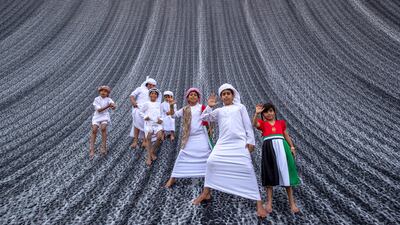
Children enjoy the water feature at Expo 2020 Dubai. Victor Besa / The National -
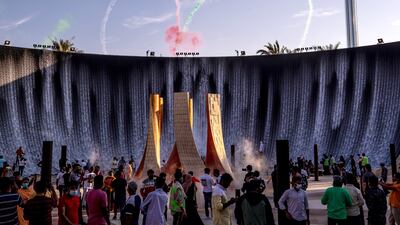
An air display by the Al Fursan team wows the crowds at Expo 2020 Dubai. Victor Besa / The National -
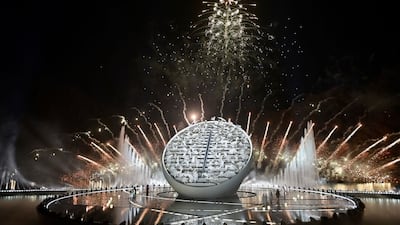
The UAE's 50th National Day show in Hatta. Photo: Dubai Media Office -

Hatta's Golden Jubilee show reflected the country's 'early dreamers' who began the story of the Emirates. Victor Besa / The National -
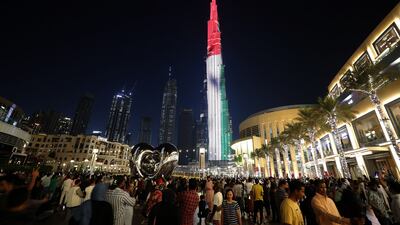
Burj Khalifa in Dubai illuminated in the colours of the national flag. Pawan Singh / The National -
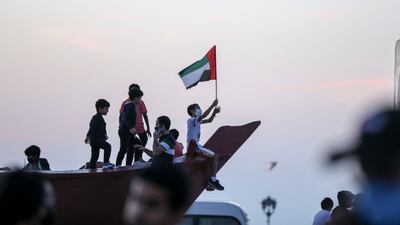
A group of children celebrate National Day at the dhow monument on the Corniche in Abu Dhabi. Khushnum Bhandari / The National -
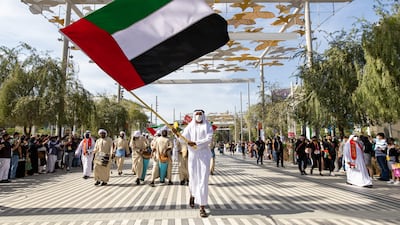
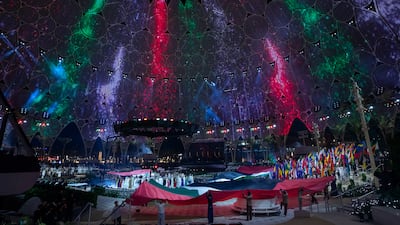
Colours of the World Parade during Golden Jubilee celebrations at Expo 2020 Dubai. Photo: Expo 2020 Dubai -

A visitor to Al Wasl Plaza, Expo 2020 Dubai. Photo: Expo 2020 Dubai -
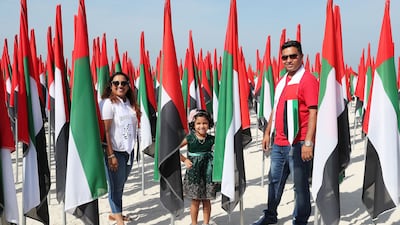
(L-R) Anju Jacob, Evelyn and Sebin Dcruz in the flag garden near Kite Beach, Dubai. Pawan Singh / The National -
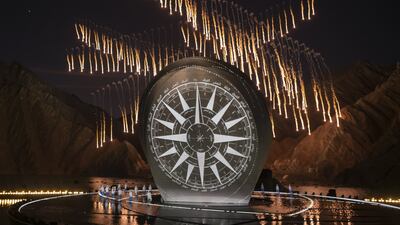
Fireworks light up the night sky at the UAE's 50th National Day celebrations in Hatta. Photo: Ministry of Presidential Affairs -
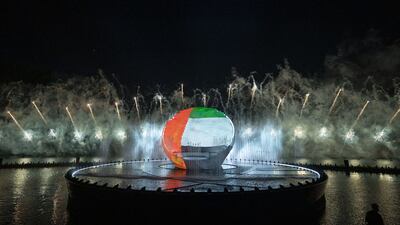
The UAE flag is illuminated in Hatta. Photo: Ministry of Presidential Affairs -
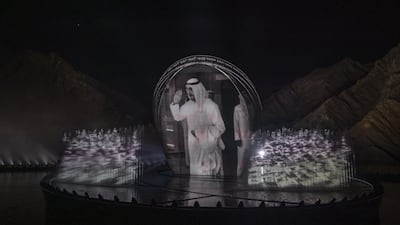
Part of the UAE's 50th National Day extravaganza in Hatta. Photo: Ministry of Presidential Affairs -
Golden Jubilee show which reflects on the country's "early dreamers" who began the story of the Emirates. Victor Besa / The National -
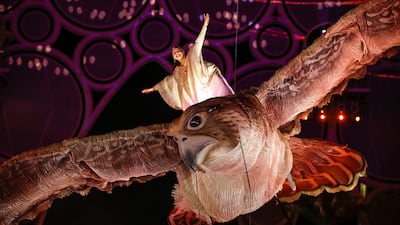
Artists perform during the celebration of the 50th UAE National Day at Expo 2020 Dubai. EPA -

Adnoc's headquarters in Abu Dhabi displays an image of the UAE's Founding Father, Sheikh Zayed. Khushnum Bhandari / The National -
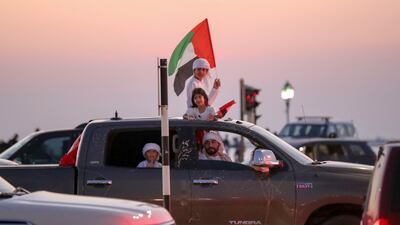
Proud Emirati children wave the UAE flag from a sunroof in Abu Dhabi. Khushnum Bhandari/ The National -
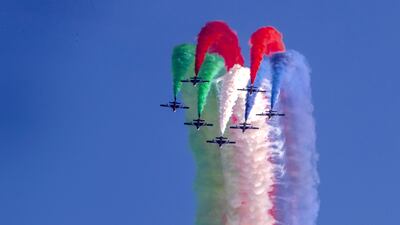
The Al Fursan team put on a dazzling display. Victor Besa / The National. -
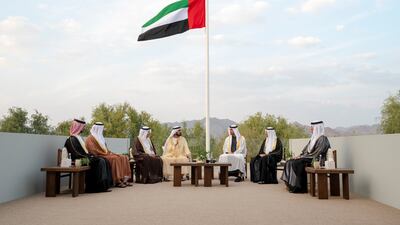
From left: Sheikh Ammar bin Humaid Al Nuaimi, Crown Prince of Ajman, Sheikh Sultan bin Mohammed Al Qasimi, Crown Prince and Deputy Ruler of Sharjah, Sheikh Saud bin Rashid Al Mualla, Ruler of Umm Al Quwain, Sheikh Mohammed bin Rashid, Vice President and Ruler of Dubai, Sheikh Mohamed bin Zayed, Crown Prince of Abu Dhabi and Deputy Supreme Commander of the Armed Forces, Sheikh Hamad bin Mohammed Al Sharqi, Ruler of Fujairah and Sheikh Saud bin Saqr Al Qasimi, Ruler of Ras Al Khaimah, attend the Federal Supreme Council meeting, at the Sheikh Rashid Palace in Hatta, Dubai, on Thursday. Photo: Mohamed Al Hammadi / Ministry of Presidential Affairs -
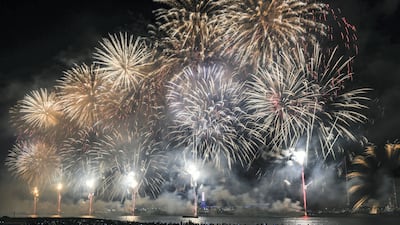
A lerge crowd watched a spectacular fireworks display over the Abu Dhabi Corniche. Khushnum Bhandari / The National -
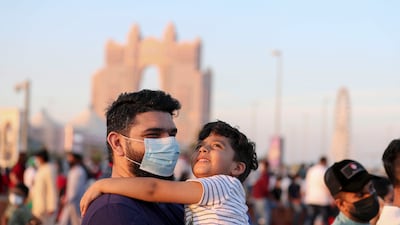
People soaking up the atmosphere on the Abu Dhabi Corniche on National Day. Khushnum Bhandari/ The National


Over 50 years, the UAE built some of the best infrastructure around the world. Its sea and air ports are some of the busiest and most efficient, the quality of its roads rank number one globally by World Economic Forum (WEF) rankings, and it has some of the fastest ICT networks around. Today, it is a powerhouse in global trade, with UAE shipping ports among the world’s busiest.
But this hard infrastructure does not explain the success and rapid rise of the nation. In fact, it has been copied by many countries around the world, often with more resources, without the same impact. While hard infrastructure is critical to development, it is just hardware, and everyone knows it is useless without the software. This is where the UAE’s real competitive edge comes from. Its soft infrastructure.
At the core of this soft infrastructure is the quality of life on offer. In November 2021, the UAE was named the world's safest country to walk at night, according to Gallup's Global Law and Order Report. For most people around the world, the issue of safety and security is a key determinant when it comes to quality of life. The UAE managed to maintain this even in the toughest times when the world faced the Covid-19 pandemic. On November 30, the UAE ranked first in Bloomberg's Covid-19 Resilience Ranking.
The elements of this soft infrastructure are simple to explain, but very difficult to attain: talent, agility and entrepreneurial government.
The UAE is considered a hub for global talent. It tops the Middle East, Africa and Southeast Asia (MEASA) region in the Global Talent Competitiveness Index and has been the number-one sought after destination by Arab youth to live and work for eight years in a row in the annual Arab Youth Survey. This position earned it many titles like "Land of New Opportunity" and the region’s "Scale-up" nation.
The other element is its agility. Small countries such as the UAE have the advantage of being nimble and responsive to global geopolitics. Decision making in the UAE is extremely fast, in addition to its cherished values of openness and tolerance. It is also highly pragmatic. The UAE today is forging new trade deals and economic partnerships ranging from Indonesia to Colombia, and from Turkey to India. In the future, speed not size will be the key determinant for economic success.
At the heart of all of this soft infrastructure is a world-class local civil service. By 2021, the UAE was a clear leader in the Middle East when it came to government performance. It was first regionally and 21st globally in the E-Government Survey 2020 by the UN's Department of Economic and Social Affairs. It came third globally on the Government Responsiveness to Change indicator and fourth on the Government Long-term Vision indicator in the Global Competitiveness Report 2020 by WEF. It also came third globally for trust in government in the Edelman Trust Barometer 2021.
Centuries ago, while different communities were still exploring the globe, cartographers often alerted wayward travellers to "terra incognita", an unknown region outside the bounds of the known world. Trends around us today, from the rise of Asia to the pace of technological innovation, mean that many of today’s historical patterns will not apply to the future. The pace of change is accelerating, and the way in which change affects society is different. More importantly, new and unprecedented factors are emerging that are altering the very nature of change itself, making the historical patterns that we have once understood obsolete. The future is a churning and unknowable landscape, where the rules of the global game will be rewritten. The fast will have distinct advantages over the large, and the innovative will succeed over the resource-rich.
The UAE’s focus on local and global talent pools, relentless innovation, investment in future industries and expanding trade routes will be critical for the country to chart this unknown territory and thrive over the next 50 years.

