Steam comes out of the chimneys of the coal-fired power station in Niederaussem, Germany. The share of coal around the world has fallen to an all-time low. AP Photo
Dietmar Siersdorfer is the managing director of Siemens Energy Middle East
November 14, 2021
Climate change needs our utmost attention and immediate action. The non-binding pledges made in Glasgow during the just-concluded Cop26 do not appear to go far enough or fast enough. The Intergovernmental Panel on Climate Change (IPCC) has already warned that the average global temperature could rise by more than 1.5°C before 2030. This could leave the once historic Paris climate target, agreed by 191 countries and the EU in 2015, consigned to the dustbin of missed opportunities.
The Middle East, in particular, is facing a bleak outlook. Climate change is expected to cause extreme heat events across greater areas and for longer periods, making some regions unlivable. Rising temperatures will put intense pressure on crops and already scarce water resources. We have seen this in other regions already.
What should give us hope is the fact that we can still change a lot, but we must act now. Declarations of intent without corresponding measures are no longer enough. What we need are clear targets and measurable objectives with specific timelines.
Whether Glasgow really marks the start of the decade of implementation can only be judged when the World Climate Summit comes to an end. However, there is a concern that the hopes placed in Cop26 are unlikely to be fulfilled.
The IPCC report is very clear: we need to act, and we need to act now. It's not just about introducing new technologies. Nor is it just about saving a little energy. It's about fundamentally changing our approach to dealing with energy in an environmentally responsible and climate-friendly way. This affects everyone, whether governments, corporations or citizens.
Delegates view the UK pavilion at Cop26 in Glasgow. Day 11 of the 2021 climate summit will focus on the global transition to zero-emission transport. Getty Images
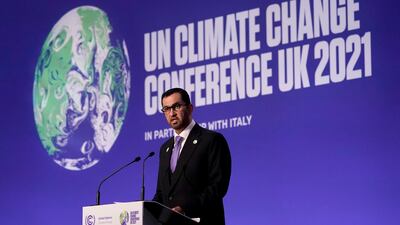
Dr Sultan Al Jaber, Minister of Industry and Advanced Technology and UAE Special Envoy for Climate Change, addresses delegates at the summit. AP Photo
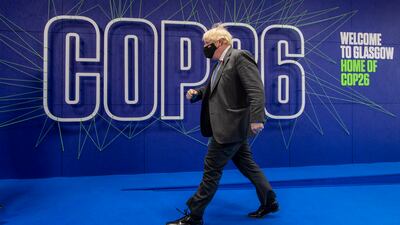
British Prime Minister Boris Johnson arrives to attend the summit. EPA
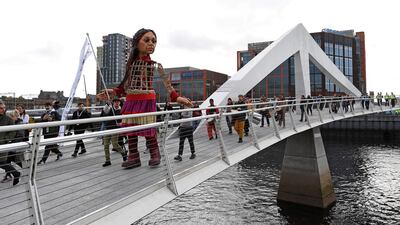
Little Amal, a giant puppet depicting a Syrian refugee girl who has walked across Europe, crosses Tradeston Bridge over the River Clyde in Glasgow. AFP
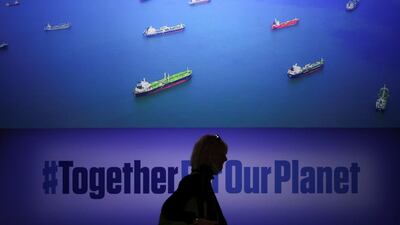
A visitor is silhouetted against a screen depicting shipping at the Cop26 summit. Reuters
Nancy Pelosi, Speaker of the US House of Representatives, exchanges her views at the summit. Getty Images
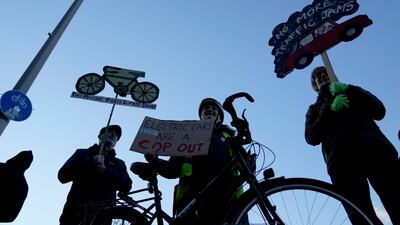
People take part in a pro-cycling rally outside the SEC (Scottish Event Campus), venue of Cop26, in Glasgow. AP Photo
Youth Climate Activists protest outside the plenary rooms at Cop26 as high-level negotiations continue in Glasgow. Getty Images
Alexandria Ocasio-Cortez, US Representative for New York's 14th congressional district, attends a press conference held by Nancy Pelosi. Getty Images
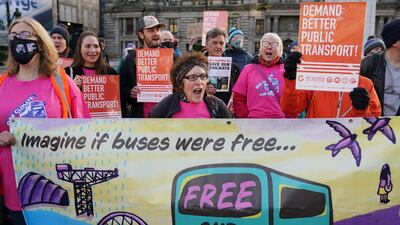
Campaigners from Friends of the Earth Scotland, Get Glasgow Moving and the International Transport Workers Federation gather in George Square, Glasgow, demanding better public transport as an essential part of addressing climate change during the Cop26 summit in the city. PA
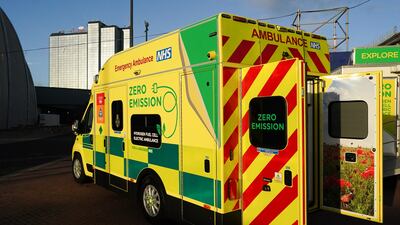
A hydrogen-powered, zero-emission ambulance is displayed in Glasgow. Getty Images
Scotland's First Minister Nicola Sturgeon speaks to the media during the Cop26 summit. PA
On the plus side, the share of coal has fallen to an all-time low; just under 2 per cent of the electricity mix, compared with about 40 per cent a decade ago. A switch away from coal to renewable energies and nuclear power, as well as the use of natural gas can have a significant impact on our carbon footprint. The largest greenhouse gas emitters need to act together with one another. While environmental groups criticise the use of natural gas, the fact is that the fuel can help to significantly reduce CO2 emissions immediately. Of course, more renewable energies are preferable. But the quantities available are currently nowhere near enough to meet the world's electricity needs. If gas helps us build a bridge by reducing CO2 emissions by a good two-thirds compared to coal, while guaranteeing security of supply, then we should use the bridge. Will gas still be the right approach 25 years from now? Probably not. But we should finally stop talking about long-term targets and act immediately.
The Middle East has a leading role to play not just in ensuring security of supply of affordable gas to the world, but also to reduce the carbon cost of that gas – by improving efficiency and cutting emissions. But this region also has an opportunity to develop the technologies of the future. With abundant natural renewable resources in the forms of sun and wind, converting that into green hydrogen is one of those opportunities. It has the potential, not only to leverage existing gas infrastructure, but also decarbonise multiple industries and become an exportable commodity.
Another important factor for Glasgow’s success will be whether the industrialised countries keep their promise to support energy transformation in poorer countries with $100 billion annually. This was first decided in 2009 at Cop15 in Copenhagen, and the process was due to begin in 2020. However, not enough has happened, with experts estimating that the funding target will not be reached for another two years. Yet, the poorer countries are in urgent need of support, and not just for the coal phase-out. The effects of climate change are unevenly distributed, with developing countries and those located in the southern hemisphere being hit hardest. Not only was it affirmed in the Paris Agreement, but it is also the moral obligation of the industrialised countries, which have built up their prosperity over decades at the expense of both the environment and the poorer countries.
A boy shepherds camels near Al Karamah Dam in Shouneh, Jordan. As of today, the Middle East is facing a bleak outlook. Reuters
Finally, we all need to accept the introduction of a CO2 price. Without appropriate incentives, behaviour will not change. How high the price must be can vary from sector to sector. There are already enough studies and expert opinions on this matter. However, it is important that there is a common, fair price system in as many regions as possible, which takes account of international competition and prevents social burdens – and thus the division of society – through compensation mechanisms.
This will also help to spur investment and innovation in clean technologies. We need to leverage technology quickly. We need to have more partnerships, more demonstrator plants and more pilot projects to test the capabilities of clean innovations, which can then be rapidly ramped up and expanded. Higher prices for goods and services need to be accepted to safeguard the planet.
No matter what the delegates in Glasgow decide, in the end it is also up to each of us whether we get back on track and turn things around. Every government, every company and ultimately every consumer has a responsibility. We need a social consensus that change is necessary and positive, and that sustainability has value. We are already in the middle of the storm.
Dietmar Siersdorfer is the managing director of Siemens Energy Middle East

Our family matters legal consultant
Name: Hassan Mohsen Elhais
Position: legal consultant with Al Rowaad Advocates and Legal Consultants.
Islamophobia definition
A widely accepted definition was made by the All Party Parliamentary Group on British Muslims in 2019: “Islamophobia is rooted in racism and is a type of racism that targets expressions of Muslimness or perceived Muslimness.” It further defines it as “inciting hatred or violence against Muslims”.
Saturday Crotone v Spezia (6pm), Torino v Udinese (9pm), Lazio v Verona (11.45pm)
Sunday Cagliari v Inter Milan (3.30pm), Atalanta v Fiorentina (6pm), Napoli v Sampdoria (6pm), Bologna v Roma (6pm), Genoa v Juventus (9pm), AC Milan v Parma (11.45pm)
German intelligence warnings
2002: "Hezbollah supporters feared becoming a target of security services because of the effects of [9/11] ... discussions on Hezbollah policy moved from mosques into smaller circles in private homes." Supporters in Germany: 800
2013: "Financial and logistical support from Germany for Hezbollah in Lebanon supports the armed struggle against Israel ... Hezbollah supporters in Germany hold back from actions that would gain publicity." Supporters in Germany: 950
2023: "It must be reckoned with that Hezbollah will continue to plan terrorist actions outside the Middle East against Israel or Israeli interests." Supporters in Germany: 1,250
Source: Federal Office for the Protection of the Constitution
Buyers should try to pay as much in cash as possible for a property, limiting the mortgage value to as little as they can afford. This means they not only pay less in interest but their monthly costs are also reduced. Ideally, the monthly mortgage payment should not exceed 20 per cent of the purchaser’s total household income, says Carol Glynn, founder of Conscious Finance Coaching.
“If it’s a rental property, plan for the property to have periods when it does not have a tenant. Ensure you have enough cash set aside to pay the mortgage and other costs during these periods, ideally at least six months,” she says.
Also, shop around for the best mortgage interest rate. Understand the terms and conditions, especially what happens after any introductory periods, Ms Glynn adds.
Using a good mortgage broker is worth the investment to obtain the best rate available for a buyer’s needs and circumstances. A good mortgage broker will help the buyer understand the terms and conditions of the mortgage and make the purchasing process efficient and easier.
6.30pm: Handicap (rated 100 ) US$175,000 1,200m
Winner: Baccarat, William Buick (jockey), Charlie Appleby (trainer)
7.05pm: Handicap (78-94) $60,000 1,800m
Winner: Baroot, Christophe Soumillon, Mike de Kock
7.40pm: Firebreak Stakes Group 3 $200,000 1,600m
Winner: Heavy Metal, Mickael Barzalona, Salem bin Ghadayer
8.15pm: Handicap (95-108) $125,000 1,200m
Winner: Yalta, Mickael Barzalona, Salem bin Ghadayer
8.50pm: Balanchine Group 2 $200,000 1,800m
Winner: Promising Run, Pat Cosgrave, Saeed bin Suroor
9.25pm: Handicap (95-105) $125,000 1,800m
Winner: Blair House, James Doyle, Charlie Appleby
10pm: Handicap (95-105) $125,000 1,400m
Winner: Oh This Is Us, Tom Marquand, Richard Hannon
Rooney's club record
At Everton Appearances: 77; Goals: 17
At Manchester United Appearances: 559; Goals: 253
Know your camel milk: Flavour: Similar to goat’s milk, although less pungent. Vaguely sweet with a subtle, salty aftertaste. Texture: Smooth and creamy, with a slightly thinner consistency than cow’s milk. Use it: In your morning coffee, to add flavour to homemade ice cream and milk-heavy desserts, smoothies, spiced camel-milk hot chocolate. Goes well with: chocolate and caramel, saffron, cardamom and cloves. Also works well with honey and dates.
Estimates of the number of deaths caused by the famine range from 400,000 to 1 million, according to a document prepared for the UK House of Lords in 2024. It has been claimed that the policies of the Ethiopian government, which took control after deposing Emperor Haile Selassie in a military-led revolution in 1974, contributed to the scale of the famine. Dr Miriam Bradley, senior lecturer in humanitarian studies at the University of Manchester, has argued that, by the early 1980s, “several government policies combined to cause, rather than prevent, a famine which lasted from 1983 to 1985. Mengistu’s government imposed Stalinist-model agricultural policies involving forced collectivisation and villagisation [relocation of communities into planned villages]. The West became aware of the catastrophe through a series of BBC News reports by journalist Michael Buerk in October 1984 describing a “biblical famine” and containing graphic images of thousands of people, including children, facing starvation.
Band Aid
Bob Geldof, singer with the Irish rock group The Boomtown Rats, formed Band Aid in response to the horrific images shown in the news broadcasts. With Midge Ure of the band Ultravox, he wrote the hit charity single Do They Know it’s Christmas in December 1984, featuring a string of high-profile musicians. Following the single’s success, the idea to stage a rock concert evolved. Live Aid was a series of simultaneous concerts that took place at Wembley Stadium in London, John F Kennedy Stadium in Philadelphia, the US, and at various other venues across the world. The combined event was broadcast to an estimated worldwide audience of 1.5 billion.
Points about the fast fashion industry Celine Hajjar wants everyone to know
Fast fashion is responsible for up to 10 per cent of global carbon emissions
Fast fashion is responsible for 24 per cent of the world's insecticides
Synthetic fibres that make up the average garment can take hundreds of years to biodegrade
Fast fashion labour workers make 80 per cent less than the required salary to live
27 million fast fashion workers worldwide suffer from work-related illnesses and diseases
Hundreds of thousands of fast fashion labourers work without rights or protection and 80 per cent of them are women
BULKWHIZ PROFILE
Date started: February 2017
Founders: Amira Rashad (CEO), Yusuf Saber (CTO), Mahmoud Sayedahmed (adviser), Reda Bouraoui (adviser)
Based: Dubai, UAE
Sector: E-commerce
Size: 50 employees
Funding: approximately $6m
Investors: Beco Capital, Enabling Future and Wain in the UAE; China's MSA Capital; 500 Startups; Faith Capital and Savour Ventures in Kuwait
Who's who in Yemen conflict
Houthis: Iran-backed rebels who occupy Sanaa and run unrecognised government
Yemeni government: Exiled government in Aden led by eight-member Presidential Leadership Council
Southern Transitional Council: Faction in Yemeni government that seeks autonomy for the south
Habrish 'rebels': Tribal-backed forces feuding with STC over control of oil in government territory
Tenants also require a letter of no objection from their landlord before being allowed to list the property.
There is a cost of Dh1,590 before starting the process, with an additional licence fee of Dh300 per bedroom being rented in your home for the duration of the rental, which ranges from three months to a year.
Anyone hoping to list a property for rental must also provide a copy of their title deeds and Ejari, as well as their Emirates ID.
if you go
The Lowdown
Kesari
Rating: 2.5/5 stars
Produced by: Dharma Productions, Azure Entertainment
Directed by: Anubhav Singh
Cast: Akshay Kumar, Parineeti Chopra
if you go
The flightsFly Dubai, Air Arabia, Emirates, Etihad, and Royal Jordanian all offer direct, three-and-a-half-hour flights from the UAE to the Jordanian capital Amman. Alternatively, from June Fly Dubai will offer a new direct service from Dubai to Aqaba in the south of the country. See the airlines’ respective sites for varying prices or search on reliable price-comparison site Skyscanner.
The trip
Jamie Lafferty was a guest of the Jordan Tourist Board. For more information on adventure tourism in Jordan see Visit Jordan. A number of new and established tour companies offer the chance to go caving, rock-climbing, canyoning, and mountaineering in Jordan. Prices vary depending on how many activities you want to do and how many days you plan to stay in the country. Among the leaders are Terhaal, who offer a two-day canyoning trip from Dh845 per person. If you really want to push your limits, contact the Stronger Team. For a more trek-focused trip, KE Adventure offers an eight-day trip from Dh5,300 per person.