


This week’s terrorist attack on a military hospital in Kabul raises serious concerns about the ability of the newly installed Taliban regime to curb the activities of Islamist militant groups active in Afghanistan.
Since seizing power in August, senior Taliban commanders have stressed their commitment to tackling Islamist militant groups such as ISIS, and their determination to prevent the country from becoming a safe haven for terror groups.
Yet, with the new regime struggling to assert its authority over the entire country, a wave of recent terror attacks has highlighted the threat posed by ISIS-K, an Afghan offshoot of ISIS which has deep ideological differences with the Taliban.
ISIS-K has been accused of mounting a series of suicide bomb attacks, including at the Kabul airport and at two Shiite mosques, as well as assaults on Taliban convoys, which have killed hundreds, and there are fears that ISIS-K will intensify its campaign of violence as it tries to prevent the Taliban from consolidating their grip on Afghanistan.

In the latest attack, at least 20 people were killed and dozens wounded when militants stormed Sardar Mohammad Daud Khan military hospital in the capital. Witnesses said a suicide bomber blasted his way through the gates of the compound before gunmen rushed through the breach, firing on patients and staff as they tried to flee. Taliban security forces killed the attackers after a lengthy gun battle.
There are now mounting concerns that support for the militant group is growing throughout Afghanistan because its more hardline stance is proving attractive to disgruntled Taliban fighters.
Some more conservative supporters of the Taliban have been dismayed at their reluctance to impose tougher restrictions on women, as well as their attempts to establish international legitimacy by making diplomatic advances to countries such as the US, China and Russia.
Faced with a collapsing economy, in part caused by the withdrawal of Western aid, the Taliban are desperate to demonstrate that they are a more moderate organisation from the uncompromising Taliban administration that ran the country in the 1990s. By adopting a supposedly less hardline approach to sensitive social issues, such as female education, the Taliban hope to persuade foreign donors to resume their contacts with Kabul, a move that would help ease economic difficulties.
This approach risks alienating more conservative-minded supporters, with the result that many are reported to have pledged allegiance to groups like ISIS-K, which espouse a more uncompromising agenda. The group, which is said to have access to significant financial reserves, is gaining in strength because it is able to recruit new fighters from desperate civilians who are easily lured to its ranks by the promise of a salary as the Afghan economy crumbles.
Western security officials have also expressed concern about reports that the organisation is gaining strength by recruiting members of elite Afghan military units and intelligence agents who previously worked with the US-led coalition, but now feel abandoned following last August’s withdrawal of foreign forces.
-
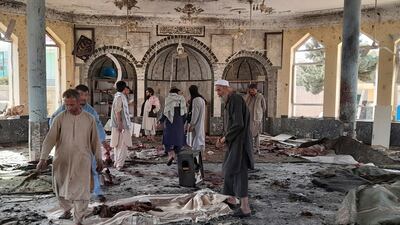
People view the damage inside a mosque following a bombing in Kunduz, northern Afghanistan, on Friday. All photos: AP Photo / Abdullah Sahil -
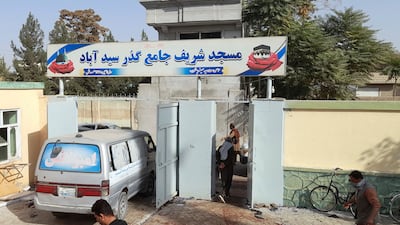
The powerful explosion caused several casualties, witnesses and the Taliban's spokesman said. -
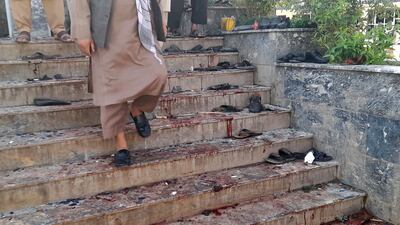
A man walks down the mosque's blood-stained steps following the bombing. -

People carry a body from inside the mosque. -
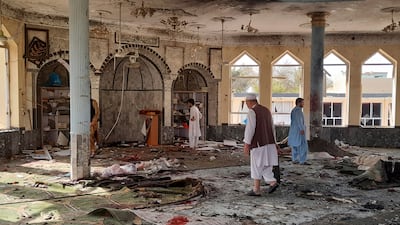
The devastation was all to clear to see.


As the Wall Street Journal reported earlier this week, Taliban leaders claim the number of defectors joining the terrorist group is relatively small. The concern, though, is that these new recruits bring critical expertise in intelligence-gathering and warfare techniques, potentially strengthening the extremist organisation’s ability to contest Taliban supremacy. It has also enabled ISIS-K to expand into new territory from its stronghold in the eastern province of Nangarhar.
Many of those opting to join the ranks of ISIS-K believe they have no option other than to align themselves with the militants. Abandoned by their erstwhile American protectors, many have been forced into hiding as the Taliban hunts down members of the former regime of President Ashraf Ghani.
A number of former Afghan security and intelligence officials have been kidnapped and killed by the Taliban, while their families have been threatened, with the result that some have decided their best chance of survival is to throw their lot in with ISIS-K rather than find themselves at the mercy of the Taliban.
It is estimated that hundreds of thousands of former Afghan republic intelligence officers, soldiers and police personnel are unemployed and afraid for their lives despite pledges of amnesty from the Taliban. Only a fraction of them, mostly in the National Directorate of Security, have returned to work under Taliban supervision. Like nearly all other Afghan government employees, they haven’t been paid for months.
There are fears that, just as happened in Iraq after the overthrow of Saddam Hussein when hundreds of thousands of regime loyalists lost their jobs, disenchanted former members of Afghanistan’s intelligence and security establishment will now side with Islamist militant groups.
These reports will increase pressure on President Joe Biden over his controversial decision to end Washington’s two-decade military involvement in Afghanistan.
The chaotic nature of the withdrawal after the Taliban seized control of the country resulted in hundreds of US civilians left behind, along with thousands of Afghan staff who had worked with Nato forces and were targeted by the Taliban.
ISIS-K demonstrated the mounting threat it posed during the evacuation by carrying out a devastating suicide attack on the crowds at Kabul airport that killed 13 US service personnel and about 90 Afghan civilians.
Mr Biden attempted to justify the withdrawal by claiming that terrorist groups were no longer in a position to use Afghanistan as a safe haven to threaten the US. But this assessment now lacks credibility given the resurgence of groups like ISIS-K and Al Qaeda since the Taliban seized control.
The growing potency of groups like ISIS-K was confirmed last week by Colin Kahl, Mr Biden’s undersecretary of defence for policy, who told the Senate armed services committee that Isis-K could develop the capability to launch attacks outside Afghanistan within a year, and admitted: “We actually are fairly certain they have the intention to do so.”
And if groups like ISIS-K achieve this aim, then Mr Biden’s withdrawal strategy will be seen as an act of extreme folly, one that could have disastrous consequences for his presidency.

