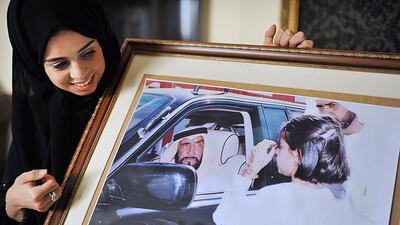
Next year's Year of Zayed will mark 100 years since the birth of the late UAE Founding Father Sheikh Zayed. Courtesy Al Ittihad


Sheikh Zayed would have been proud of the UAE today


  • English
  • Arabic

October 07, 2021

As the UAE’s 50th anniversary approaches, I realise, to my surprise, that it is now nearly 17 years since the death of the country’s Founding Father, Sheikh Zayed. For many of us, his memory is still vivid, but how do the younger generation or foreign residents, who have arrived since his passing, think of him? A distant historical figure or someone who continues to have an impact?

I wonder, too, what Sheikh Zayed would make of the Emirates at 50. There has been so much change since his death in 2004. The population has increased. The infrastructure has grown. The economy is no longer under developed, largely dependent on a single source. Major scientific achievements have been made, such as the Mars mission. And now with Expo 2020 open, the eyes of the world are upon the country. People will, I am sure, be amazed by much of what they see.

All of this represents what was built upon the foundations laid down by Sheikh Zayed.

The world around us has evolved. Naturally, the way in which we engage with new challenges has changed too. Sheikh Zayed’s ways cannot provide detailed step-by-step guidance for everything we do today, but the underlying principles of governance and the philosophy of the state that he laid down remain at the heart of decisions taken in the country.

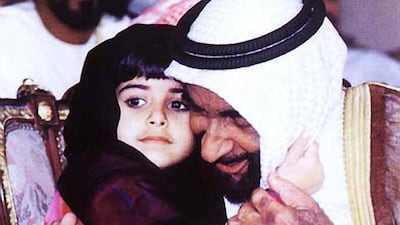
  • Sheikha Latifa bint Hamdan bin Zayed Al Nahyan said: "No words can express how lucky I feel to have known him." Courtesy Latifa bint Hamdan bin Zayed Al Nahyan
    Sheikha Latifa bint Hamdan bin Zayed Al Nahyan said: "No words can express how lucky I feel to have known him." Courtesy Latifa bint Hamdan bin Zayed Al Nahyan
  • Abla Al Nowais said: "Sheikh Zayed was a believer in women’s rights and a man who encouraged women to pursue an education." Fatima Al Marzooqi/ The National
    Abla Al Nowais said: "Sheikh Zayed was a believer in women’s rights and a man who encouraged women to pursue an education." Fatima Al Marzooqi/ The National
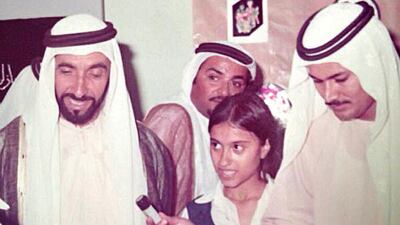
  • Alia Al Mazrouri said: "I remember he kept holding my hand the whole time." Delores Johnson / The National
    Alia Al Mazrouri said: "I remember he kept holding my hand the whole time." Delores Johnson / The National
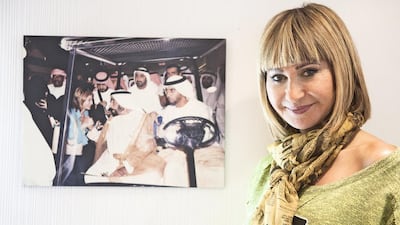
  • Maha Misto said: "I cried, held his hand and kissed it over 100 times." Lee Hoagland / The National
    Maha Misto said: "I cried, held his hand and kissed it over 100 times." Lee Hoagland / The National
  • Chaltham Ameen said: "At every stage of my life, he continued to be the greatest teacher." Courtesy Chaltham Ameen
    Chaltham Ameen said: "At every stage of my life, he continued to be the greatest teacher." Courtesy Chaltham Ameen
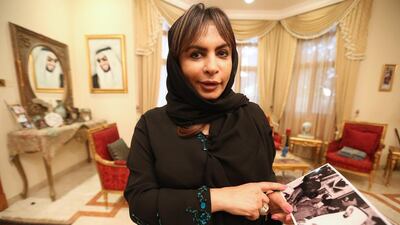
  • An Emirati lady showing a picture of herself as a young girl, meeting Sheikh Zayed.
    An Emirati lady showing a picture of herself as a young girl, meeting Sheikh Zayed.

Addressing a Cabinet meeting nearly 45 years ago, Sheikh Zayed explained the role he sought to play in guiding the Emirates towards a developed and prosperous future. “I am like an old father who heads his family and takes care of his children,” he said. “He takes them by the hand and supports them until they have passed through adolescence.”

He was able, of course, to provide that support because of the natural resources of the country.

“The time has come for us,” he added, “through the ample blessings God has given us, to compensate our people for what they missed in the past.”

He was determined to make use of the oil revenues to develop Emirati society, not simply in a physical sense, but in terms of the people, who he described as "the real wealth of the nation". Without that, he felt, the revenues would be of little value in the long term. That drove his passion for education, both for men and for women.

Once educated and having “passed through adolescence,” as Sheikh Zayed phrased it, the people of the Emirates would be equipped to play their part in building society.

Recognising that Emiratis had been “deprived of the many services and amenities which others enjoyed,” he extended a hand to those who could come and play their part in the development of the country, from doctors and teachers to bankers and petroleum engineers. That process continues today, for the nature and scale of the UAE’s aspirations allows others to join in the process of building.

I know how interested he was in promoting the study of the country’s history and heritage

In welcoming those coming from abroad, Sheikh Zayed knew that the country could not achieve the progress he sought without taking from other countries and cultures those things which would be of benefit for the emerging Emirates. In a time before the world had become closely linked through modern communications and technology, Sheikh Zayed saw the need to reach out and to form partnerships with others.

As a corollary to that, in line with his own commitment to religious and cultural tolerance, he instilled a philosophy of tolerance that would come to be at the heart of how the UAE operated. He emphasised, too, the need to promote conservation of the country’s environment and a sustainable use of its resources. His initiatives for the protection of wildlife laid the groundwork for much that has followed.

I know from my own involvement with the Abu Dhabi Islands Archaeological Survey, ADIAS, which he personally funded for many years, how interested he was in promoting the study of the country’s history and heritage. I remember how pleased he was when it was reported to him that we had found an early Christian monastery on his own private island of Sir Bani Yas.

Sheikh Zayed devoted himself, as Ruler of Abu Dhabi and then as President of the UAE, to laying the foundations of a society where the wealth with which the country had been fortunately endowed, would be used to build a people who could then move forward with confidence to build for today and tomorrow.

Were he still to be amongst us, he would, I believe, find much that surprised him. The accelerating pace of development has introduced us to aspects of life that had not been envisaged during his lifetime. I believe, though, that he would recognise the continued commitment to the underlying principles which guided his own leadership as the country’s founding father. And he would have been satisfied by the way in which the people of the Emirates have passed through their "adolescence" to take the country forward.

That link between the recent, but fast-receding, past and today and tomorrow is exemplified in the description earlier this week by the Crown Prince of Abu Dhabi, Sheikh Mohamed bin Zayed, of the UAE Pavilion at Expo 2020. “It honours,” he said, “the early dreamers that built our nation and shines a light on the dreamers of today who are striving to ensure its future success.”

It is clear that even today, Sheikh Zayed’s legacy remains a vibrant inspiration.

The six points:

1. Ministers should be in the field, instead of always at conferences

2. Foreign diplomacy must be left to the Ministry of Foreign Affairs and International Co-operation

3. Emiratisation is a top priority that will have a renewed push behind it

4. The UAE's economy must continue to thrive and grow

5. Complaints from the public must be addressed, not avoided

6. Have hope for the future, what is yet to come is bigger and better than before

The biog

Favourite film: Motorcycle Dairies, Monsieur Hulot’s Holiday, Kagemusha

Favourite book: One Hundred Years of Solitude

Holiday destination: Sri Lanka

First car: VW Golf

Proudest achievement: Building Robotics Labs at Khalifa University and King’s College London, Daughters

Driverless cars or drones: Driverless Cars

How Islam's view of posthumous transplant surgery changed

Transplants from the deceased have been carried out in hospitals across the globe for decades, but in some countries in the Middle East, including the UAE, the practise was banned until relatively recently.

Opinion has been divided as to whether organ donations from a deceased person is permissible in Islam.

The body is viewed as sacred, during and after death, thus prohibiting cremation and tattoos.

One school of thought viewed the removal of organs after death as equally impermissible.

That view has largely changed, and among scholars and indeed many in society, to be seen as permissible to save another life.

Mercer, the investment consulting arm of US services company Marsh & McLennan, expects its wealth division to at least double its assets under management (AUM) in the Middle East as wealth in the region continues to grow despite economic headwinds, a company official said.

Mercer Wealth, which globally has $160 billion in AUM, plans to boost its AUM in the region to $2-$3bn in the next 2-3 years from the present $1bn, said Yasir AbuShaban, a Dubai-based principal with Mercer Wealth.

Within the next two to three years, we are looking at reaching $2 to $3 billion as a conservative estimate and we do see an opportunity to do so,” said Mr AbuShaban.

Mercer does not directly make investments, but allocates clients’ money they have discretion to, to professional asset managers. They also provide advice to clients.

“We have buying power. We can negotiate on their (client’s) behalf with asset managers to provide them lower fees than they otherwise would have to get on their own,” he added.

Mercer Wealth’s clients include sovereign wealth funds, family offices, and insurance companies among others.

From its office in Dubai, Mercer also looks after Africa, India and Turkey, where they also see opportunity for growth.

Wealth creation in Middle East and Africa (MEA) grew 8.5 per cent to $8.1 trillion last year from $7.5tn in 2015, higher than last year’s global average of 6 per cent and the second-highest growth in a region after Asia-Pacific which grew 9.9 per cent, according to consultancy Boston Consulting Group (BCG). In the region, where wealth grew just 1.9 per cent in 2015 compared with 2014, a pickup in oil prices has helped in wealth generation.

BCG is forecasting MEA wealth will rise to $12tn by 2021, growing at an annual average of 8 per cent.

Drivers of wealth generation in the region will be split evenly between new wealth creation and growth of performance of existing assets, according to BCG.

Another general trend in the region is clients’ looking for a comprehensive approach to investing, according to Mr AbuShaban.

“Institutional investors or some of the families are seeing a slowdown in the available capital they have to invest and in that sense they are looking at optimizing the way they manage their portfolios and making sure they are not investing haphazardly and different parts of their investment are working together,” said Mr AbuShaban.

Some clients also have a higher appetite for risk, given the low interest-rate environment that does not provide enough yield for some institutional investors. These clients are keen to invest in illiquid assets, such as private equity and infrastructure.

“What we have seen is a desire for higher returns in what has been a low-return environment specifically in various fixed income or bonds,” he said.

“In this environment, we have seen a de facto increase in the risk that clients are taking in things like illiquid investments, private equity investments, infrastructure and private debt, those kind of investments were higher illiquidity results in incrementally higher returns.”

The Abu Dhabi Investment Authority, one of the largest sovereign wealth funds, said in its 2016 report that has gradually increased its exposure in direct private equity and private credit transactions, mainly in Asian markets and especially in China and India. The authority’s private equity department focused on structured equities owing to “their defensive characteristics.”

World record transfers

1. Kylian Mbappe - to Real Madrid in 2017/18 - €180 million (Dh770.4m - if a deal goes through)
2. Paul Pogba - to Manchester United in 2016/17 - €105m
3. Gareth Bale - to Real Madrid in 2013/14 - €101m
4. Cristiano Ronaldo - to Real Madrid in 2009/10 - €94m
5. Gonzalo Higuain - to Juventus in 2016/17 - €90m
6. Neymar - to Barcelona in 2013/14 - €88.2m
7. Romelu Lukaku - to Manchester United in 2017/18 - €84.7m
8. Luis Suarez - to Barcelona in 2014/15 - €81.72m
9. Angel di Maria - to Manchester United in 2014/15 - €75m
10. James Rodriguez - to Real Madrid in 2014/15 - €75m

COMPANY PROFILE
Name: ARDH Collective
Based: Dubai
Founders: Alhaan Ahmed, Alyina Ahmed and Maximo Tettamanzi
Sector: Sustainability
Total funding: Self funded
Number of employees: 4
The%20end%20of%20Summer
%3Cp%3EAuthor%3A%20Salha%20Al%20Busaidy%3C%2Fp%3E%0A%3Cp%3EPages%3A%20316%3C%2Fp%3E%0A%3Cp%3EPublisher%3A%20The%20Dreamwork%20Collective%C2%A0%3C%2Fp%3E%0A

COMPANY PROFILE

Name: N2 Technology

Founded: 2018

Based: Dubai, UAE

Sector: Startups

Size: 14

Funding: $1.7m from HNIs

SPECS
%3Cp%3E%3Cstrong%3EEngine%3A%20%3C%2Fstrong%3E2.4-litre%204-cylinder%20turbo%20hybrid%0D%3Cbr%3E%3Cstrong%3EPower%3A%3C%2Fstrong%3E%20366hp%0D%3Cbr%3E%3Cstrong%3ETorque%3A%20%3C%2Fstrong%3E550Nm%0D%3Cbr%3E%3Cstrong%3ETransmission%3A%20%3C%2Fstrong%3ESix-speed%20auto%0D%3Cbr%3E%3Cstrong%3EPrice%3A%3C%2Fstrong%3E%20From%20Dh360%2C000%0D%3Cbr%3E%3Cstrong%3EAvailable%3A%20%3C%2Fstrong%3ENow%0D%3C%2Fp%3E%0A
ENGLAND SQUAD

Goalkeepers: Jack Butland, Jordan Pickford, Nick Pope 
Defenders: John Stones, Harry Maguire, Phil Jones, Kyle Walker, Kieran Trippier, Gary Cahill, Ashley Young, Danny Rose, Trent Alexander-Arnold 
Midfielders: Eric Dier, Jordan Henderson, Dele Alli, Jesse Lingard, Raheem Sterling, Ruben Loftus-Cheek, Fabian Delph 
Forwards: Harry Kane, Jamie Vardy, Marcus Rashford, Danny Welbeck

Desert Warrior

Starring: Anthony Mackie, Aiysha Hart, Ben Kingsley

Director: Rupert Wyatt

Rating: 3/5

Farasan Boat: 128km Away from Anchorage

Director: Mowaffaq Alobaid 

Stars: Abdulaziz Almadhi, Mohammed Al Akkasi, Ali Al Suhaibani

Rating: 4/5

Islamophobia definition

A widely accepted definition was made by the All Party Parliamentary Group on British Muslims in 2019: “Islamophobia is rooted in racism and is a type of racism that targets expressions of Muslimness or perceived Muslimness.” It further defines it as “inciting hatred or violence against Muslims”.

COMPANY%20PROFILE
%3Cp%3E%3Cstrong%3ECompany%20name%3A%3C%2Fstrong%3E%20Mozn%3C%2Fp%3E%0A%3Cp%3E%3Cstrong%3EStarted%3A%3C%2Fstrong%3E%202017%3C%2Fp%3E%0A%3Cp%3E%3Cstrong%3EFounders%3A%3C%2Fstrong%3E%20Mohammed%20Alhussein%2C%20Khaled%20Al%20Ghoneim%2C%20Abdullah%20Alsaeed%20and%20Malik%20Alyousef%3C%2Fp%3E%0A%3Cp%3E%3Cstrong%3EBased%3A%3C%2Fstrong%3E%20Riyadh%2C%20Saudi%20Arabia%3C%2Fp%3E%0A%3Cp%3E%3Cstrong%3EIndustry%3A%3C%2Fstrong%3E%20FinTech%3C%2Fp%3E%0A%3Cp%3E%3Cstrong%3EFunding%3A%3C%2Fstrong%3E%20%2410%20million%3C%2Fp%3E%0A%3Cp%3E%3Cstrong%3EInvestors%3A%3C%2Fstrong%3E%20Raed%20Ventures%2C%20Shorooq%20Partners%2C%20VentureSouq%2C%20Sukna%20Ventures%20and%20others%3C%2Fp%3E%0A
Updated: October 07, 2021, 8:30 AM