


On Sunday, President Kais Saied dismissed Prime Minister Hichem Mechichi, who was handpicked by Mr Saied and had served less than a year in office. Removing Mr Mechichi from power was only one of several steps Mr Saied took to consolidate power and address what he saw as an urgent, emergency situation. He also suspended Parliament for 30 days and removed parliamentary immunity for MPs, with the army preventing Speaker Rached Ghannouchi, who is the head of the Islamist Ennahda party, from entering the parliament building. He has pledged to personally preside over the public trials of parliamentarians, whom he has accused of corruption. He also dismissed the defence and acting justice ministers.
Mr Saied justified his actions by stating that the country faced an imminent threat and that he was given the power to undertake these actions under Article 80 of the Tunisian Constitution, which states: “In the event of imminent danger threatening the nation's institutions or the security or independence of the country, and hampering the normal functioning of the state, the President of the Republic may take any measures necessitated by the exceptional circumstances, after consultation with the Head of Government and the Speaker of the Assembly of the Representatives of the People and informing the President of the Constitutional Court.”
On Monday, Mr Saied issued a presidential decree extending a curfew that had already been in place for 30 days. The curfew requires Tunisians to remain at home from 7pm to 6am, with exceptions made for medical needs and essential workers. He also banned travel between cities and gatherings of more than three people on public roads and in public areas.
The political crisis that is unfolding began long before Mr Saied’s actions. The 2019 election ushered in the country’s most fractured parliament to date, with the largest party, Ennahda, winning only 25 per cent of the seats in parliament and 31 parties or lists making up the 217-seat body. Mr Saied himself also represents a political shift. A law professor, he came in as an outsider and a populist, with no political party or political experience. Many of Mr Saied’s supporters see him as the person who can finally address the endemic corruption that metastasised under Ben Ali and Tunisia’s various democratic leaders have been either unable or unwilling to address. His opponents see him as an inexperienced, power-hungry leader willing to sacrifice the democratic progress the country has made since the 2011 uprising.
Many Tunisians have become increasingly angry and frustrated over the government’s inability to adequately deal with the Covid-19 pandemic. The pandemic not only led to horrific health consequences but also contributed to a severe economic decline with the tourism sector largely decimated in both 2020 and 2021, unemployment on the rise and an economy that shrank by nearly nine per cent in 2020. Mr Saied and Mr Mechichi have been in conflict with each other for several months, contributing to a political paralysis that has prevented the government from addressing the economic challenges facing Tunisia. Tunisia also saw an uptick in police brutality this year, leading to further anger and disillusionment with the government.
When protesters took to the streets on Sunday, expressing their anger at the government’s failure to contain the pandemic, Mr Saied seized on the opportunity to respond to demands for a government reshuffle. Mr Saied had previously threatened to remove Mr Mechichi, but had been unable to secure enough votes in Parliament to remove him through normal parliamentary means.
-
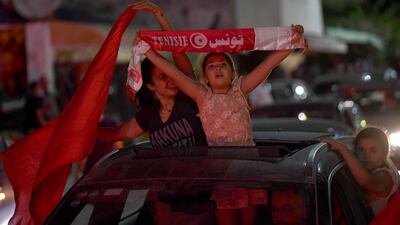
People celebrate on the streets after Tunisian President Kais Saied announced the dissolution of parliament and Prime Minister Hichem Mechichi's government in Tunis on July 25, 2021. -
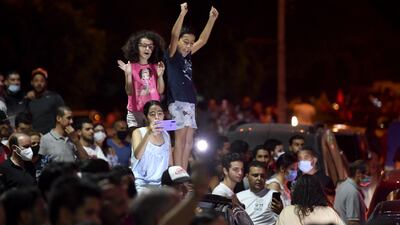
The president announced the suspension of Tunisia's parliament following a day of protests against the ruling party. -

Thousands of Tunisians waved flags and honked horns in cities and towns across the country. -
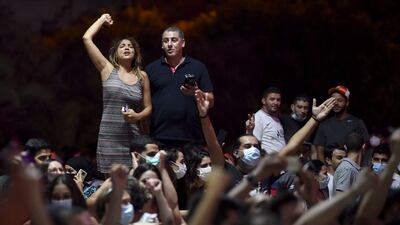
Crowds sang the national anthem. -
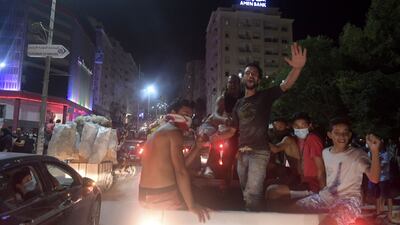
Tunisia has been in a political crisis for months, as the country tackles an economic crunch and the pandemic. -
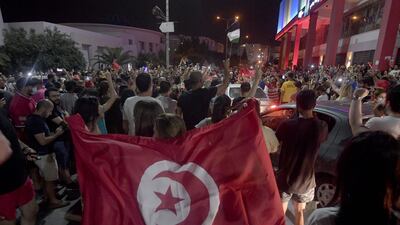
The street celebrations were held under the watch of military personnel, reports said. -

A woman raises the Tunisian flag. -
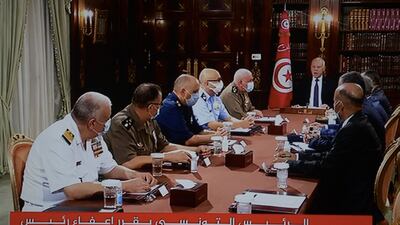
President Kais Saied, flanked by military officials, announces the dissolution of parliament and Prime Minister Mechichi's government. -

Mr Saied said he would assume executive authority with the assistance of a new prime minister.


The public response to Mr Saied’s moves demonstrates how divided Tunisian society is today. Both supporters of Mr Saied and his opponents poured into the streets on Sunday and Monday, demonstrating both euphoria over what supporters see as the president's decisive action and anger over what opponents see as an unlawful seizure of power. Pro-Saied protesters ransacked Ennahda's offices, who had the largest share of seats in Parliament, as well as the Free Destourian Party led by Abir Moussi, a polarising figure who has called for a return to the Ben Ali era. While Mr Saied’s opponents initially carried out a sit-in in front of Parliament, Ennahda issued a statement on Tuesday, calling on its supporters to stay home to prevent further violent confrontations.
Civil society groups such as the main labour union, the UGTT, have offered to facilitate a national dialogue that could help bring the various factions together and craft a roadmap forward. Tunisia has had success with such efforts, with the national dialogue that took place in 2013, following another period of political upheaval culminating in the assassination of two political figures, eventually putting the democratic transition back on track and netting the four organisations that facilitated the dialogue with the Nobel Peace Prize.
A statement by some of the most influential civil society organisations – the National Union of Tunisian Journalists, the UGTT, the National Bar Association, the Tunisian Association of Democratic Women, the Association of Tunisian judges, the Tunisian League of Human Rights and the Tunisian Forum of Economic and Social Rights, largely supports the president’s actions, but emphasises the need for him to ensure the emergency measures remain temporary. The groups have called on him to adhere to the 30-day timeline, after which the emergency measures should expire, according to Article 80, and to develop a roadmap within that timeframe.

There has been a wide variety of responses from the international community, with Arab states divided based on their political loyalties. The strongest condemnation of Mr Saied’s actions has been from Turkey, who is close to the Ennahda leadership and shares its Islamist ideology. On Tuesday, Mr Saied welcomed both the Moroccan and Algerian foreign ministers, with the North African nations watching what unfolds in Tunisia closely.
The West has been engaged, but relatively muted in its response so far, taking a wait-and-see approach. Most statements from Europe and the US have emphasised the need to adhere to human rights and democratic principles. France has called for a “return, as soon as possible, to normal functioning of institutions". And the EU focused its statement on ensuring that Tunisia adheres to the constitution and rule of law.
The events unfolding in Tunisia are far from over. After consolidating executive power into his own hands, President Saied now has 30 days to show Tunisians his plan to address the political, economic and health crises that have paralysed the country.

