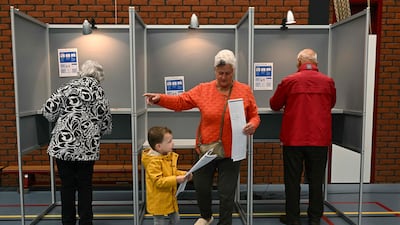
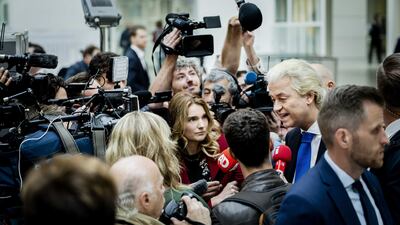
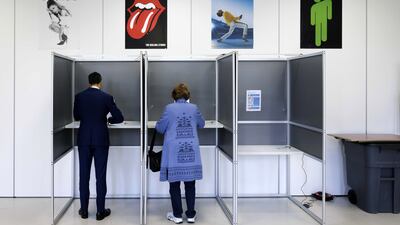
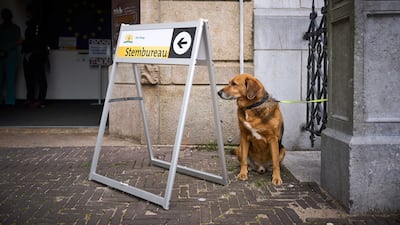
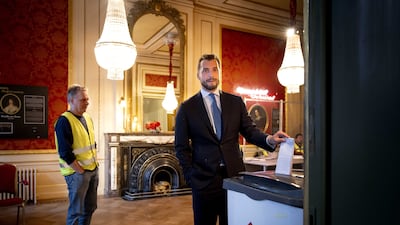
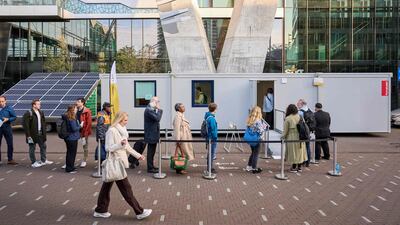
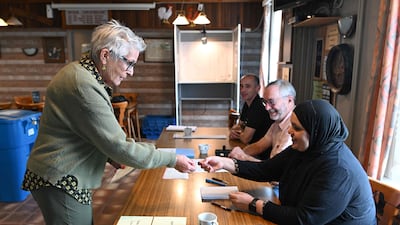
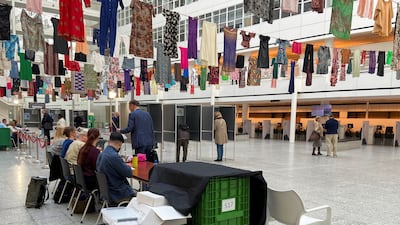
The elections for the European Parliament began on Thursday, June 6. It’s both a pertinent and poignant date. June 6 is the 80th commemoration of the start of D-Day, the Allied invasion of Nazi-occupied Europe. Out of the ashes of this devastating conflict, the nations of the European continent would go on to forge new relationships.
Far from creating just an economic union, the architects of the EU were citizens who had observed the carnage of the Second World War up close and sought to build a peaceful Europe. It was a political project that used and strengthened economic ties between nations to try to avoid another cataclysmic war and to prevent France and Germany from ever coming into conflict with one another again.
It is unsurprising that a lot has changed since the 1957 Treaty of Rome that established this community. The EU has always had to wrestle with a host of competing interests. This is inevitable in a union of 27 states and almost 450 million people that contains myriad economic, cultural and social differences between its members. One way to transcend all these differences was through championing a European identity: a sense of belonging to a unifying concept of “Europe” that could speak to all. Identity is the glue that holds people to a national home and produces a familiarity that enables them to identify with one another.
In these elections, we can see the weakness of such a “European” identity. States are tribal, and their own national interests dominate the electoral picture. “All politics is local”, to borrow a phrase used to describe American politics, and there is a dizzying number of reasons to explain why European voters are motivated principally by domestic, not EU, issues. Coalition instability in Germany, corruption in Bulgaria, budget problems in Denmark, inflation in Austria, geopolitics in Finland, housing issues in Ireland and an assassination attempt against a prime minister last month in Slovakia all suggest that, for European voters, the domestic trumps the regional.
As things stand, electoral predictions suggest that the far right will improve its position in many countries. Confronted by such exclusivist and nativist policies, it seems difficult to believe a pan-continental European identity has anything to tell us about the current state of EU politics. Is modern Europe, symbolised in the institutions and practices of the EU, in fact built on xenophobia and exclusion?
The common focus is on Europe’s cultural composition. As a cultural community, Europe has heard arguments to exclude “non-European” – perhaps culturally non-Christian? – nations.
The EU is more than a cultural project – it is also a political project. Its members are expected to legalise and apply certain values
Former French president Nicolas Sarkozy embodied this view in his own policies towards potential Turkish membership of the EU during his time in office, and afterwards. “What is the idea behind Europe?” he asked in a 2016 interview with a French channel. “Can Turkey be regarded as a European country culturally, historically and economically speaking?”
He added: “But if we begin to explain it – that Turkey is in Europe – European school students will have to be told that the European border lies in Syria. Where’s common sense?”
Ankara’s application to join the EU dates to 1987, but in 2019 the European Parliament formally suspended negotiations with Turkey.
But the EU is more than a cultural project – it is also a political project. Its members are expected to legalise and apply certain values such as democracy, a free press, the rule of law and human rights to name a few. These values are often held up to the point of being cliched, but they are applied. The EU has fined or withheld funds to members it says have breached them – members such as Hungary and Poland, two states that do not culturally clash with the concept of “Europe”.
The EU also has several new applicants on its books including Muslim-majority Albania and Bosnia, as well as Serbia and perhaps – eventually – Ukraine. As a regional institution, the EU was always going to be exclusivist in some way, but it continues to exert a gravitational pull for neighbouring states.
Nonetheless, is there really any hope for a concept of European identity based on democratic values when a 20 per cent surge for far-right parties is broadly predicted in these elections? In a sense, the EU is a victim of its own success. Perhaps the geographical nativism embedded in the pan-European project gives even greater fire to the nativism that has already long been a feature of national politics. And as an institution that straddles the local and the global, with soft-power dominance, the EU for perhaps too long has deluded itself on its ability to transcend the national problems its members face.
One obvious issue, ignored for too long, is illegal immigration, which certainly seems to link several far-right parties across borders, and rallies voters to their cause. The ugly language of extreme nationalism, always more widespread during crises, suggests the institutions of the EU are not up to the task of dealing with migration, and national governments must instead build walls. The EU has to respond more robustly to such sentiments, while refraining from demonising citizens’ sentiments, expecting these problems to simply go away or merely invoking the language of a chimerical European identity.
If there is optimism, it can still be found in the ideals attached to European identity – but this is not the same as national identity. A European identity cannot not really be rooted in a cultural landscape that is far too diverse to emotionally connect everyone. Instead, a truly European identity can best be found in the political; it is the political values of EU member states that make it what it is. This must of course always be juxtaposed within an ugly history of European colonialism and conquest. But the men who threw themselves at the beaches of Normandy on D-Day 80 years ago, and who died in their droves, were sacrificing themselves for these ideals and helping to build a Europe free from fascism.
It is the upholding of these ideals, for all Europeans, born there or otherwise, EU citizens or not, that is the best way to contribute to a more unified concept of Europe and a more solid conceptualisation of European identity.

Killing of Qassem Suleimani
Tips to keep your car cool
- Place a sun reflector in your windshield when not driving
- Park in shaded or covered areas
- Add tint to windows
- Wrap your car to change the exterior colour
- Pick light interiors - choose colours such as beige and cream for seats and dashboard furniture
- Avoid leather interiors as these absorb more heat
A State of Passion
Directors: Carol Mansour and Muna Khalidi
Stars: Dr Ghassan Abu-Sittah
Rating: 4/5
UAE currency: the story behind the money in your pockets
THE BIO
Favourite car: Koenigsegg Agera RS or Renault Trezor concept car.
Favourite book: I Am Pilgrim by Terry Hayes or Red Notice by Bill Browder.
Biggest inspiration: My husband Nik. He really got me through a lot with his positivity.
Favourite holiday destination: Being at home in Australia, as I travel all over the world for work. It’s great to just hang out with my husband and family.
Mercedes-AMG GT 63 S E Performance: the specs
Engine: 4.0-litre twin-turbo V8 plus rear-mounted electric motor
Power: 843hp at N/A rpm
Torque: 1470Nm N/A rpm
Transmission: 9-speed auto
Fuel consumption: 8.6L/100km
On sale: October to December
Price: From Dh875,000 (estimate)
Zidane's managerial achievements
La Liga: 2016/17
Spanish Super Cup: 2017
Uefa Champions League: 2015/16, 2016/17, 2017/18
Uefa Super Cup: 2016, 2017
Fifa Club World Cup: 2016, 2017
Who's who in Yemen conflict
Houthis: Iran-backed rebels who occupy Sanaa and run unrecognised government
Yemeni government: Exiled government in Aden led by eight-member Presidential Leadership Council
Southern Transitional Council: Faction in Yemeni government that seeks autonomy for the south
Habrish 'rebels': Tribal-backed forces feuding with STC over control of oil in government territory
FIXTURES
December 28
Stan Wawrinka v Pablo Carreno Busta, 5pm
Milos Raonic v Dominic Thiem, no earlier then 7pm
December 29 - semi-finals
Rafael Nadal v Stan Wawrinka / Pablo Carreno Busta, 5pm
Novak Djokovic v Milos Raonic / Dominic Thiem, no earlier then 7pm
December 30
3rd/4th place play-off, 5pm
Final, 7pm
Timeline
2012-2015
The company offers payments/bribes to win key contracts in the Middle East
May 2017
The UK SFO officially opens investigation into Petrofac’s use of agents, corruption, and potential bribery to secure contracts
September 2021
Petrofac pleads guilty to seven counts of failing to prevent bribery under the UK Bribery Act
October 2021
Court fines Petrofac £77 million for bribery. Former executive receives a two-year suspended sentence
December 2024
Petrofac enters into comprehensive restructuring to strengthen the financial position of the group
May 2025
The High Court of England and Wales approves the company’s restructuring plan
July 2025
The Court of Appeal issues a judgment challenging parts of the restructuring plan
August 2025
Petrofac issues a business update to execute the restructuring and confirms it will appeal the Court of Appeal decision
October 2025
Petrofac loses a major TenneT offshore wind contract worth €13 billion. Holding company files for administration in the UK. Petrofac delisted from the London Stock Exchange
November 2025
180 Petrofac employees laid off in the UAE
The%20specs
%3Cp%3E%3Cstrong%3EEngine%3A%3C%2Fstrong%3E%206.5-litre%20V12%20and%20three%20electric%20motors%0D%3Cbr%3E%3Cstrong%3EPower%3A%20%3C%2Fstrong%3E1%2C015hp%0D%3Cbr%3E%3Cstrong%3ETorque%3A%20%3C%2Fstrong%3E1%2C500Nm%20(estimate)%0D%3Cbr%3E%3Cstrong%3ETransmission%3A%3C%2Fstrong%3E%20Eight-speed%20dual-clutch%20auto%0D%3Cbr%3E%3Cstrong%3EOn%20sale%3A%3C%2Fstrong%3E%20Early%202024%0D%3Cbr%3E%3Cstrong%3EPrice%3A%20%3C%2Fstrong%3EFrom%20Dh2%20million%20(estimate)%3C%2Fp%3E%0A
ELIO
Starring: Yonas Kibreab, Zoe Saldana, Brad Garrett
Directors: Madeline Sharafian, Domee Shi, Adrian Molina
Rating: 4/5
The specs
AT4 Ultimate, as tested
Engine: 6.2-litre V8
Power: 420hp
Torque: 623Nm
Transmission: 10-speed automatic
Price: From Dh330,800 (Elevation: Dh236,400; AT4: Dh286,800; Denali: Dh345,800)
On sale: Now
Mercer, the investment consulting arm of US services company Marsh & McLennan, expects its wealth division to at least double its assets under management (AUM) in the Middle East as wealth in the region continues to grow despite economic headwinds, a company official said.
Mercer Wealth, which globally has $160 billion in AUM, plans to boost its AUM in the region to $2-$3bn in the next 2-3 years from the present $1bn, said Yasir AbuShaban, a Dubai-based principal with Mercer Wealth.
“Within the next two to three years, we are looking at reaching $2 to $3 billion as a conservative estimate and we do see an opportunity to do so,” said Mr AbuShaban.
Mercer does not directly make investments, but allocates clients’ money they have discretion to, to professional asset managers. They also provide advice to clients.
“We have buying power. We can negotiate on their (client’s) behalf with asset managers to provide them lower fees than they otherwise would have to get on their own,” he added.
Mercer Wealth’s clients include sovereign wealth funds, family offices, and insurance companies among others.
From its office in Dubai, Mercer also looks after Africa, India and Turkey, where they also see opportunity for growth.
Wealth creation in Middle East and Africa (MEA) grew 8.5 per cent to $8.1 trillion last year from $7.5tn in 2015, higher than last year’s global average of 6 per cent and the second-highest growth in a region after Asia-Pacific which grew 9.9 per cent, according to consultancy Boston Consulting Group (BCG). In the region, where wealth grew just 1.9 per cent in 2015 compared with 2014, a pickup in oil prices has helped in wealth generation.
BCG is forecasting MEA wealth will rise to $12tn by 2021, growing at an annual average of 8 per cent.
Drivers of wealth generation in the region will be split evenly between new wealth creation and growth of performance of existing assets, according to BCG.
Another general trend in the region is clients’ looking for a comprehensive approach to investing, according to Mr AbuShaban.
“Institutional investors or some of the families are seeing a slowdown in the available capital they have to invest and in that sense they are looking at optimizing the way they manage their portfolios and making sure they are not investing haphazardly and different parts of their investment are working together,” said Mr AbuShaban.
Some clients also have a higher appetite for risk, given the low interest-rate environment that does not provide enough yield for some institutional investors. These clients are keen to invest in illiquid assets, such as private equity and infrastructure.
“What we have seen is a desire for higher returns in what has been a low-return environment specifically in various fixed income or bonds,” he said.
“In this environment, we have seen a de facto increase in the risk that clients are taking in things like illiquid investments, private equity investments, infrastructure and private debt, those kind of investments were higher illiquidity results in incrementally higher returns.”
The Abu Dhabi Investment Authority, one of the largest sovereign wealth funds, said in its 2016 report that has gradually increased its exposure in direct private equity and private credit transactions, mainly in Asian markets and especially in China and India. The authority’s private equity department focused on structured equities owing to “their defensive characteristics.”
MATCH INFO
What: 2006 World Cup quarter-final
When: July 1
Where: Gelsenkirchen Stadium, Gelsenkirchen, Germany
Result:
England 0 Portugal 0
(Portugal win 3-1 on penalties)
Look north
BBC business reporters, like a new raft of government officials, are being removed from the national and international hub of London and surely the quality of their work must suffer.
LEADERBOARD
%3Cp%3E-19%20T%20Fleetwood%20(Eng)%3B%20-18%20R%20McIlroy%20(NI)%2C%20T%20Lawrence%20(SA)%3B%20-16%20J%20Smith%3B%20-15%20F%20Molinari%20(Ita)%3B%20-14%20Z%20Lombard%20(SA)%2C%20S%20Crocker%20(US)%3C%2Fp%3E%0A%3Cp%3E%3Cstrong%3ESelected%3A%20%3C%2Fstrong%3E-11%20A%20Meronk%20(Pol)%3B%20-10%20E%20Ferguson%20(Sco)%3B%20-8%20R%20Fox%20(NZ)%20-7%20L%20Donald%20(Eng)%3B%20-5%20T%20McKibbin%20(NI)%2C%20N%20Hoejgaard%20(Den)%3C%2Fp%3E%0A
How%20to%20avoid%20getting%20scammed
%3Cul%3E%0A%3Cli%3ENever%20click%20on%20links%20provided%20via%20app%20or%20SMS%2C%20even%20if%20they%20seem%20to%20come%20from%20authorised%20senders%20at%20first%20glance%3C%2Fli%3E%0A%3Cli%3EAlways%20double-check%20the%20authenticity%20of%20websites%3C%2Fli%3E%0A%3Cli%3EEnable%20Two-Factor%20Authentication%20(2FA)%20for%20all%20your%20working%20and%20personal%20services%3C%2Fli%3E%0A%3Cli%3EOnly%20use%20official%20links%20published%20by%20the%20respective%20entity%3C%2Fli%3E%0A%3Cli%3EDouble-check%20the%20web%20addresses%20to%20reduce%20exposure%20to%20fake%20sites%20created%20with%20domain%20names%20containing%20spelling%20errors%3C%2Fli%3E%0A%3C%2Ful%3E%0A