


It is welcome news that Iran wants to restore ties with Saudi Arabia, and that the five permanent members of the UN Security Council are reaching out to Tehran to urge it to play a constructive role in ending the war in Yemen. The Saudi-Iranian talks in Iraq must also continue beyond the recent fourth round, with the aim being to begin a new chapter in Arab-Iran relations. One can only hope that these developments mark a serious and positive shift for the region.
However, the policy being pursued by the world’s major powers of separating the start-stop Vienna talks to strike a new nuclear deal with Iran from its destabilising activities in the Arab world will continue to have profound implications for the region. Iraq, Lebanon and Yemen are all run by weak governments, with Tehran-sponsored proxies wielding outsized influence in all three countries.
Last week’s parliamentary election in Iraq produced a surprising outcome, with Iran-backed political parties faring poorly – and, therefore, revealing the resentment ordinary Iraqis bear towards the neighbouring country’s influence in their affairs. The announcement of the results was followed by threats from Tehran’s allies to undo the results, thereby risking a security crisis in the country. It also proved that the Islamic Revolutionary Guard Corps, in charge of Tehran’s overseas military activities – and which has been emboldened by the global powers’ decision to isolate the nuclear talks from Iran’s regional activities – does not have a stomach for genuine elections.
It is a similar story in Lebanon. Believing that it doesn't need to account for its destabilising activities there, Iran’s Lebanese proxy, Hezbollah, is working hard to undermine the judiciary’s remit to deliver justice, in cases in which the group is implicated. It is currently trying to derail the investigation into last year’s Beirut Port explosion that left more than 200 people dead and over 7,000 injured. It has even threatened to topple the newly installed federal government if the latter refuses to give in to its diktats. Such an outcome could lead to street battles in a country that continues to have strong memories of its 15-year civil war, even though it ended more than three decades ago.
Hezbollah and the Amal Movement party, its ally in Parliament, are targeting Tarek Bitar, the judge probing the port blast by accusing him of politicising the investigation, simply because he has refused to tolerate their interference. Both parties have targeted other officials in similar fashion before, but this time, they are doing so feeling confident that no foreign power will do anything to intervene, beyond making denunciations.
It is increasingly evident that Hezbollah wants to shut down the probe into the August 2020 blast, which has a complicated backstory allegedly involving corrupt politicians, international shell companies and – most crucially – Hezbollah, which controlled the port at the time of the explosion.
Many questions over the explosion remain unanswered: was it an act of terror or simply an accident? Either way, how did it happen and who was responsible for it? The investigation has yet to arrive at any conclusions, because the judiciary has so far been hamstrung by Hezbollah’s politicking and, allegedly, due to a lack co-operation from other countries. Again, the question is why.
-
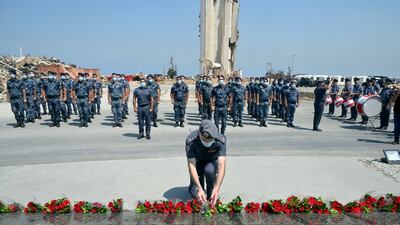
Members of the Lebanese Internal Security Forces lay flowers in front of a memorial to the victims of the explosion in Beirut's port last year. -
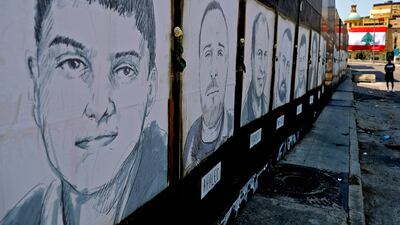
Portraits of victims of last year's Beirut port blast. -
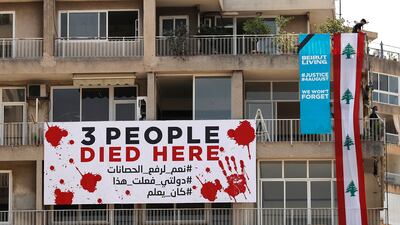
A man, right, hangs a giant Lebanese flag on a building that was damaged in last year's blast. -
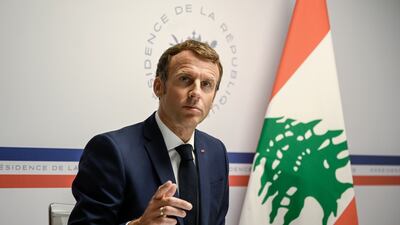
France's President Emmanuel Macron remotely attends a Lebanon donors' conference one year after the Beirut port blast. -

Police hold flowers to mark the anniversary of Beirut's 2020 port blast on August 5. -
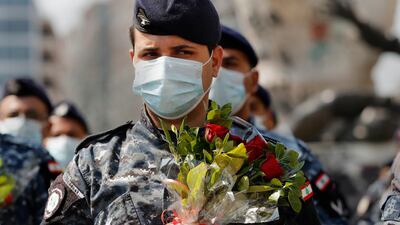
Police hold flowers to mark the anniversary of Beirut's massive 2020 port blast. -

Police hold flowers to mark the anniversary of the Beirut port explosion. -
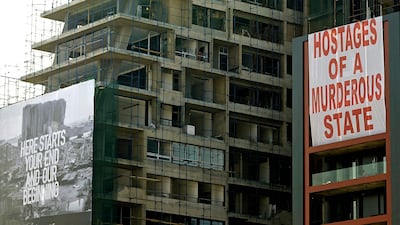
Banners reading 'Here starts your end and our beginning' and 'Hostages of a murderous state' hang on a building damaged in last August's port blast, as Lebanon marks a year since a the cataclysmic explosion devastated Lebanon's capital. -
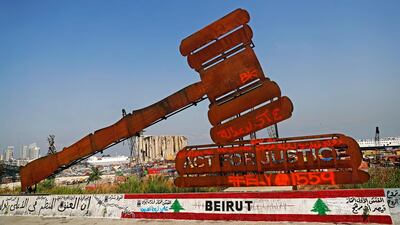
A gavel monument symbolising justice can be seen in front of the damaged grain silos at Beirut port, as Lebanon marks a year since an explosion ravaged the country's capital. -
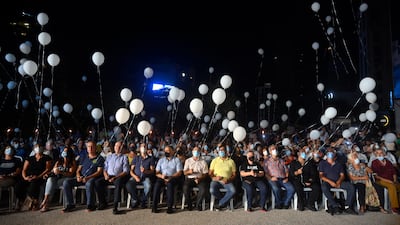
Supporters of Lebanon's Free Patriotic Movement release white balloons to mark one year since the huge explosion in Beirut's port. At least 200 people were killed, and more than 6,000 injured in the blast on August 4, 2020. -
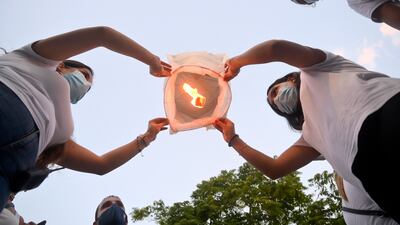
Supporters of the Free Patriotic Movement release paper lanterns to mark one year since a huge explosion in Beirut's port. -
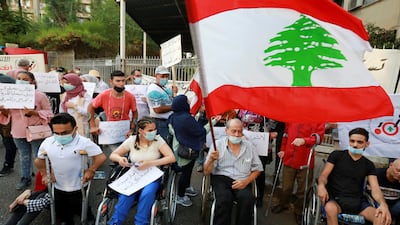
A man in a wheelchair flies a Lebanese flag during a protest demanding justice for the victims of last year's Beirut port blast. -
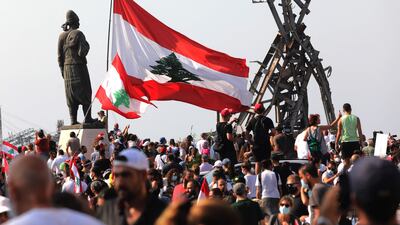
Demonstrators gather outside Beirut port on the anniversary of the blast that ravaged the city last August. Hundreds of Lebanese marched on August 4 to mark the explosion, protesting against impunity over the country's worst peacetime disaster at a time when its economy was already in tatters. -
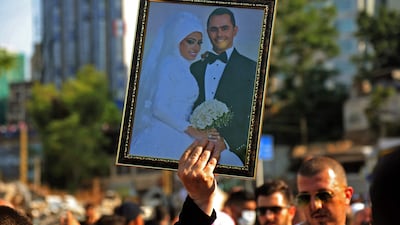
Relatives of Beirut port blast victims arrive for a remembrance ceremony at the site of the explosion on the first anniversary of the disaster. -
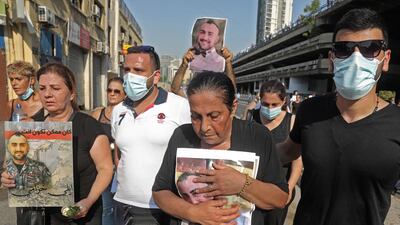
Relatives of Beirut port blast victims arrive for a remembrance ceremony at the site of the explosion on the first anniversary of the disaster. -
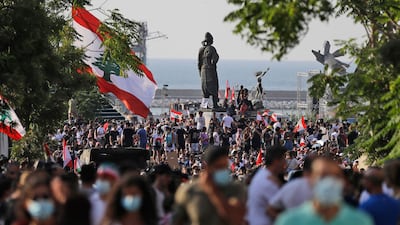
Demonstrators gather by the statue of 'The Lebanese Emigrant' near Beirut port on the first anniversary of the blast that ravaged the port and the city. -
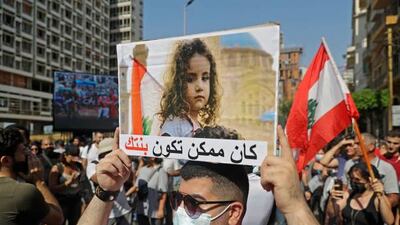
A demonstrator marches with a sign showing one of the young victims of the 2020 Beirut blast. -

People carry flags and banners as they march to mark the anniversary of Beirut's port blast. -
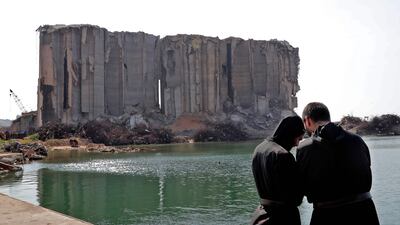
Priests pray near the remains of Beirut port on the first anniversary of the blast that ravaged the port and the city. -
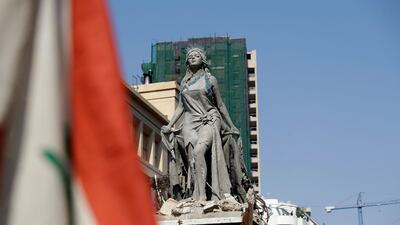
Demonstrators in Lebanon's capital march past a statue symbolising "Beirut rising from destruction" on their way towards the port on the first anniversary of the blast that ravaged the city. -
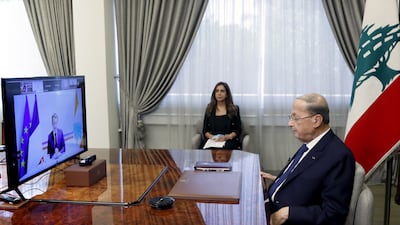
France's President Emmanuel Macron talks to his Lebanese counterpart Michel Aoun during a remote international conference to raise aid for the country. France has pledged about €100 million ($118.3m) in emergency aid as well as 500,000 Covid-19 vaccine doses for Lebanon. -
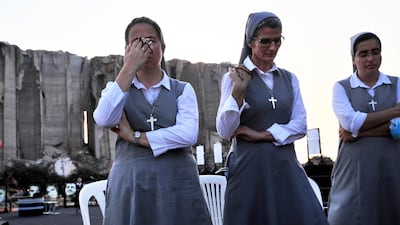
Nuns pray during a mass organised at the Beirut port with the relatives of last year's blast victims. -
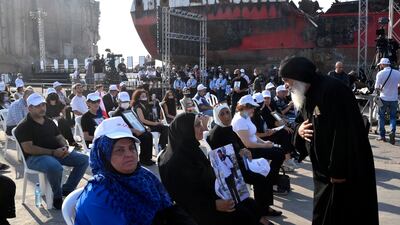
A priest comforts the relative of a blast victim at a Mass organised in Beirut. -
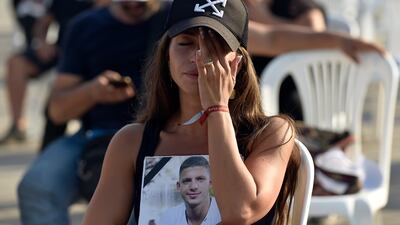
Families and relatives of people killed in the blast carried portraits of their loved ones to the commemoration Mass in Beirut. -
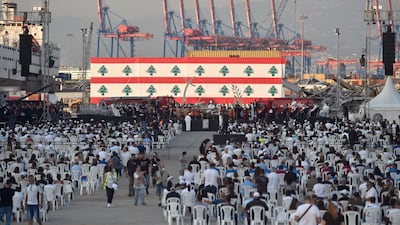
Families and relatives of victims of the explosion at Beirut port attend a Mass held to commemorate the anniversary. -
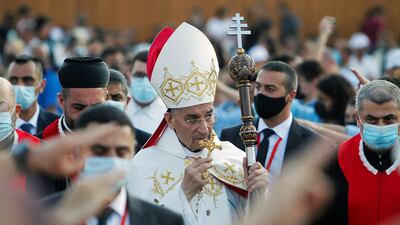
Lebanese Maronite Patriarch Bechara Boutros Al-Rai arrives to lead a Mass in memory of people who died in the explosion. -
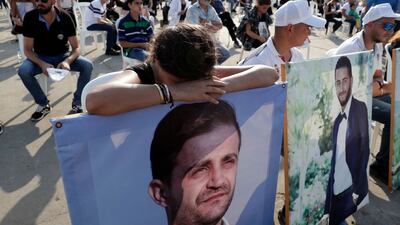
Relatives of people who died in the 2020 Beirut blast attend a Maronite Christian Mass at the city’s port. -
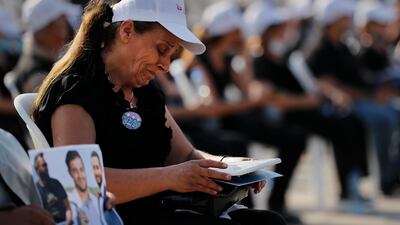
A relative of a victim of the blast weeps as she attends the Mass. -
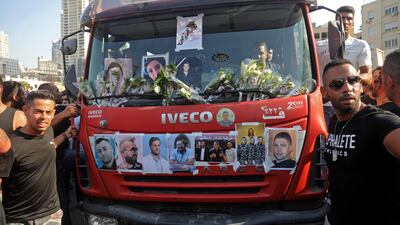
A fire engine carrying portraits of blast victims is driven during a remembrance ceremony at the port of Lebanon’s capital. -
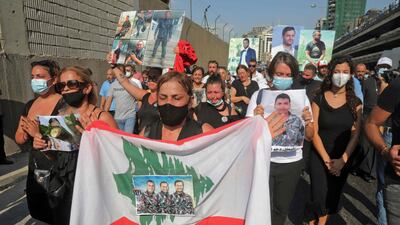
Relatives of the Beirut port blast victims arrive for a remembrance ceremony at the Lebanese capital’s port.


One theory is that illicit imports and exports were transiting through the Beirut Port to and from Syria and Iran. Could these products have included chemicals, spare parts, chips and electronics, or any sensitive material that Tehran would need for its nuclear and missile development programmes? Any evidence to back such claims would set not only the Vienna talks back but also the prospect of the US lifting its sanctions on Iran. Mr Bitar’s investigation, it seems, has been a source of great discomfort to Hezbollah and its patrons in Tehran.
What gives Hezbollah some of its clout, which it uses to try and push officials around, is its alliance with Lebanese President Michel Aoun’s Free Patriotic Movement party. Mr Aoun currently finds himself having to choose between yielding to Hezbollah's demands and listening to his own political base, which seems increasingly impatient with the slow pace of the investigation.
Mr Aoun, however, is not a victim who lacks agency. He can act in Lebanon’s interest by upholding the principle of the separation of powers. He must show wisdom and courage based on a profound reading of the outcome of his party’s alliance with Hezbollah, which has allowed the latter to seize key levers of the Lebanese state, put the presidency in an awkward spot, and threaten to pull down the government.
The president can take positive action by permitting Mr Bitar to question Maj Gen Tony Saliba, the head of state security. Prime Minister Najib Mikati, meanwhile, can ask the interior ministry to allow Mr Bitar to question Maj Gen Abbas Ibrahim, the head of general security. By doing so, both the president and prime minister can prove they are protectors of the judiciary and can, thereby, set a positive example for other leaders.
The current crisis in Lebanon is one involving the purportedly independent judiciary on the one side and the political class that considers itself above the law on the other. Internal matter or not, however, the international community must throw its support behind the judiciary. For, this branch of the government is in grave danger and its officials need international backing and protection. The US and the European powers, led by France, can move to deploy sanctions against those mutinying against the judiciary, as the Lebanese security services fail to act fearing political recriminations.
Failing to do so will give Hezbollah – with support from Tehran – and Amal the space to do what they can to foil the investigation. The fate of the court case could prove consequential for Lebanese politics and the stakes Hezbollah, and by extension Iran, will continue to have in it.

