
The Republican Party’s massive losses at the midterm elections mean Washington's foreign policy outlook is about to undergo a major shift, with the Democrats taking control of powerful committees in the House and Senate that provide oversight of the State Department and Pentagon.
After nearly two years on the sidelines, the Democrats will have the power to investigate the Trump administration and shape legislation on military spending, foreign aid and international security.
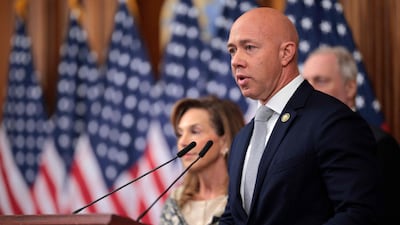
In the House, Representative Gregory Meeks is expected to take over as chairman of the foreign affairs committee, pushing aside current Republican chairman Brian Mast.
Representative Adam Smith is likely to lead the House armed services committee, replacing Republican Mike Rogers. Mr Meeks and Mr Smith are the ranking members on the committees, meaning they are the most senior members of their party on the panels.
In the Senate, Jack Reed is expected to become chairman of the armed services committee, replacing Republican Roger Wicker. And Chris Coons is widely expected to take over the foreign relations committee when its current Democratic leader, Jeanne Shaheen, retires in January.

The appointments have yet to be formally confirmed and could change.
Tuesday's midterm losses saw the Republicans suffer a deep blow to their foreign policy expertise.
For example, Senator Susan Collins lost her seat in Maine. She was a senior voice on national security, serving on the Senate intelligence committee and leading the defence appropriations subcommittee, where she helped to shape Pentagon spending and championed US naval shipbuilding.
Another Republican Senator, Thom Tillis, is retiring in January and his seat was won by former North Carolina governor Roy Cooper, a Democrat. Mr Tillis was a prominent bipartisan advocate for Nato, transatlantic security and continued support for Ukraine.
Another Republican foreign policy expert, Lindsey Graham, died in July and his sister Darline Graham, who had been appointed as a temporary senator, lost the seat to Democrat Annie Andrews.

Also soon to be gone are Senator Mitch McConnell, who is retiring, and Representative Michael McCaul, a former chairman of the House foreign affairs committee, who is stepping down after serving 11 terms.
Representative Mike Turner, who chaired the House Intelligence Committee from 2023 to 2025, lost his contest to Democrat Kristina Knickerbocker.
“What's most troubling is just the significant hollowing out of strong Republican national security experts in Congress, you know, whether it was through retirements or losses or sadly death," Leslie Shedd, a non-resident fellow at the Atlantic Council’s Eurasia Centre, said in a briefing.
Ms Shedd questioned whether incoming politicians would maintain an internationalist approach or whether the Republican Party would lean further towards its isolationist wing.
“It's really disheartening to see that these have all been really strong advocates for American strength abroad, for continuing strong American alliances, particularly with Ukraine," she said.

The new Democratic chairmen of the foreign policy panels will have considerable influence over which issues receive congressional attention.
The Iran war is likely to be an early focus. Democrats have repeatedly challenged Mr Trump's decision to launch military operations without congressional authorisation.
"On the legislative front, I intend to bring resolutions to the floor to immediately terminate the President's war with Iran and will prioritise clawing back Congress's proper role in the making of American foreign policy," Mr Meeks, the aspiring chair of the House foreign affairs committee, said in a letter on Thursday.
The Pentagon's budget will also be a major point of contention, with the Democrats set to scrutinise the administration's requests for more funding and its wider military priorities.
Israel is another area where the change in committee leadership could have consequences. Democratic politicians have become increasingly divided over US military assistance to Israel, and the incoming Congress is likely to see greater scrutiny of arms transfers and conditions attached to US support.
The new leadership will also reassess US policy towards Ukraine, where Democrats have overall been more supportive of continued military assistance than Mr Trump, whose administration has been negotiating with Moscow.
The new Congress begins in January.

Over in the executive branch, meanwhile, there are plenty of murmurings about who might be in or out of Mr Trump's cabinet but so far nothing has been confirmed.
The State Department forcefully denied a British newspaper report that Secretary of State Marco Rubio might be preparing to resign.
Washington insiders say Defence Secretary Pete Hegseth is vulnerable because the Iran war played so badly with voters. When asked about any staffing changes on Friday, Mr Trump said the Pentagon chief had done a "fantastic job".