


The UN envoy for Syria has welcomed the US decision to ease some sanctions against Damascus to enable humanitarian aid deliveries, but called for a greater push for long-term relief.
Geir Pedersen's remarks on Wednesday came after US President Joe Biden's administration this week issued a six-month suspension of sanctions on Syrian governing institutions.
“I welcome the recent issuance of a new temporary general licence by the United States government. But significant further efforts to adjust sanctions will inevitably be necessary,” Mr Pedersen told the UN Security Council, in its first meeting of the year on Syria.
Syria's Foreign Affairs Ministry on Wednesday said the complete removal of sanctions “is essential” to allow for Syria's recovery. Since 2011, Syria has been under severe sanctions imposed by countries and blocs including the US, the UK and the EU after former president Bashar Al Assad's brutal response to pro-democracy protests, which escalated into a civil war.
The group that toppled Mr Al Assad, former Al Qaeda affiliate Hayat Tahrir Al Sham, remains a US-designated terrorist organisation. But Washington says it would work with HTS, which has renounced its ties with Al Qaeda, if it can prove it has moderated its views.
France’s Foreign Minister Jean-Noel Barrot said the EU could also ease some sanctions related to aid, but the lifting of more political sanctions would depend on how Syria's new leadership handled the transition.
HTS leader Ahmad Al Shara, formerly known by the nom de guerre Abu Mohammed Al Jawlani, has announced plans for a national conference to assist the country's transition, with a timeline of up to four years for holding elections. He also said he intends to form a committee representing various sectors of Syrian society to prepare for the dialogue.
-
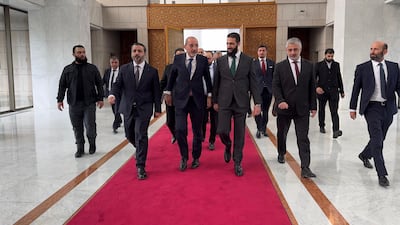
Jordan's Foreign Minister Ayman Safadi meets Syria's de facto leader Ahmad Al Shara in Damascus. Photo: Jordanian Foreign Ministry -
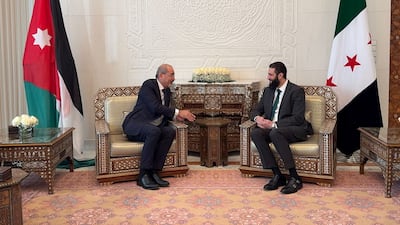
The two men held extensive talks in the Syrian capital. Photo: Jordanian Foreign Ministry -
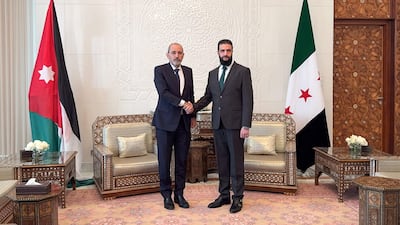
Mr Safadi, left, seen shaking hands with Mr Al Shara, is expected to meet other key Syrian officials during the visit. AFP -
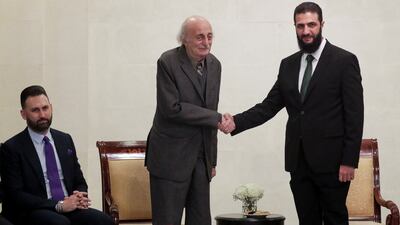
Lebanese Druze leader Walid Jumblatt, with his son Taymur looking on, is received by Mr Al Shara in Damascus. Reuters -
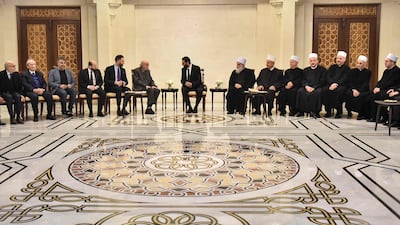
Walid and Taymur Jumblatt in talks with Mr Al Shara, Syria’s interim prime minister Mohammed Al Bashir and Druze leaders in Damascus. AFP -
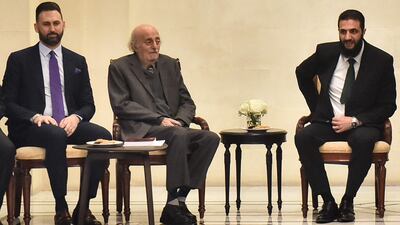
Walid Jumblatt is the first Lebanese leader to meet Mr Al Shara since his Hayat Tahrir Al Sham group and allied rebel factions launched a lightning offensive, seizing Damascus and ousting long-time Syrian president Bashar Al Assad. AFP -
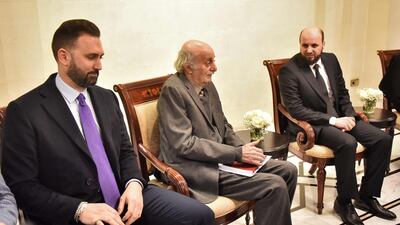
Taymur Jumblatt, Walid Jumblatt and Mr Al Bashir. AFP -
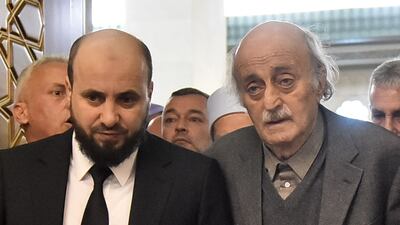
Mr Al Bashir with Walid Jumblatt. AFP -
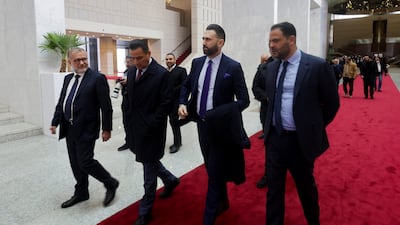
Taymur Jumblatt with officials in Damascus. Reuters -
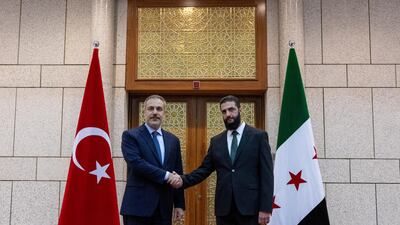
Turkish Foreign Minister Hakan Fidan meets Mr Al Shara in Damascus. Reuters -
Mr Fidan, left, with Mr Al Shara during their meeting. Mr Fidan is the first foreign minister to visit Damascus since president Bashar Al Assad's overthrow two weeks ago. Reuters -
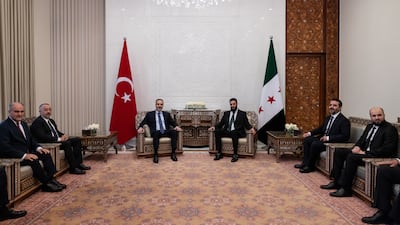
Mr Fidan and Mr Al Shara held talks on Sunday during which they vowed to strengthen bilateral ties. EPA -
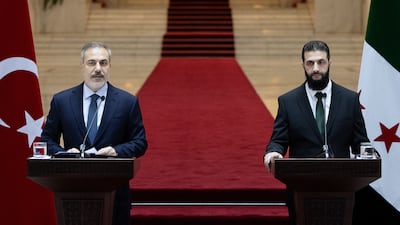
Mr Fidan, left, and Mr Al Shara attend a press conference after their meeting. EPA -
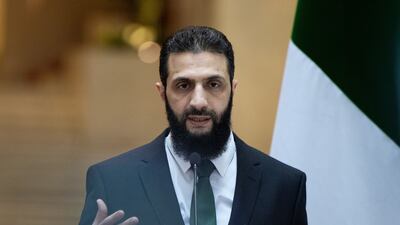
Hayat Tahrir Al Sham leader Mr Al Shara at a press conference after meeting Mr Fidan in Damascus, Syria. EPA -

Mr Fidan at a press conference after a meeting Mr Al Sharaa in Damascus, Syria. EPA


Mr Pedersen warned the caretaker authorities against making mistakes that would imperil the transition, after decades of dictatorship under Mr Al Assad.
“Decisions taken now will determine the future for a long time to come. There are great opportunities and real dangers,” he said, stressing that Syria and the international community need to “get the next phase right".
Mr Pedersen also discussed UN Security Council Resolution 2254, which backs a political process led by Syrians to form a non-sectarian government within six months and to hold elections within 18 months. He said the resolution, which was written when Mr Al Assad was in power, can no longer be applied “in the literal manner”. “Clearly, there is a need for a new approach and modes of thinking on many fronts,” he said.
In a recent interview with Saudi broadcaster Al Arabiya, Mr Al Shara criticised the UN's ineffectiveness and called on the world body to avoid imposing outdated resolutions on Syrians.
“There has been a lot of suffering and there have been many attempts to fix the Syrian situation, but the UN and the international community failed to release a single prisoner in 14 years and failed to return a single refugee,” he said. “So, today, the Syrian people have saved themselves.”
Qutaiba Idlbi, who leads the Atlantic Council's Syria Strategy, said much work was needed from Mr Pedersen’s team to “create trust” in Damascus, especially as recent years included normalisation of ties with the Assad regime.
It “didn't really reflect well on the work of ambassador Pedersen”, Mr Idlbi told The National. “We see at the same time people in Damascus now calling to actually change the UN special envoy for Syria to reflect like a better ... more positive environment between the UN and Damascus."
Richard Gowan, UN director of the International Crisis Group, said Mr Pedersen and his team faced the substantial challenge of convincing Syrian political factions of the “concrete benefits” of working with the UN.
“It is all well and good for the UN to encourage an inclusive transition, but the new power-brokers will want to know what they will get in return for co-operation,” said Mr Gowan. "The Security Council could offer a clear road map for ending UN sanctions on the new authorities, if they meet certain conditions on political inclusion and counter-terrorism issues. That would give Pedersen some leverage, and Damascus a reason to listen to New York."

