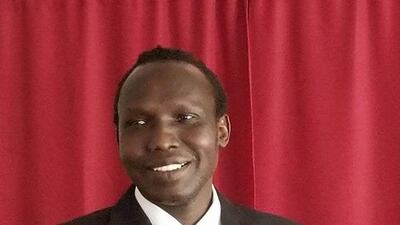
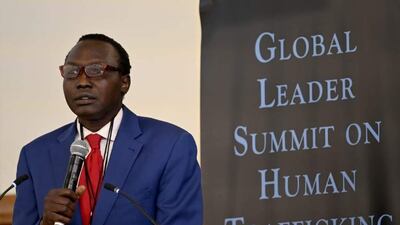
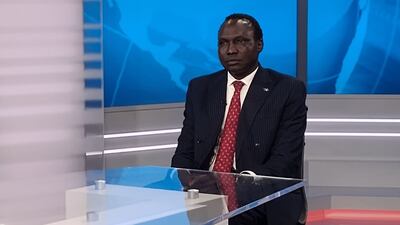
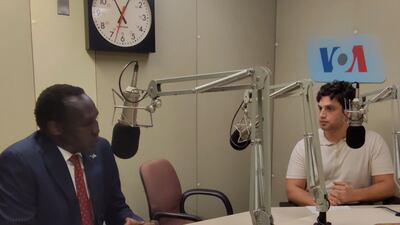
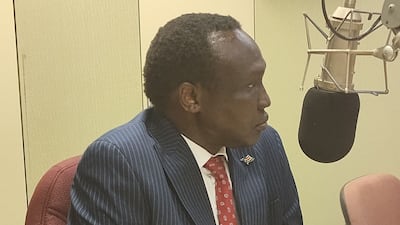
As South Sudan prepares for elections later this year, Bol Gai Deng has his eye on the presidency - even though he lives thousands of kilometres away.
Mr Deng, the candidate for the Kush Democratic Majority Party, began his campaign in 2017 after elections were announced for the following year in South Sudan.
He has been running his campaign from the US, however, where he has lived for the past two decades.
'War is not an option'
In 1987, when he was just seven years old, Mr Deng's village was attacked by elements of a radical militia.
Most of the people in the village were killed but more than 700 children - including Mr Deng - were abducted and taken to western Sudan.
Once they arrived, according to Mr Deng, they were sold as slaves.
After several years in slavery, Mr Deng escaped to Egypt, where, after being sponsored by a church in Virginia, he was able to come to the US.
He went on to graduate from Virginia Commonwealth University with a double major in political science and homeland security.
From his new home in the US, he has watched the situation in his country deteriorate.
“I grew up in war, lived at war and grew grey hair at war. I have seen the devastating effects of war in South Sudan for a long time," Mr Deng told The National.
"We have lost about 4.5 million people in the first and second wars. We know war is not an option."
South Sudan was once part of Sudan but gained autonomy in 2005 and then independence in 2011 following a referendum. After independence, the new country spiralled into civil war due to conflict between the president, Salva Kiir, and his former deputy Riek Machar.
The conflict resulted in more than 400,000 deaths and caused millions to flee their homes. Previous conflicts had taken the lives of millions more.
A peace agreement reached in 2018, which has not been fully enacted, was extended by 24 months to better prepare for the December 2024 elections. However, there is a possibility that these elections may be pushed back again.
'Free and fair elections'
Mr Deng asserts that the people of South Sudan have not exercised their right to choose their leaders since the 2011 referendum. Instead, they have endured a cycle of violent conflict that has prevented a democratic transfer of power.
“We have been campaigning to stop the tribal war in the country and urging South Sudanese to unite because tribal conflict has been perpetuated by the regime,” said Mr Deng, a member of the Dinka tribe.
“We have unresolved issues from the peace agreement, such as the status of Abyei, Blue Nile and Nuba Mountains.
Ultimately, Mr Deng is running for president to prevent the next generation from facing the same obstacles he encountered growing up.
He has been actively engaging with the US State Department, the US mission to the UN, members of Congress, civic groups and representatives of refugee camps in East Africa to promote the scheduling of elections. He has also been involved in protests in the US to bring more attention to the plight of his country.
“We have been telling South Sudanese that they must vote for free and fair elections. Our job is also to support humanitarian efforts on the ground," he said.
"About 75 per cent of our people live under NGOs, supported by UN humanitarian aid. Our people lack medicine and proper education, and these are the issues we are campaigning for."
Conflict in Sudan
Though South Sudan is now an independent country, its neighbour to the north is still affecting its stability today.
A civil war broke out in Sudan in April last year when relations soured between Gen Abdel Fattah Al Burhan, who heads the country's armed forces, and paramilitary leader Gen Mohamed Dagalo. Thousands have been killed in the conflict so far and millions forced to flee their homes.
Mr Deng emphasised the importance of addressing the war in Sudan.
“These two men are causing immense suffering in Sudan, and the victims are primarily women and children. It is our duty, as a region familiar with Sudanese culture, to lead the efforts for peace,” he said.
If elected in December, he said that he will focus on ending the war in Sudan, which has pushed thousands of refugees into South Sudan.
He said he plans to mobilise members of the Intergovernmental Authority on Development trade bloc, the African Union and the international community to address Sudan's problems by bringing the two warring generals to the negotiating table.
Asked whether he has a realistic shot at winning, Mr Deng pointed to recent polls in South Sudan showing people are "fed up" with the current administration. He added that he has a good base in the Dinka community and beyond.
Mr Deng believes it is crucial for young South Sudanese Americans to be educated about the complex situation in the country.
He intends to continue sharing his story as he urges the younger generation of South Sudanese Americans to step up, leave the comfort of the US and lead the country towards a better future.

Specs
Engine: Electric motor generating 54.2kWh (Cooper SE and Aceman SE), 64.6kW (Countryman All4 SE)
Power: 218hp (Cooper and Aceman), 313hp (Countryman)
Torque: 330Nm (Cooper and Aceman), 494Nm (Countryman)
On sale: Now
Price: From Dh158,000 (Cooper), Dh168,000 (Aceman), Dh190,000 (Countryman)
About Takalam
Date started: early 2020
Founders: Khawla Hammad and Inas Abu Shashieh
Based: Abu Dhabi
Sector: HealthTech and wellness
Number of staff: 4
Funding to date: Bootstrapped
LILO & STITCH
Starring: Sydney Elizebeth Agudong, Maia Kealoha, Chris Sanders
Director: Dean Fleischer Camp
Rating: 4.5/5
Pharaoh's curse
British aristocrat Lord Carnarvon, who funded the expedition to find the Tutankhamun tomb, died in a Cairo hotel four months after the crypt was opened.
He had been in poor health for many years after a car crash, and a mosquito bite made worse by a shaving cut led to blood poisoning and pneumonia.
Reports at the time said Lord Carnarvon suffered from “pain as the inflammation affected the nasal passages and eyes”.
Decades later, scientists contended he had died of aspergillosis after inhaling spores of the fungus aspergillus in the tomb, which can lie dormant for months. The fact several others who entered were also found dead withiin a short time led to the myth of the curse.
Fitness problems in men's tennis
Andy Murray - hip
Novak Djokovic - elbow
Roger Federer - back
Stan Wawrinka - knee
Kei Nishikori - wrist
Marin Cilic - adductor
UAE v Gibraltar
What: International friendly
When: 7pm kick off
Where: Rugby Park, Dubai Sports City
Admission: Free
Online: The match will be broadcast live on Dubai Exiles’ Facebook page
UAE squad: Lucas Waddington (Dubai Exiles), Gio Fourie (Exiles), Craig Nutt (Abu Dhabi Harlequins), Phil Brady (Harlequins), Daniel Perry (Dubai Hurricanes), Esekaia Dranibota (Harlequins), Matt Mills (Exiles), Jaen Botes (Exiles), Kristian Stinson (Exiles), Murray Reason (Abu Dhabi Saracens), Dave Knight (Hurricanes), Ross Samson (Jebel Ali Dragons), DuRandt Gerber (Exiles), Saki Naisau (Dragons), Andrew Powell (Hurricanes), Emosi Vacanau (Harlequins), Niko Volavola (Dragons), Matt Richards (Dragons), Luke Stevenson (Harlequins), Josh Ives (Dubai Sports City Eagles), Sean Stevens (Saracens), Thinus Steyn (Exiles)
Desert Warrior
Starring: Anthony Mackie, Aiysha Hart, Ben Kingsley
Director: Rupert Wyatt
Rating: 3/5
One in nine do not have enough to eat
Created in 1961, the World Food Programme is pledged to fight hunger worldwide as well as providing emergency food assistance in a crisis.
One of the organisation’s goals is the Zero Hunger Pledge, adopted by the international community in 2015 as one of the 17 Sustainable Goals for Sustainable Development, to end world hunger by 2030.
The WFP, a branch of the United Nations, is funded by voluntary donations from governments, businesses and private donations.
Almost two thirds of its operations currently take place in conflict zones, where it is calculated that people are more than three times likely to suffer from malnutrition than in peaceful countries.
It is currently estimated that one in nine people globally do not have enough to eat.
On any one day, the WFP estimates that it has 5,000 lorries, 20 ships and 70 aircraft on the move.
Outside emergencies, the WFP provides school meals to up to 25 million children in 63 countries, while working with communities to improve nutrition. Where possible, it buys supplies from developing countries to cut down transport cost and boost local economies.
Mercer, the investment consulting arm of US services company Marsh & McLennan, expects its wealth division to at least double its assets under management (AUM) in the Middle East as wealth in the region continues to grow despite economic headwinds, a company official said.
Mercer Wealth, which globally has $160 billion in AUM, plans to boost its AUM in the region to $2-$3bn in the next 2-3 years from the present $1bn, said Yasir AbuShaban, a Dubai-based principal with Mercer Wealth.
“Within the next two to three years, we are looking at reaching $2 to $3 billion as a conservative estimate and we do see an opportunity to do so,” said Mr AbuShaban.
Mercer does not directly make investments, but allocates clients’ money they have discretion to, to professional asset managers. They also provide advice to clients.
“We have buying power. We can negotiate on their (client’s) behalf with asset managers to provide them lower fees than they otherwise would have to get on their own,” he added.
Mercer Wealth’s clients include sovereign wealth funds, family offices, and insurance companies among others.
From its office in Dubai, Mercer also looks after Africa, India and Turkey, where they also see opportunity for growth.
Wealth creation in Middle East and Africa (MEA) grew 8.5 per cent to $8.1 trillion last year from $7.5tn in 2015, higher than last year’s global average of 6 per cent and the second-highest growth in a region after Asia-Pacific which grew 9.9 per cent, according to consultancy Boston Consulting Group (BCG). In the region, where wealth grew just 1.9 per cent in 2015 compared with 2014, a pickup in oil prices has helped in wealth generation.
BCG is forecasting MEA wealth will rise to $12tn by 2021, growing at an annual average of 8 per cent.
Drivers of wealth generation in the region will be split evenly between new wealth creation and growth of performance of existing assets, according to BCG.
Another general trend in the region is clients’ looking for a comprehensive approach to investing, according to Mr AbuShaban.
“Institutional investors or some of the families are seeing a slowdown in the available capital they have to invest and in that sense they are looking at optimizing the way they manage their portfolios and making sure they are not investing haphazardly and different parts of their investment are working together,” said Mr AbuShaban.
Some clients also have a higher appetite for risk, given the low interest-rate environment that does not provide enough yield for some institutional investors. These clients are keen to invest in illiquid assets, such as private equity and infrastructure.
“What we have seen is a desire for higher returns in what has been a low-return environment specifically in various fixed income or bonds,” he said.
“In this environment, we have seen a de facto increase in the risk that clients are taking in things like illiquid investments, private equity investments, infrastructure and private debt, those kind of investments were higher illiquidity results in incrementally higher returns.”
The Abu Dhabi Investment Authority, one of the largest sovereign wealth funds, said in its 2016 report that has gradually increased its exposure in direct private equity and private credit transactions, mainly in Asian markets and especially in China and India. The authority’s private equity department focused on structured equities owing to “their defensive characteristics.”
UAE SQUAD
Omar Abdulrahman (Al Hilal), Ali Khaseif, Ali Mabkhout, Salem Rashed, Khalifa Al Hammadi, Khalfan Mubarak, Zayed Al Ameri, Mohammed Al Attas (Al Jazira), Khalid Essa, Ahmed Barman, Ryan Yaslam, Bandar Al Ahbabi (Al Ain), Habib Fardan, Tariq Ahmed, Mohammed Al Akbari (Al Nasr), Ali Saleh, Ali Salmin (Al Wasl), Adel Al Hosani, Ali Hassan Saleh, Majed Suroor (Sharjah), Ahmed Khalil, Walid Abbas, Majed Hassan, Ismail Al Hammadi (Shabab Al Ahli), Hassan Al Muharrami, Fahad Al Dhahani (Bani Yas), Mohammed Al Shaker (Ajman)
The specs
Engine: 1.5-litre turbo
Power: 181hp
Torque: 230Nm
Transmission: 6-speed automatic
Starting price: Dh79,000
On sale: Now
DC%20League%20of%20Super-Pets
%3Cp%3EDirector%3A%20Jared%20Stern%3C%2Fp%3E%0A%3Cp%3EStarring%3A%20Dwayne%20Johnson%2C%20Kevin%20Hart%2C%20John%20Krasinski%2C%20Keanu%20Reeves%2C%20Olivia%20Wilde%2C%20Kate%20McKinnon%2C%20Jameela%20Jamil%3C%2Fp%3E%0A%3Cp%3ERating%3A%203%2F5%3C%2Fp%3E%0A