From the mountains of Tripoli to Steel City: How a Libyan made it in Pittsburgh


Joshua Longmore
  • English
  • Arabic

Abdullah Salem owes everything to his father.

A first-generation Arab American, he strides into the latest iteration of supermarket chain Salem’s Market and Grill, welcoming the shop’s early-morning customers before offering a helping hand in the butchery department, cutting meat for his regulars.

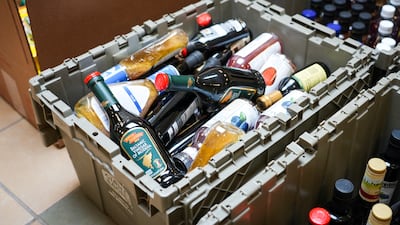
A team bustle about the aisles, monitoring items of stock with a hand-held barcode scanner to confirm all produce is halal. Anything that fails the test is collected in boxes and donated to local charitable causes.

“We are here to serve the community," Abdullah tells The National.

“That’s our job as a grocery store … when we were young and teachers taught us about community, there was police, firefighters and always a grocery store.”

The community Abdullah is referring to is Pittsburgh’s Hill District, a vibrant inner-city neighbourhood with a history rooted in jazz music, but one that has been “underserved” throughout recent decades.

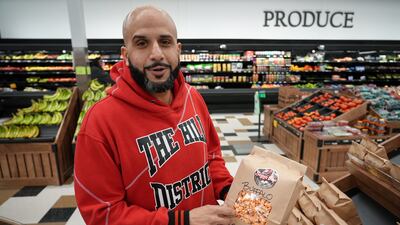
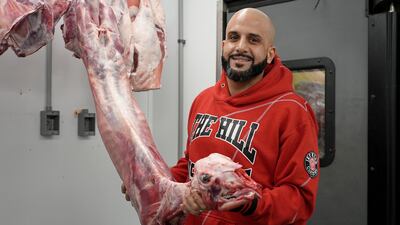
The Hill District, which Abdullah proudly represents on his red hooded sweatshirt, was regarded as a food desert before Salem’s Market opened on Centre Avenue in March.

A team scans products in Salem's Market and Grill to make sure everything is halal. Joshua Longmore / The National

“We’re in an area where the median annual income is about $15,000 and 60 per cent of residents don’t have access to transportation," he says.

“We get freezing weather here. Imagine a mum with two or three kids having to get on a bus, or two buses, to get to a grocery store and carry those bags home. It’s heartbreaking.”

Abdullah’s drive to serve the community and empathy for those who are less fortunate can be attributed to his family’s humble roots.

His father, Massaud Salem, lived a tough life when he was young.

He grew up in the village of Alriyayna, in the mountains outside of Libya’s capital city Tripoli.

Massaud Salem on a trip to Libya. Photo courtesy of Abdullah Salem

“He wrote on stone at school and there was no power, no electricity," he says.

“I saw where he slept, it was like a dug-into-the-ground cave with small holes in a clay wall.”

Massaud left the mountain village to go into Tripoli when he was about 16 to further his education.

But a run-in with the regime of the late Libyan dictator Muammar Qaddafi would change Massaud’s life forever.

“He was outspoken in Libya and he was put in prison for that," Abdullah says. “He was against the persecution of religious rights and didn’t feel like people were being treated justly.”

Muammar Qaddafi, pictured in 2011. EPA

Massaud was able to escape the hardship he faced in Libya after his wife, Abdullah’s mother, received a scholarship from the University of Pittsburgh to pursue her PhD.

They quickly moved to the western Pennsylvania city, known for its many bridges and history of steelworks, and settled in the Oakland area.

But being in Pittsburgh in the 1970s, they found themselves part of a tiny immigrant community, unable to enjoy the home comforts and needs they took for granted in Libya.

One of the main challenges was food.

“My father could not find halal meat for himself to eat,” Abdullah says. “And as Muslims, if we cannot find halal we are supposed to eat kosher.”

Abdullah Salem with his father Massaud in Pittsburgh. Picture: Abdullah Salem

Massaud sought out a kosher supermarket in the predominantly Jewish neighbourhood of Squirrel Hill and was invited by its owner to visit the slaughterhouse they use. They let Massaud slaughter a goat.

“Every so often he would do this and that was how he was able to have halal food for himself,” says Abdullah.

“But as it started to become burdensome to bring so many animals back, him and his friend decided to open a small meat store to serve the community while they were studying.”

As the business began to grow, Massaud would bring home leftover meat and cook curries with his wife, usually rice with lamb or chicken, then sell the packages for $3 or $4 to students at the university.

“By God’s grace, the kids really caught on to it … and that’s how the concept was born,” Abdullah says.

Abdullah Salem opened his latest store in Pittsburgh's Hill District. Joshua Longmore / The National

Those humble beginnings have spurred on a burgeoning business empire.

With Abdullah at the helm today, his family own several businesses aside from the new Hill District store. They include a second location of Salem’s Market and Grill in the city’s Strip District and a real estate company which owns the properties.

Massaud, now 78, is taking a well-earned break from work but still lives in the US.

“After the revolution, he did build a home for himself in Libya,” says Abdullah. “But Pittsburgh is Pittsburgh.”

Life has not always been easy. Abdullah says he and his family have suffered racial discrimination over the years.

“As an immigrant growing up in America, it’s extremely challenging,” Abdullah says. “Especially in the early '80s and '90s … no-one knew what I was, it was hard to explain to people that I’m Arab.”

“My sisters were one of the first hijab girls in Pittsburgh public schools … we were called terrorists.”

While Abdullah runs a number of businesses in Pittsburgh, he is a butcher by trade and remains connected to his roots. Joshua Longmore / The National

But there are fond memories woven into Abdullah’s immigrant experience, too.

He recounts stories of nationals from around the world sharing food at his home while growing up.

“We would always have a Nigerian person, a Ghanaian person, a Turkish person at our house for dinner every other night," he says.

“A lot of people’s first experience here is coming to Salem’s and we ended up being this connection point for all immigrants.”

Today, Abdullah is fiercely proud of Pittsburgh and its residents. He eagerly tells of how the city's public school system gives all students the Eid holiday off, a far cry from the days in which his late mother fought with the city's board of education for alternative lunches.

The city of Pittsburgh seen from Point State Park. Joshua Longmore / The National

“Back then, they only had pepperoni pizza for lunch," he says.

And he has vowed to continue serving Pittsburgh through food.

“I think what we're doing is special, as we become more and more diverse, I think a store like this is needed.”

Abdullah has been recognised for his contributions.

Upon moving his business into the Hill District, a much-needed boost for the area, the city of Pittsburgh declared July 17 to be Abdullah Salem Day.

Mr Salem is handed a plaque declaring July 17 as Abdullah Salem day. Photo: Abdullah Salem

“I have no explanation for it," Abdullah says about the award. “I thought maybe they made a mistake.”

And in the same humble manner which laid the foundations of his life’s work, he refuses to pat himself on the back.

“I don’t need to be celebrated in any way for doing my Islamic duty … my reward will be from God,” he says.

Salem's Market and Grill – in pictures

  • The Hill District was considered a 'food desert' before Salem's Market moved into the area
    The Hill District was considered a 'food desert' before Salem's Market moved into the area
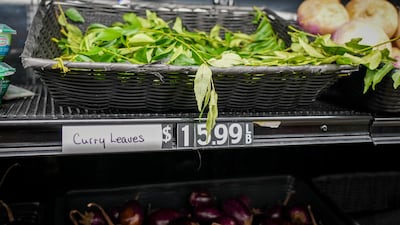
  • Salem's Market carries stock for Pittsburgh's immigrant community
    Salem's Market carries stock for Pittsburgh's immigrant community
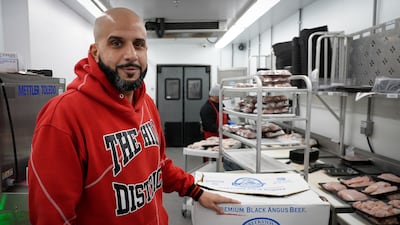
  • Abdullah Salem and his team prepare meat before it is sent to the shelves
    Abdullah Salem and his team prepare meat before it is sent to the shelves
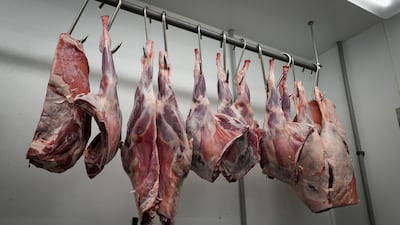
  • Various cuts of meat are hung from the butchery section of Salem's Market
    Various cuts of meat are hung from the butchery section of Salem's Market
  • Abdullah Salem holds up a goat in the butchery section of Salem's Market
    Abdullah Salem holds up a goat in the butchery section of Salem's Market
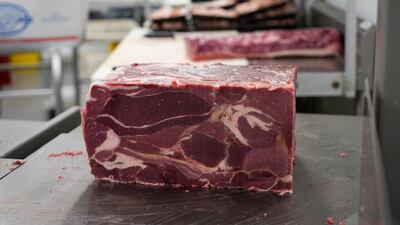
  • A slab of meat is brought out before being sliced for customers
    A slab of meat is brought out before being sliced for customers
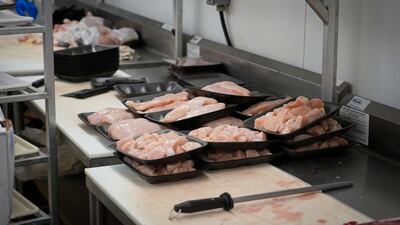
  • Chicken is packaged in a chilled backroom at Salem's Market
    Chicken is packaged in a chilled backroom at Salem's Market
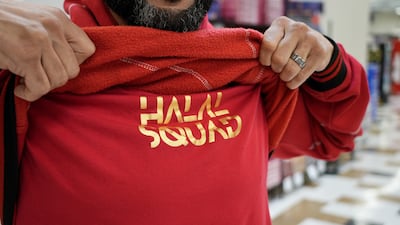
  • Abdullah Salem lifts up his hoodie to reveal a 'Halal Squad' t-shirt underneath
    Abdullah Salem lifts up his hoodie to reveal a 'Halal Squad' t-shirt underneath
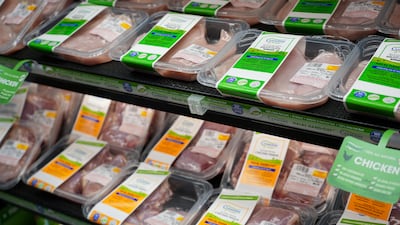
  • Chicken products listed as 'Halal Hand-Cut' are displayed at Salem's Market
    Chicken products listed as 'Halal Hand-Cut' are displayed at Salem's Market
  • Any items that do not pass the halal test are boxed up and donated to local charities
    Any items that do not pass the halal test are boxed up and donated to local charities
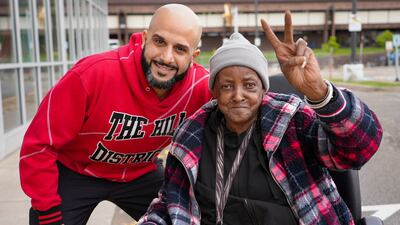
  • Abdullah Salem greets a customer, known only as Sugar, outside Salem's Market in Pittsburgh's Hill District
    Abdullah Salem greets a customer, known only as Sugar, outside Salem's Market in Pittsburgh's Hill District
MATCH INFO

Who: UAE v USA
What: first T20 international
When: Friday, 2pm
Where: ICC Academy in Dubai

Bharatanatyam

A ancient classical dance from the southern Indian state of Tamil Nadu. Intricate footwork and expressions are used to denote spiritual stories and ideas.

Five%20calorie-packed%20Ramadan%20drinks
%3Cp%3E%3Cstrong%3ERooh%20Afza%3C%2Fstrong%3E%0D%3Cbr%3E100ml%20contains%20414%20calories%0D%3Cbr%3E%3Cstrong%3ETang%20orange%20drink%3C%2Fstrong%3E%0D%3Cbr%3E100ml%20serving%20contains%20300%20calories%0D%3Cbr%3E%3Cstrong%3ECarob%20beverage%20mix%3C%2Fstrong%3E%0D%3Cbr%3E100ml%20serving%20contains%20about%20300%20calories%0D%3Cbr%3E%3Cstrong%3EQamar%20Al%20Din%20apricot%20drink%3C%2Fstrong%3E%0D%3Cbr%3E100ml%20saving%20contains%2061%20calories%0D%3Cbr%3E%3Cstrong%3EVimto%20fruit%20squash%3C%2Fstrong%3E%0D%3Cbr%3E100ml%20serving%20contains%2030%20calories%3C%2Fp%3E%0A
How much do leading UAE’s UK curriculum schools charge for Year 6?
  1. Nord Anglia International School (Dubai) – Dh85,032
  2. Kings School Al Barsha (Dubai) – Dh71,905
  3. Brighton College Abu Dhabi - Dh68,560
  4. Jumeirah English Speaking School (Dubai) – Dh59,728
  5. Gems Wellington International School – Dubai Branch – Dh58,488
  6. The British School Al Khubairat (Abu Dhabi) - Dh54,170
  7. Dubai English Speaking School – Dh51,269

*Annual tuition fees covering the 2024/2025 academic year

Mercer, the investment consulting arm of US services company Marsh & McLennan, expects its wealth division to at least double its assets under management (AUM) in the Middle East as wealth in the region continues to grow despite economic headwinds, a company official said.

Mercer Wealth, which globally has $160 billion in AUM, plans to boost its AUM in the region to $2-$3bn in the next 2-3 years from the present $1bn, said Yasir AbuShaban, a Dubai-based principal with Mercer Wealth.

Within the next two to three years, we are looking at reaching $2 to $3 billion as a conservative estimate and we do see an opportunity to do so,” said Mr AbuShaban.

Mercer does not directly make investments, but allocates clients’ money they have discretion to, to professional asset managers. They also provide advice to clients.

“We have buying power. We can negotiate on their (client’s) behalf with asset managers to provide them lower fees than they otherwise would have to get on their own,” he added.

Mercer Wealth’s clients include sovereign wealth funds, family offices, and insurance companies among others.

From its office in Dubai, Mercer also looks after Africa, India and Turkey, where they also see opportunity for growth.

Wealth creation in Middle East and Africa (MEA) grew 8.5 per cent to $8.1 trillion last year from $7.5tn in 2015, higher than last year’s global average of 6 per cent and the second-highest growth in a region after Asia-Pacific which grew 9.9 per cent, according to consultancy Boston Consulting Group (BCG). In the region, where wealth grew just 1.9 per cent in 2015 compared with 2014, a pickup in oil prices has helped in wealth generation.

BCG is forecasting MEA wealth will rise to $12tn by 2021, growing at an annual average of 8 per cent.

Drivers of wealth generation in the region will be split evenly between new wealth creation and growth of performance of existing assets, according to BCG.

Another general trend in the region is clients’ looking for a comprehensive approach to investing, according to Mr AbuShaban.

“Institutional investors or some of the families are seeing a slowdown in the available capital they have to invest and in that sense they are looking at optimizing the way they manage their portfolios and making sure they are not investing haphazardly and different parts of their investment are working together,” said Mr AbuShaban.

Some clients also have a higher appetite for risk, given the low interest-rate environment that does not provide enough yield for some institutional investors. These clients are keen to invest in illiquid assets, such as private equity and infrastructure.

“What we have seen is a desire for higher returns in what has been a low-return environment specifically in various fixed income or bonds,” he said.

“In this environment, we have seen a de facto increase in the risk that clients are taking in things like illiquid investments, private equity investments, infrastructure and private debt, those kind of investments were higher illiquidity results in incrementally higher returns.”

The Abu Dhabi Investment Authority, one of the largest sovereign wealth funds, said in its 2016 report that has gradually increased its exposure in direct private equity and private credit transactions, mainly in Asian markets and especially in China and India. The authority’s private equity department focused on structured equities owing to “their defensive characteristics.”

The%20specs
%3Cp%3E%3Cstrong%3EEngine%3A%3C%2Fstrong%3E%204.0-litre%20twin-turbo%20V8%3Cbr%3E%3Cstrong%3EPower%3A%20%3C%2Fstrong%3E680hp%20at%206%2C000rpm%3Cbr%3E%3Cstrong%3ETorque%3A%20%3C%2Fstrong%3E800Nm%20at%202%2C750-6%2C000rpm%3Cbr%3E%3Cstrong%3ETransmission%3A%20%3C%2Fstrong%3ERear-mounted%20eight-speed%20auto%3Cbr%3E%3Cstrong%3EFuel%20consumption%3A%20%3C%2Fstrong%3E13.6L%2F100km%3Cbr%3E%3Cstrong%3EOn%20sale%3A%3C%2Fstrong%3E%20Orderbook%20open%3B%20deliveries%20start%20end%20of%20year%3Cbr%3E%3Cstrong%3EPrice%3A%20%3C%2Fstrong%3EFrom%20Dh970%2C000%3C%2Fp%3E%0A
Dengue%20fever%20symptoms
%3Cp%3EHigh%20fever%20(40%C2%B0C%2F104%C2%B0F)%3Cbr%3ESevere%20headache%3Cbr%3EPain%20behind%20the%20eyes%3Cbr%3EMuscle%20and%20joint%20pains%3Cbr%3ENausea%3Cbr%3EVomiting%3Cbr%3ESwollen%20glands%3Cbr%3ERash%26nbsp%3B%3C%2Fp%3E%0A
Our legal consultant

Name: Hassan Mohsen Elhais

Position: legal consultant with Al Rowaad Advocates and Legal Consultants

SHOW COURTS ORDER OF PLAY

Centre Court (4pm UAE/12pm GMT)
Victoria Azarenka (BLR) v Heather Watson (GBR)
Rafael Nadal (ESP x4) v Karen Khachanov (RUS x30)
Andy Murray (GBR x1) v Fabio Fognini (ITA x28)

Court 1 (4pm UAE)
Steve Johnson (USA x26) v Marin Cilic (CRO x7)
Johanna Konta (GBR x6) v Maria Sakkari (GRE)
Naomi Osaka (JPN) v Venus Williams (USA x10)

Court 2 (2.30pm UAE)
Aljaz Bedene (GBR) v Gilles Muller (LUX x16)
Peng Shuai (CHN) v Simona Halep (ROM x2)
Jelena Ostapenko (LAT x13) v Camila Giorgi (ITA)
Jo-Wilfried Tsonga (FRA x12) v Sam Querrey (USA x24)

Court 3 (2.30pm UAE)
Kei Nishikori (JPN x9) v Roberto Bautista Agut (ESP x18)
Carina Witthoeft (GER) v Elina Svitolina (UKR x4)

Court 12 (2.30pm UAE)
Dominika Cibulkova (SVK x8) v Ana Konjuh (CRO x27)
Kevin Anderson (RSA) v Ruben Bemelmans (BEL)

Court 18 (2.30pm UAE)
Caroline Garcia (FRA x21) v Madison Brengle (USA)
Benoit Paire (FRA) v Jerzy Janowicz (POL)

How to protect yourself when air quality drops

Install an air filter in your home.

Close your windows and turn on the AC.

Shower or bath after being outside.

Wear a face mask.

Stay indoors when conditions are particularly poor.

If driving, turn your engine off when stationary.

Price, base / as tested From Dh173,775 (base model)
Engine 2.0-litre 4cyl turbo, AWD
Power 249hp at 5,500rpm
Torque 365Nm at 1,300-4,500rpm
Gearbox Nine-speed auto
Fuel economy, combined 7.9L/100km

Benefits of first-time home buyers' scheme
  • Priority access to new homes from participating developers
  • Discounts on sales price of off-plan units
  • Flexible payment plans from developers
  • Mortgages with better interest rates, faster approval times and reduced fees
  • DLD registration fee can be paid through banks or credit cards at zero interest rates
Updated: May 17, 2024, 6:00 PM