


Student protest encampments continued at universities across the US on Friday, while anger grew over reports of police brutality during mass arrests at some schools.
As mass arrests were conducted at institutions including Columbia University, the University of Southern California, the University of Texas at Austin and elsewhere, members of faculty have been denouncing school leadership to demand safety and freedom for students.
“As Faculty for Justice in Palestine, we fully support the strength and clarity of purpose that our students are bringing in asking for disclosure and divestment from weapons of destruction,” a Yale University professor told The National.
“And we do not want a university to be profiting from the death and slaughter of Palestinians in Gaza or anywhere else.”
Colleges and universities have become sites of student protests demanding a ceasefire in the Israel-Gaza war and also that their schools divest from financial connections that support Israel's actions in the occupied Palestinian territories.
Despite more than 45 people being arrested at Yale earlier in the week, a protest encampment still stands on the campus. An anti-war hunger strike also took place, but it recently ended.
“The fact that they are being criminalised and silenced is an ideological stance that the university leadership is taking and we condemn that,” the Yale professor added.
And it is not only US universities that are seeing protest movements: Dozens of students rallied at University College London, with banners calling it “complicit in genocide” and demanding it “divest from death”, while protesters at Paris's Sciences Po university blocked an entrance to the school.
In Berlin, 150 police officers moved to ban a protest camp set up near the German parliament building.
Pro-Palestine protests at US universities – in pictures
-

Activists and students take part in an encampment protest at George Washington University, in Washington. AFP -
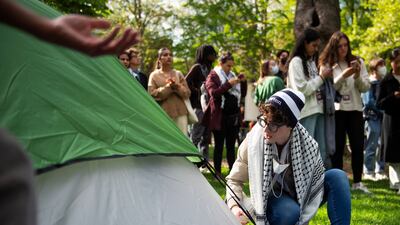
Students and faculty of Drexel University and University of Pennsylvania erect an encapment to protest against the war in Gaza, at the University of Pennsylvania campus, in Philadelphia. AFP -
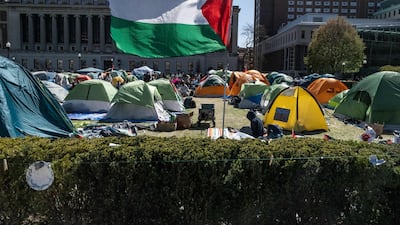
Columbia University students continue their demonstration on campus afterlast week's arrest of more than 100 protesters, in New York City. Getty Images -
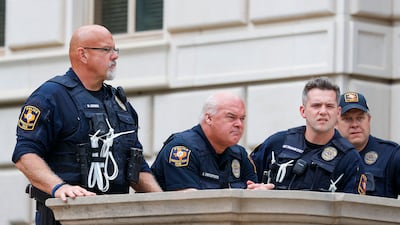
Police watch as students and faculty show support at a Protect Palestine Rally at the University of Texas, in Austin. EPA -
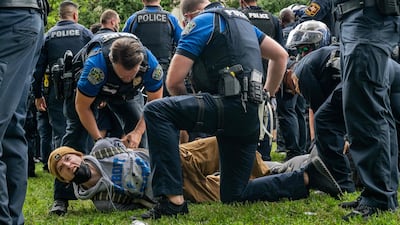
A student is arrested during a pro-Palestine demonstration at the University of Texas at Austin. Getty Images -
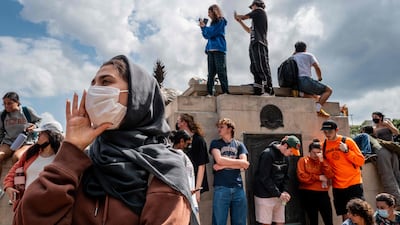
Students rally at the University of Texas at Austin, where police arrested scores of protesters. Getty images -
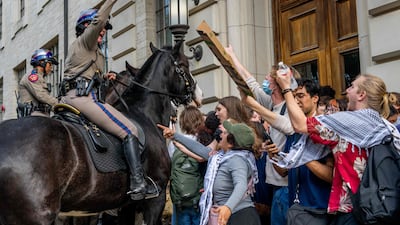
Mounted police confront students protesting against the war in Gaza, at the University of Texas at Austin. Getty Images -
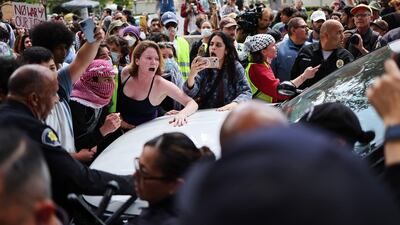
Pro-Palestine demonstrators argue with University of Southern California officials, who attempted to take down an encampment set up in support of Gaza, at the institution in Los Angeles. Getty images -
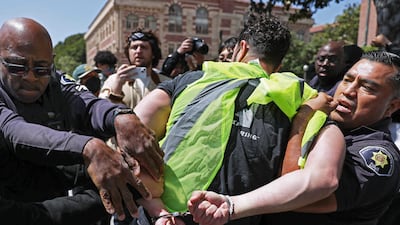
University of Southern California police officers detain a pro-Palestine demonstrator. Getty Images -
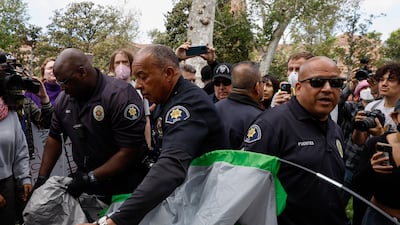
University of Southern California officers dismantle protesters' tents. EPA -
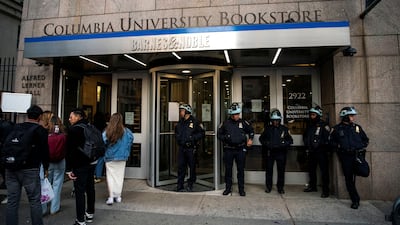
Police stand guard at an entrance to Columbia University, in New York City, where students continue to protest in support of Palestinians, amid the war in Gaza. Reuters -
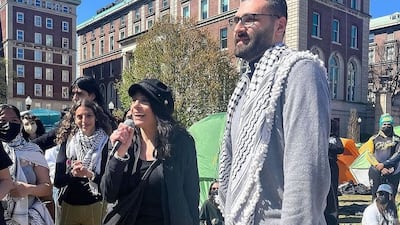
Najla Said, daughter of Palestinian-American academic and literary critic Edward Said, and Motaz Azaiza, a Palestinian photojournalist from Gaza, join the Gaza solidarity encampment at Columbia University. Photo: Columbia Students for Justice in Palestine -
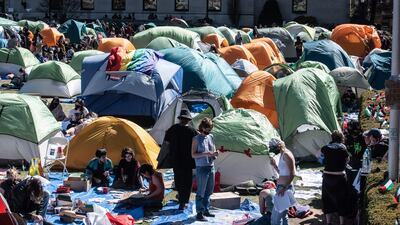
As the campus protests continue, Columbia has moved its classes online. AFP -
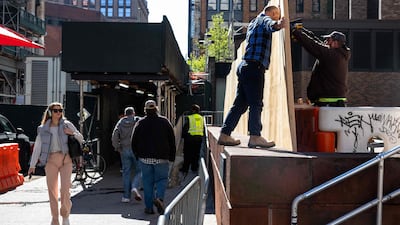
Workers erect a wooden barrier at New York University Stern School of Business after an encampment set up by students was cleared out on Monday night. Getty Images -
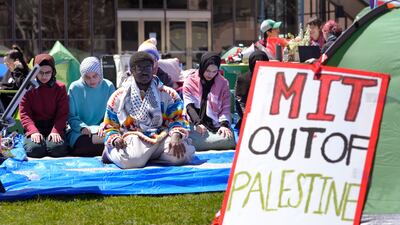
Massachusetts Institute of Technology student Isa Liggans, front left, takes part in Muslim prayer with others, at an encampment of tents at the college, in Cambridge, Massachusetts. AP -
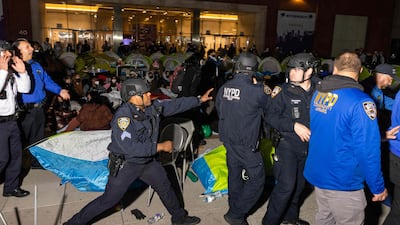
Police officers disperse pro-Palestinian students and protesters who set up an encampment on the campus of New York University. AFP -
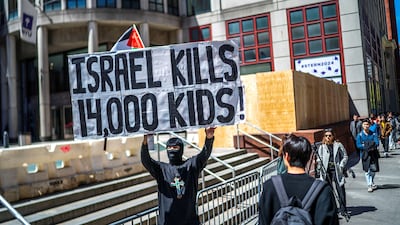
A protester outside New York University. Reuters -
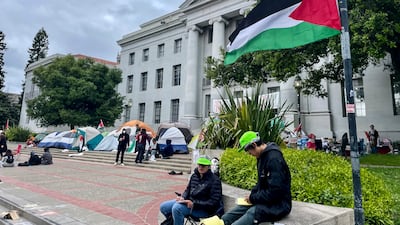
Pro-Palestinian protesters gather in front of Sproul Hall on the campus of the University of California, Berkeley. AP -
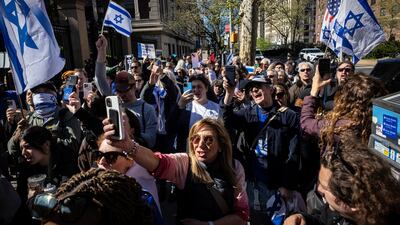
Pro-Israeli demonstrators chant 'shame' after Columbia University assistant professor Shai Davidai was denied access to the main campus. AP -
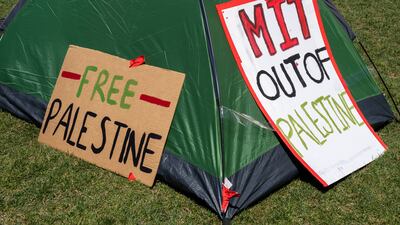
A tent used by pro-Palestinian demonstrators at MIT. Bloomberg -
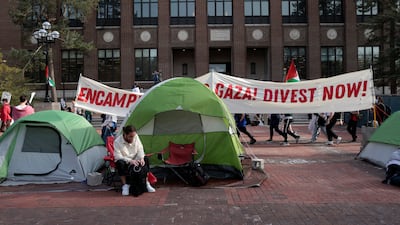
A coalition of University of Michigan students rally to pressure the university to divest its endowment from companies that support Israel. Reuters -
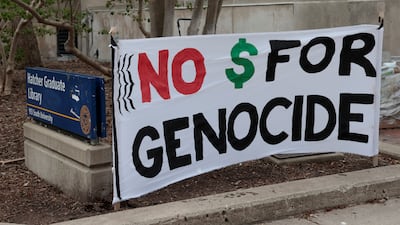
A sign at the University of Michigan. Reuters -
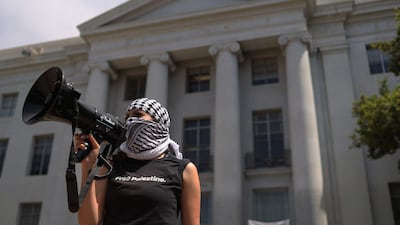
A pro-Palestinian protester in front of Sproul Hall in Berkeley, California. Getty Images / AP -
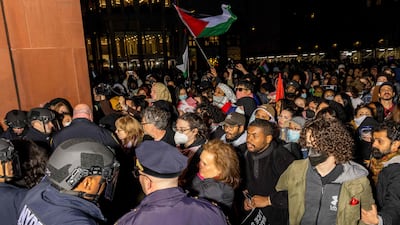
Police officers detain pro-Palestinian students and protesters at New York University. AFP -
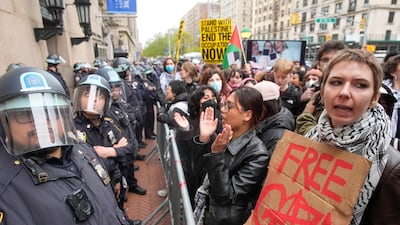
Police in Riot gear stand guard as demonstrators chant slogans outside the Columbia University campus. AP -
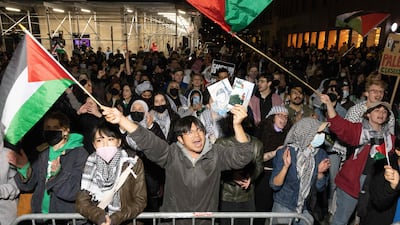
Pro-Palestinian students and activists protest against the Israel-Gaza war on the campus of New York University. AFP


Policing and arrests
While Secretary of State Antony Blinken said the protests were a "hallmark of our democracy", some raised alarm over the police response to the demonstrations.
Ohio State University student newspaper The Lantern confirmed that state troopers had been using “long-range firearms” on a building roof overlooking a pro-Palestine student protest on campus, citing a university representative, after social media photos of the officers inflamed conversation over policing.
Emory University in Georgia was the site of several incidents on Thursday, including the arrest of a number of professors.
Republican Representative Mike Collins of Georgia posted a video compiling instances of police conducting the mass arrests of 28 people at the school.
The video also showed footage of police officers repeatedly using a Taser on a person lying handcuffed on the ground.
“We don't give them time to encamp,” Mr Collins wrote. “Tazers set to stun!”
Noelle McAfee, a department chairwoman at the university, was seen being handcuffed in a viral video, while asking the videographer to tell the philosophy department that she had been arrested.
Ms McAfee later told a local NBC affiliate that she was observing a student being “pummelled” by officers.
“I stood on my campus, I stood to prevent somebody being beaten to death, so that was disorderly conduct,” she said.
A CNN video showed Caroline Fohlin, a tenured economics professor, approaching police officers leaning on to a person on the ground and asking what they were doing.
As she was speaking to the officers, another officer threw her to the ground to handcuff her, while she identified herself as a professor.
The Atlanta-Journal Constitution reported on Friday that Ms Fohlin had been charged with simple battery against a law enforcement officer.
Charges against 57 people at the University of Texas protest were dismissed on Friday, The Austin American-Statesman reported.
Dozens of faculty members sent a letter on Friday to the Yale president, provost and deans to drop all criminal charges against protesters.
Human rights organisations such as the American Civil Liberties Union, Human Rights Watch and others issued warnings and condemnation of university leaders.
The ACLU published an open letter to school presidents arguing that academic freedom and free speech be protected on campuses. It also urged leaders to not “single out particular viewpoints for censorship, discipline, or disproportionate punishment” and that they “protect students from discriminatory harassment and violence”.
“As protests spread to campuses across the country, university administrations should be careful not to mislabel criticism of Israeli government policies or advocacy for Palestinian rights as inherently anti-Semitic or to misuse university authority to quash peaceful protest. Instead, universities should safeguard people’s rights to assembly and free expression,” said Lou Charbonneau, UN director for Human Rights Watch.
The Knight First Amendment Institute at Columbia University condemned American universities resorting to policing in response to the protests.
“The large-scale deployment of armed officers to suppress peaceful protest on college campuses around the country is a shocking development,” executive director Jameel Jaffer said in a statement.
“This response to peaceful protest is an assault on free speech – and it is also deeply reckless.”
-
Activists and students take part in an encampment protest at George Washington University, in Washington. AFP -
Students and faculty of Drexel University and University of Pennsylvania erect an encapment to protest against the war in Gaza, at the University of Pennsylvania campus, in Philadelphia. AFP -
Columbia University students continue their demonstration on campus afterlast week's arrest of more than 100 protesters, in New York City. Getty Images -
Police watch as students and faculty show support at a Protect Palestine Rally at the University of Texas, in Austin. EPA -
A student is arrested during a pro-Palestine demonstration at the University of Texas at Austin. Getty Images -
Students rally at the University of Texas at Austin, where police arrested scores of protesters. Getty images -
Mounted police confront students protesting against the war in Gaza, at the University of Texas at Austin. Getty Images -
Pro-Palestine demonstrators argue with University of Southern California officials, who attempted to take down an encampment set up in support of Gaza, at the institution in Los Angeles. Getty images -
University of Southern California police officers detain a pro-Palestine demonstrator. Getty Images -
University of Southern California officers dismantle protesters' tents. EPA -
Police stand guard at an entrance to Columbia University, in New York City, where students continue to protest in support of Palestinians, amid the war in Gaza. Reuters -
Najla Said, daughter of Palestinian-American academic and literary critic Edward Said, and Motaz Azaiza, a Palestinian photojournalist from Gaza, join the Gaza solidarity encampment at Columbia University. Photo: Columbia Students for Justice in Palestine -
As the campus protests continue, Columbia has moved its classes online. AFP -
Workers erect a wooden barrier at New York University Stern School of Business after an encampment set up by students was cleared out on Monday night. Getty Images -
Massachusetts Institute of Technology student Isa Liggans, front left, takes part in Muslim prayer with others, at an encampment of tents at the college, in Cambridge, Massachusetts. AP -
Police officers disperse pro-Palestinian students and protesters who set up an encampment on the campus of New York University. AFP -
A protester outside New York University. Reuters -
Pro-Palestinian protesters gather in front of Sproul Hall on the campus of the University of California, Berkeley. AP -
Pro-Israeli demonstrators chant 'shame' after Columbia University assistant professor Shai Davidai was denied access to the main campus. AP -
A tent used by pro-Palestinian demonstrators at MIT. Bloomberg -
A coalition of University of Michigan students rally to pressure the university to divest its endowment from companies that support Israel. Reuters -
A sign at the University of Michigan. Reuters -
A pro-Palestinian protester in front of Sproul Hall in Berkeley, California. Getty Images / AP -
Police officers detain pro-Palestinian students and protesters at New York University. AFP -
Police in Riot gear stand guard as demonstrators chant slogans outside the Columbia University campus. AP -
Pro-Palestinian students and activists protest against the Israel-Gaza war on the campus of New York University. AFP

