It has historically been known as the home of the British aristocracy, with its Victorian gentlemen’s clubs and royal palaces.
But away from the gentile pavements of Pall Mall and Jermyn Street, and south of the royal park that bears its name, St James’s has also played its part in industry and innovation.
It has a claim to the first skyscraper in London – a Grade I-listed art deco building above the Tube station, which for years was the headquarters of London Underground.
That building at 55 Broadway is being redeveloped by Blue Orchid Hotels, using the same architects behind The Ned and The Old War Office (OWO), into a luxury 526-bedroom hotel with restaurants, spa and rooftop bars.
It is part of a trio of redevelopments – The Broadway and 102 Petty France the others – within yards of each other, breathing a new lease of life into the area, which is squeezed between the transport hub of Victoria and the political hotbed of Westminster, but often overshadowed by its glamorous neighbour, Mayfair.
-

The Broadway is a new residential project near St James's Park tube station in London. Photo: Jack Hobhouse -

A living space in one of The Broadway's apartments. Photo: Taran Wilkhu -
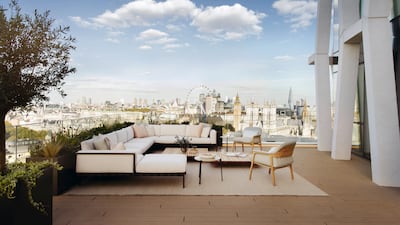
A balcony with a view of the London skyline. Photo: Taran Wilkhu -
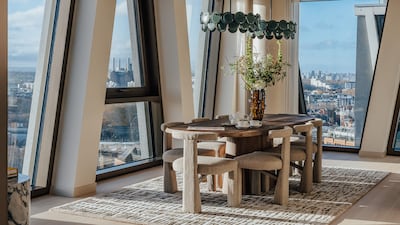
A dining area. Photo: Taran Wilkhu -

A kicthen. Photo: Taran Wilkhu -
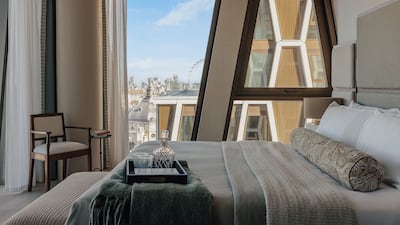
A bedroom. Photo: Taran Wilkhu -

A seating area. Photo: Taran Wilkhu


Value play
According to Becky Fatemi, executive partner at Sotheby’s International Realty UK, a “value play” has allowed the area to regenerate, “providing prime space at a more accessible price per square foot than some of the £4,000 to £5,000 [$5,400 to $6,750] levels seen in the most traditional Prime Central London enclaves”.
Sotheby's International Realty
It has meant buyers could stay “properly central” without paying Mayfair premiums. “It’s central, it’s connected, and it now feels confidently residential,” she told The National.
It is also due for an injection of spark with the arrival of Formula One, after this month announcement it was relocating its headquarters to 40 Broadway. This was built speculatively by Tellon Capital, which said it “reinforces that offices continue to play a key role for businesses today”.
Only a few yards away at 102 Petty France, a 14-storey, brutalist office building, most recently home to the Ministry of Justice, was bought in late 2025 by the Arora Group. Its redevelopment plans are yet to be disclosed, but the group has said it is “committed to maximising the potential of this prestigious location” and intends to transform the property into a “dynamic and world-class asset”.
Completing the triumvirate is The Broadway, a 1 million sq ft, 19-storey luxury residential and commercial complex on the site of New Scotland Yard, the headquarters of the Metropolitan Police since the 1960s. It features 258 apartments ranging in price from £1.64 million to more than £25 million.
Dubai-backed prime developer Northacre acquired the site for £370 million and demolished the old building to make way for The Broadway, before its decision to step away from London and focus on the UAE and wider Gulf region.
Jewel in the crown
The new asset manager of the project, six diamond-themed towers designed by architects Squire & Partners, is now prime developer Valouran, which recently secured financial services firms Partners Capital and Capital.com as tenants. It is marketing the remaining apartments as for sale, including an £18.5 million five-bedroom apartment with what must be one of the most impressive views in London. As well as the Palaces of Westminster, the owner will be able to see into the courtyard of Buckingham Place, across Green Park to Hyde Park Corner and Mayfair, or in the other direction an open stretch across the south of the city.
Alex Michelin, founder and chief executive of Valouran, told The National: "St James's Park has experienced a real renaissance over the past decade, driven by a series of neighbourhood-defining developments that have introduced new offices, retail, restaurants and improved public spaces. Alongside this commercial evolution, high-quality residential schemes have emerged and together these projects have reshaped St James's Park into a highly desirable residential enclave."

According to research by JLL real estate services, St James's Park has established itself as one of central London's highest-performing residential markets.
Average apartment prices in the area have surged 142 per cent over the past 20 years, outperforming both Westminster at 126.1 per cent and Greater London at 104.9 per cent. Growth is expected to continue, with a further 14.7 per cent rise forecast between 2025 and 2029. Lettings mirror this momentum, with average rents having risen by 35 per cent in the past five years, and JLL forecasting a further rental increase of 18.8 per cent between 2025 and 2029.
It said this “robust market performance positions St James’s Park as a good-value proposition compared to neighbouring Belgravia and Mayfair, while also representing a secure long-term investment opportunity”.
Mayfair rival
Will Watson, head of The Buying Solution, agrees. "St James’s shares many of the advantages of Mayfair, with its central position, excellent transport connections and close proximity to the West End, yet it often feels more intimate and authentically London,” he said.
“Residents value the blend of quieter streets and historic charm that can be harder to find in busier prime areas. We have seen consistent demand from international purchasers seeking a more discreet, character-led address.”

He points out that in terms of pricing, St James’s has historically offered better relative value. “Best-in-class apartments in the new-prime developments such as the OWO have been trading at circa £4,000 sq ft compared with £6,000-plus sq ft for a prime Mayfair development,” he said. “Trophy townhouses can still command £15 million to £30-plus million depending on scale and outlook, but remain competitively priced versus equivalent Mayfair stock. As with any good property in a prime address, the question buyers ask is how repeatable is that property? ... and this is what will determine the premium needed to be paid.”

Charles Leigh, sales director at Valouran, said buyers understand the “uniqueness of the St James’s Park setting and the supporting data on capital appreciation and rental growth speaks for itself”.
Ms Fatemi said the transformation of neighbouring Victoria changed the surrounding area completely.
“St James’s has had a genuine glow-up, and much of that story is tied to the revitalisation of Victoria,” she said. “For years, Victoria was somewhere you passed through rather than somewhere you chose to live. It was offices, transport hubs and government buildings. Functional, yes. Exciting, not particularly.
“With the arrival of schemes such as The Nova and The Broadway developments, the area shifted from being purely commercial to a genuinely mixed residential and commercial neighbourhood. Suddenly there were proper restaurants, curated retail, landscaped public realm and buildings designed for how people want to live now, not just work. That evolution gave St James’s and the wider SW1 pocket a new energy.”
What they proved, she said, is that you can take historically overlooked sites and reposition them into sophisticated residential addresses with amenities, security and services that rival the best of prime central London. "And all of this sits moments from Westminster, which brings a level of gravitas and security that many international buyers really value.”