
The Palestinian embassy marked its official opening in London on Monday, months after the UK recognised Palestine in a historic decision in September.
Ambassador Dr Husam Zomlot unveiled the embassy’s official plaque, marking the completion of official and protocol arrangements between the two states.
The premises in Hammersmith, west London, has served as Palestinian diplomatic headquarters for more than 30 years, but the upgrade from a mission to an embassy confirms its full diplomatic status in the UK.
Obeida, 14, who was evacuated from Gaza for medical treatment to the UK, spoke at the inauguration of his survivor's guilt.

“Every day I think of the thousands of children still trapped: they're injured, struggling to survive, some without hope, many forever changed,” he said.
“I feel guilty that I am here receiving a treatment, when so many still suffer in Gaza,” he said.
He said the Palestinian embassy held tremendous significance for Palestinians in the UK, as a place where “our people are seen, where our voices are heard, and where our hope for justice and dignity lives”.
Dr Zomlot described the event as a “day of hope”, as he thanked those in attendance.
“This is a day of hope, a day of steadfastness, and a day that reminds the world that peace is not only possible, it is inevitable, when rooted in justice, dignity, and equality,” he said.
-
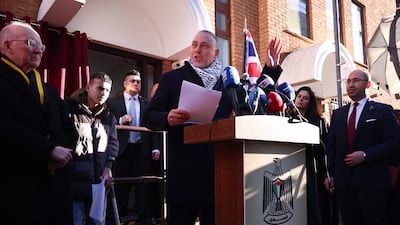
Husam Zomlot, Palestinian ambassador to the UK, delivers a speech during the opening ceremony of the Palestinian embassy in London. EPA -
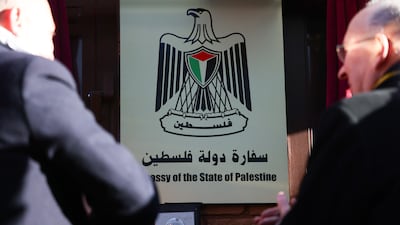
The plaque at the entrance to the embassy is unveiled. EPA -

People take a photo with the embassy sign in the background. PA -

Obeida, 14, a refugee from Gaza, speaks at the ceremony. PA -
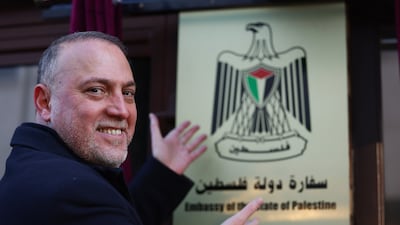
Mr Zomlot poses at the entrance to the new embassy. EPA


He said the inauguration was recognition of the Palestinian people’s inalienable right to sovereign statehood and equality among nations, adding that it was the outcome of a 100-year struggle.
“This embassy represents proof that our identity cannot be denied, our presence cannot be erased and our lives cannot be devalued,” said Dr Zomlot.
“For a people denied self-determination for over a century, this is a monumental moment. Today, the Palestinian community in Britain has a home from home − a piece of Palestine on British soil.”
Dr Ishaq Abu Arafeh, a prominent British Palestinian paediatric neurosurgeon, recalled that Palestinians had little representation when he first came to the UK 40 years ago.
“If you said I'm from Palestine, people would look at you as if you are an alien. We had to explain what Palestine is, what the Palestinians are, and sometimes people preferred to call you Jordanian, Lebanese or an Israeli,” he told The National.
“Now we can walk and hold our heads high, and speak freely,” he said.

The recognition was a moment similar in weight to the Balfour Declaration of 1917, a British colonial agreement that carved out territory for a Jewish state to be established, he said. Israel was created 31 years later.
But there was a still long road to justice and the creation of a Palestinian state, added Dr Abu Arafeh.
“I hope it won't take that long for the state of Palestine to be established,” he said.

