A UAV is flown by a soldier as the British Army demonstrate the latest and future technology. Getty Images

Massed drones ‘can cover for UK weapons shortfall’


Thomas Harding
  • English
  • Arabic

With time frames shortening on the prospect of conflict spreading in Europe, a high profile former minister has called for massed ranks of drones to be built for the British military to preserve combatants’ lives and make up for a shortfall in weapons.

James Cartlidge, the UK’s shadow defence secretary, told The National that greater use should be made of lasers to shoot down unmanned aerial vehicles (UAVs) and low-grade missiles such as those used by the Houthis in their attacks on Red Sea shipping.

The former minister for defence procurement also suggested that the technology and expertise from non-military companies should be harnessed to rapidly develop battle-winning weapons.

Mass attack

Following the “astonishing” UAV advances in Ukraine, Mr Cartlidge ordered a defence drone strategy during his year at the UK’s Ministry of Defence.

He said that several drones “gives you absolute terms of mass because of swarming” as well as the ability to produce them “relatively quickly and cheaply”.

Servicemen of Ukraine's 'Achilles' Battalion launch a Vampire hexacopter drone. AFP

It also had the benefit of “boosting the lethality and survivability of the existing people and capabilities that you've got”.

While western militaries could not disregard conventional weapons such as tanks, aircraft and warships “the uncrewed sphere offers a chance to really deliver a form of mass”, he argued.

While traditional fighting will continue – as proved by Ukraine’s grim trench warfare – there will also be “an extremely contested air domain” with both fighters and drones battling for superiority.

UK minister of State (Minister for Defence Procurement) James Cartlidge arrives to attend the European Air Defence Conference with 18 foreign counterparts, at Les Invalides in Paris on June 19, 2023. (Photo by Geoffroy VAN DER HASSELT / AFP)

Ukraine had also demonstrated the importance of electronic warfare – with the Russians able to jam sophisticated US-made artillery rounds – as well as space with Kyiv’s defence highly dependent on Elon Musk’s Starlink satellite system.

Another motivation was that the war demonstrated after years of cuts and fighting counter-insurgency wars in Iraq and Afghanistan, the British ranks had thinned. “We'd lost mass, no question about it,” he said.

Star Wars reality

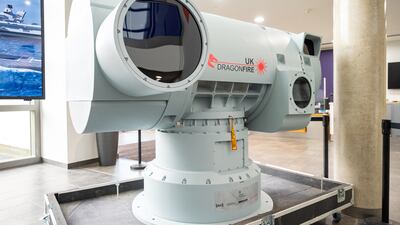
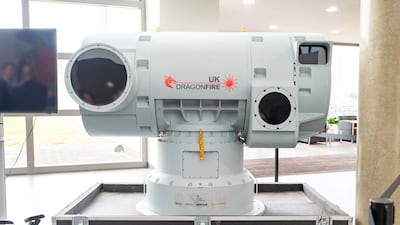
  • The DragonFire British military laser weapon system could be used on the frontline in Ukraine to take down Russian drones. All photos: PA Wire
    The DragonFire British military laser weapon system could be used on the frontline in Ukraine to take down Russian drones. All photos: PA Wire
  • UK Defence Secretary Grant Shapps has suggested the weapon may be rushed into production
    UK Defence Secretary Grant Shapps has suggested the weapon may be rushed into production
  • The UK is pushing for the DragonFire weapon to be ready for posting by 2027
    The UK is pushing for the DragonFire weapon to be ready for posting by 2027
  • That would have 'huge ramifications' for the conflict in Europe, Mr Shapps said
    That would have 'huge ramifications' for the conflict in Europe, Mr Shapps said
  • The laser was originally expected to be rolled out in 2032
    The laser was originally expected to be rolled out in 2032
  • But, it will now be operational five years earlier than planned
    But, it will now be operational five years earlier than planned

The science fiction of Star Wars is soon to become a reality on the battlefield with laser warfare introduced at scale, with the former minster pushing hard for the new technology.

With Israel expecting to field its new “Iron Beam” laser system which can shoot down incoming missiles next year, in two years British destroyers should have the similar “Dragon Fire” capability.

“I massively accelerated the Dragon Fire procurement that gives you the potential ability to intercept drones and conserve your air defence missile stocks in the process,” said Mr Cartlidge, 50, speaking at his office in parliament.

Palestinian protesters use lasers against the Israeli settlers in the occupied West Bank. AFP

He ordered the rapid introduction as the prospect of the Houthis “getting hold of ballistic missiles from Iran and firing them at our ships” was a “clear and present danger”.

On land, Britain has also demonstrated it is moving fast after its first successful test last month of a vehicle-mounted laser.

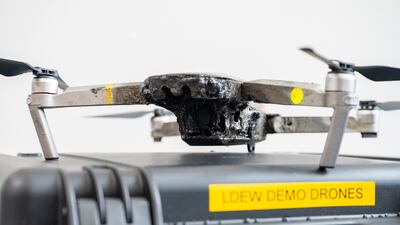
The as yet unnamed system, mounted on a Wolfhound armoured vehicle, used a high energy beam to destroy all drone targets it locked on to during a test in Wales, the Ministry of Defence (MoD) said.

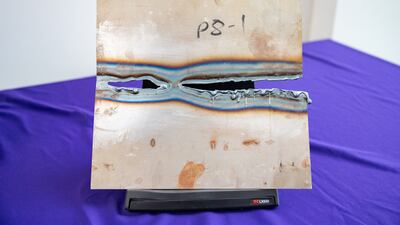
The weapon works by directing a sensor-guided beam of intense infrared light at its target. The MoD said laser weapons could be a cost-effective alternative to some current weaponry because they are “virtually limitless” in terms of ammunition supply.

Tech bros to war

Like Ukraine, Britain is now turning towards sophisticated start-ups to develop new, imaginative ways of fighting.

“You need to have this very strong relationship between your defence industry and not just defence SMEs (Small Medium Enterprise) but companies who have portable dual-use, tech but not necessarily the military application,” he said.

Defence needed to move into the “science space” so that it could “develop cutting edge capability that can be quickly developed into the battlefield”.

Russian serviceman operating FPV drones towards Ukrainian positions. EPA

Those smaller companies could also help bolster the defence industrial base which in Europe the Ukraine war has proven to be lacking.

“Ultimately it becomes a war of logistics and industrial production,” he said. “We have got to outproduce our adversaries.”

But this needed Europe to be united to “pull together, increase spending and raise industrial production”.

Mass drones could soon arrive after Britain has committed to raising its defence spending to 2.5 per cent of GDP in a timeline to be announced this year.

“The more war-ready you are, in deterrent terms, your adversary sees that you are stepping up, and in absolute terms, you have the production,” said Mr Cartlidge. “You need to maintain a degree of war readiness, which we had assumed was no longer necessary.”

Europe and Nato will also remain dependent on US military power, but the politician did not think US President Donald Trump would withdraw support.

“I've seen nothing so far from Trump to suggest he's going to be anything other than a very strong ally of European Nato, as the US, always has been,” he said.


KINGDOM%20OF%20THE%20PLANET%20OF%20THE%20APES
%3Cp%3E%3Cstrong%3EDirector%3A%3C%2Fstrong%3E%20Wes%20Ball%3C%2Fp%3E%0A%3Cp%3E%3Cstrong%3EStarring%3A%3C%2Fstrong%3E%20Owen%20Teague%2C%20Freya%20Allen%2C%20Kevin%20Durand%3C%2Fp%3E%0A%3Cp%3E%3Cstrong%3ERating%3A%20%3C%2Fstrong%3E3.5%2F5%3C%2Fp%3E%0A
Ten tax points to be aware of in 2026

1. Domestic VAT refund amendments: request your refund within five years

If a business does not apply for the refund on time, they lose their credit.

2. E-invoicing in the UAE

Businesses should continue preparing for the implementation of e-invoicing in the UAE, with 2026 a preparation and transition period ahead of phased mandatory adoption. 

3. More tax audits

Tax authorities are increasingly using data already available across multiple filings to identify audit risks. 

4. More beneficial VAT and excise tax penalty regime

Tax disputes are expected to become more frequent and more structured, with clearer administrative objection and appeal processes. The UAE has adopted a new penalty regime for VAT and excise disputes, which now mirrors the penalty regime for corporate tax.

5. Greater emphasis on statutory audit

There is a greater need for the accuracy of financial statements. The International Financial Reporting Standards standards need to be strictly adhered to and, as a result, the quality of the audits will need to increase.

6. Further transfer pricing enforcement

Transfer pricing enforcement, which refers to the practice of establishing prices for internal transactions between related entities, is expected to broaden in scope. The UAE will shortly open the possibility to negotiate advance pricing agreements, or essentially rulings for transfer pricing purposes. 

7. Limited time periods for audits

Recent amendments also introduce a default five-year limitation period for tax audits and assessments, subject to specific statutory exceptions. While the standard audit and assessment period is five years, this may be extended to up to 15 years in cases involving fraud or tax evasion. 

8. Pillar 2 implementation 

Many multinational groups will begin to feel the practical effect of the Domestic Minimum Top-Up Tax (DMTT), the UAE's implementation of the OECD’s global minimum tax under Pillar 2. While the rules apply for financial years starting on or after January 1, 2025, it is 2026 that marks the transition to an operational phase.

9. Reduced compliance obligations for imported goods and services

Businesses that apply the reverse-charge mechanism for VAT purposes in the UAE may benefit from reduced compliance obligations. 

10. Substance and CbC reporting focus

Tax authorities are expected to continue strengthening the enforcement of economic substance and Country-by-Country (CbC) reporting frameworks. In the UAE, these regimes are increasingly being used as risk-assessment tools, providing tax authorities with a comprehensive view of multinational groups’ global footprints and enabling them to assess whether profits are aligned with real economic activity. 

Contributed by Thomas Vanhee and Hend Rashwan, Aurifer

The Buckingham Murders

Starring: Kareena Kapoor Khan, Ash Tandon, Prabhleen Sandhu

Director: Hansal Mehta

Rating: 4 / 5

The UN General Assembly President in quotes:

YEMEN: “The developments we have seen are promising. We really hope that the parties are going to respect the agreed ceasefire. I think that the sense of really having the political will to have a peace process is vital. There is a little bit of hope and the role that the UN has played is very important.”

PALESTINE: “There is no easy fix. We need to find the political will and comply with the resolutions that we have agreed upon.”

OMAN: “It is a very important country in our system. They have a very important role to play in terms of the balance and peace process of that particular part of the world, in that their position is neutral. That is why it is very important to have a dialogue with the Omani authorities.”

REFORM OF THE SECURITY COUNCIL: “This is complicated and it requires time. It is dependent on the effort that members want to put into the process. It is a process that has been going on for 25 years. That process is slow but the issue is huge. I really hope we will see some progress during my tenure.”

Updated: January 23, 2025, 2:53 PM