

Ahmed Mukhtar remembers being different from other children growing up in Baghdad.
Every afternoon, TV programmes in Iraq would begin the same way, at 4pm on the dot, with the melodious sound of the oud. For many children the music was little more than a signal that they would soon be watching one of their favourite shows. But for the then six-year-old Mr Mukhtar, the oud – a pear-shaped stringed instrument similar to a guitar – was the main attraction.
“I loved the oud from the first time I saw it on the TV and heard it,” said Mr Mukhtar, who left Iraq in 1996 to study in the UK. He applied for asylum and stayed, building a life in London, where he teaches oud and Arabic percussion.
“Other children didn’t care about the oud. They liked Mickey Mouse. They would see the oud music was playing and they would say ‘oh it’s the music' and come back. I came to listen to the oud and after that I continued watching,” he told The National.
Mr Mukhtar soon began to learn the instrument, and as a child was once made to perform in front of Saddam Hussein, who had a soft spot for the traditional Arab instrument.

Mr Mukhtar went on to master it, and with that expertise came an expectation to play regularly for the Iraqi leader – an obligation he had no intention of fulfilling. “The situation was horrible. There was no freedom. They used the music for the purpose and target of the dictatorship, to play for them.”
If you did not do that “you faced a lot of problems” and could not play the oud where you liked, he said. “You were not a free person,” added Mr Mukhtar. “I found the opportunity to escape so I left.”
He had read about London and sights such as Big Ben, before he came. “I had a nice picture of London,” he said. He quickly settled in and was happy, receiving support to study English, which he can now speak fluently, and to attend university.
Making and playing the oud – in pictures
-

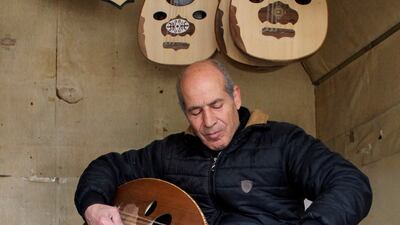
The Syrian oud has been recognised on Unesco's Intangible Cultural Heritage of Humanity list. All photos: Reuters -
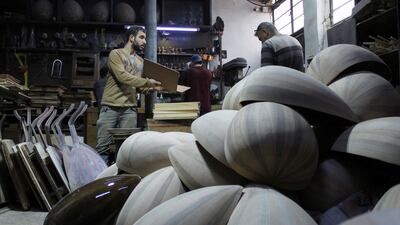
The instrument is known for its pure notes and unique, harmonious sounds. -
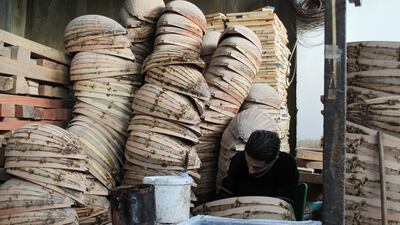
The oud industry was severely impacted by the Syrian war and the economic crisis in the years that followed, with demand for the musical instruments on the decline. -
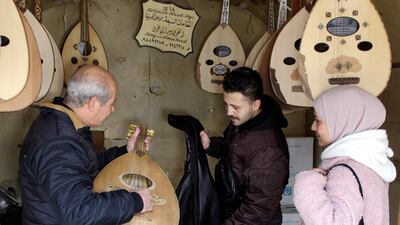
A significant price increase due to expensive raw materials was also keeping customers at bay. -
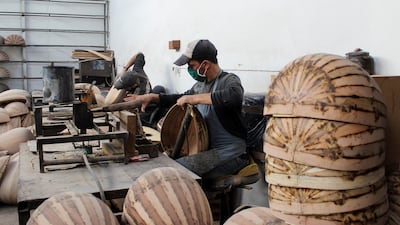
By listing the oud on Unesco's intangible list, the Syrian Development Trust will work together with the international organisation to support craftsmen in promoting and selling their products in order to preserve the industry. -
Iran's 'crafting and playing of the oud' is also included on the same list


“I found a lot of nice things [in the UK]. I liked it. I could live my life and do my favourite things,” he said. These included the oud, which he continued to study as part of a master’s degree in Middle Eastern Music at Soas – the School of Oriental and African Studies. He also studied performance and teaching.
The instrument was first found in Babylon, in ancient Iraq, around 5,000 years ago. Legend has it that it was made from the bones of Lamak, the sixth grandson of Adam. Playing the oud involves improvisation, matching its more than 25 scales to the mood of the occasion.
Mr Mukhtar is now an oud master, but he still spends much of his spare time practising, when he is not teaching others to play for Soas at the Arab British Centre. “You need to study and practise continually. I now do two hours a day but before I did more than this,” he said.
Mr Mukhtar composes title and documentary music and is working on his seventh album. He also performs all over the world.

“In the UK I have been to a lot of cities, from Edinburgh to Cardiff, to many places. And I travelled around Europe as well,” he said. “In some countries I have performed five or six times, like Holland, France and Spain. I have also performed in India and Thailand.”
Many of his students are Arab, but not all. He has some English students. “The oud helps me be in touch with many people who love Arab culture. They love Iraq and the heritage,” he said.
It also helps him stay spiritually connected to his homeland, a place he still visits. “When I play my emotions go to the area of Iraq and sometimes the places of Iraq,” he said.

