


Britain's new government launched its flagship energy policy with a royal twist on Thursday, as it announced plans to increase the number of wind farms on crown lands.
Prime Minister Keir Starmer said the new state-owned company Great British Energy will team up with the Crown Estate, a £15.5 billion ($20 billion) portfolio of land owned by King Charles III.
The estate includes large stretches of the UK's coastline, where Labour plans to place more offshore wind turbines in a sprint for clean power by 2030.
Although the wind farms are part of Labour's net-zero plans, ministers are stressing the economic rather than climate benefits after a punishing cost-of-living crisis in Britain.

Energy Secretary Ed Miliband said Britain's exposure to fossil fuels, notably the Russian-influenced gas market in Europe, was to blame for the cost-of-living problems.
"Every solar panel we put up, every offshore wind turbine we build, gives us greater energy security," Mr Miliband said.
"It’s the new case for clean energy action. We knew about the climate case but this is the energy security case and that’s the case we’re making."
Offshore wind farms already exist on seabed leased out by the Crown Estate, helping it make £1.1 billion last year in profits that go to the Treasury.
-
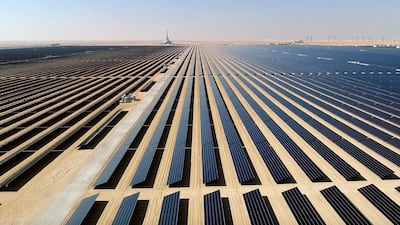
The Mohammed bin Rashid Al Maktoum Solar Park is located about 50 kilometres south of Dubai. AP -
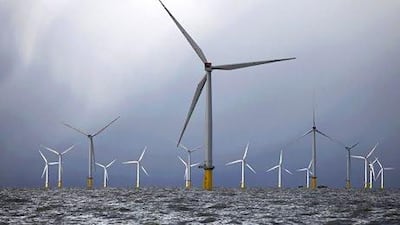
Masdar, the Abu Dhabi clean energy company, owns a one-fifth stake in London Array, the offshore wind farm in the Thames estuary. Chris Ratcliffe / Bloomberg News -

A hydro plant in Himachal Pradesh, India. Photo: Abu Dhabi National Energy Company (TAQA) -
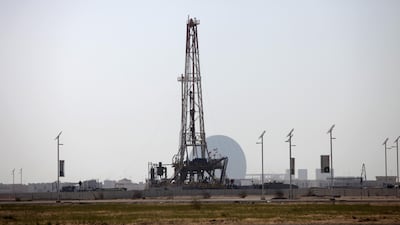
The Geothermal Pilot Project drills 4km beneath Masdar City in search of boiling temperatures to generate electricity and fuel the city's cooling system. Nicole Hill /The National -
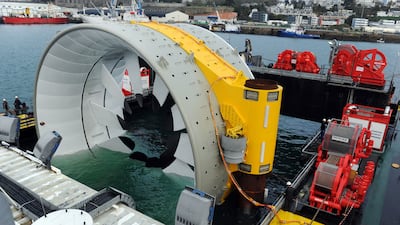
A hydroelectric motor at a tidal farm in the harbour of Brest, in western France. AFP


However, Labour says the estate will get new investment and borrowing powers in a bid to more than double offshore wind developments by 2030.
The estate is owned by King Charles in his formal capacity as monarch, meaning it is not his private property like the Sandringham and Balmoral estates are.

Part of the Crown Estate's profit is returned to the monarch to cover their expenses, in an arrangement known as the Sovereign Grant.
King Charles, a lifelong environmentalist, last year said any profits on Crown Estate wind farms should be directed to the "wider public good".
Labour said new laws to give Great British Energy and the Crown Estate the necessary powers would be introduced in Parliament on Thursday.
"This innovative partnership between Great British Energy and the Crown Estate is an important step towards our mission for clean energy by 2030 and bringing down energy bills for good," Mr Starmer said.
"This agreement will drive up to £60 billion in investment into the sector, turbocharging our country towards energy security, the next generation of skilled jobs, and lowering bills for families and business."
What will Great British Energy do?
Great British Energy is being set up in Scotland as a company that invests in clean energy projects and maintains a public stake but does not supply electricity directly to customers.
The company's initial focus is on offshore wind, which provided about 17 per cent of the UK's electricity in 2023, Crown Estate figures show.
However, there are also plans for the state-owned company to invest in carbon capture and storage, hydrogen, wave and tidal energy.

Having ruled out major tax rises, ministers hope £8.3 billion of public money going to Great British Energy will help bring in more than £50 billion in further private investment.
Setting up the company was a Labour manifesto pledge and a key plank of one of its five so-called missions in government, to make the UK a "clean energy superpower".
Mr Miliband has separately relaxed rules on building onshore wind and approved new solar farms opposed by Conservative MPs.
Sceptics of Labour's energy policy have also criticised its plans to grant no more oil and gas drilling licences in the North Sea.
"That will increase energy prices and make us more dependent on potentially unreliable foreign gas imports," Conservative shadow minister Chris Philp said.

