Ancient Egyptians may have tried to treat cancer with surgery, according to a new study that has uncovered the earliest known evidence of a procedure for the disease.
Texts dating back thousands of years describe ancient Egyptians’ advanced knowledge of medicine, including identifying and treating numerous diseases and traumatic injuries, using prostheses and dental fillings.
But it was not believed that they knew how to treat cancer, until now.
Studying ancient skulls, scientists discovered cut marks around cancerous lesions – appearing to provide evidence of experimental treatments or medical explorations of the disease.
Was it a treatment or a postmortem intervention? We cannot tell, but clearly, they were trying to deal with it
Prof Edgard Camaros,
University of Santiago de Compostela
Lead author Prof Edgard Camaros from the University of Santiago de Compostela, in Spain, told The National that the team’s research “changes our understanding of the history of medicine”.
“This is the earliest known, at least for the moment, surgical procedure related to a cancerous tumour,” he said.
“Was it a treatment or a postmortem intervention? We cannot tell, but clearly they were trying to deal with it.”
Researchers made the discovery as part of efforts to understand more about the role of cancer in the past and how prevalent it was in ancient societies.
They studied two Egyptian skulls in the University of Cambridge’s Duckworth Collection. One, from between 2687 and 2345BC, belonged to a male aged 30 to 35. The other, from between 663 and 343BC, belonged to a female who was older than 50 years.
The man’s skull showed evidence of a large lesion consistent with excessive tissue destruction, a condition known as neoplasm. There were also 30 or so small and round metastasised lesions scattered across the skull, with cut marks, which appeared to be from surgery.
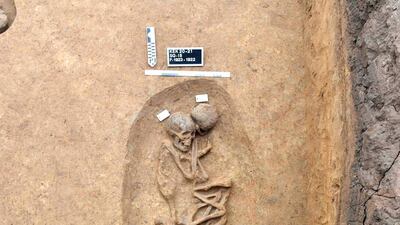
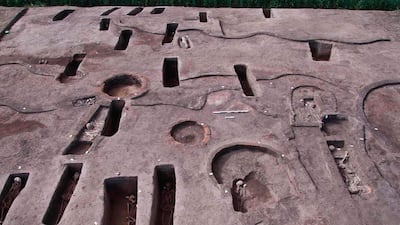
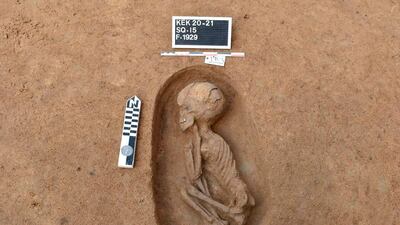
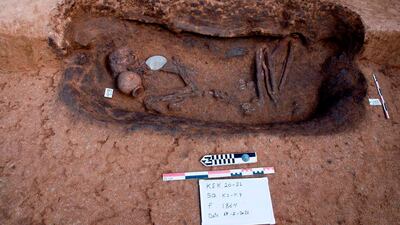
Egypt archaeologists unearth 110 ancient tombs in Nile Delta – in pictures
“This evidences a surgical intervention directly related to cancerous tumours that show that they were somehow trying to understand oncological conditions,” said Prof Camaros.
“Similar techniques were used (and sometimes still used) related to oncological surgical intervention. However, successful cancer treatment is a milestone of recent modern medicine,” he added.
The second skull, belonging to the woman, had a large lesion consistent with a cancerous tumour that destroyed the bone. The researchers said that may indicate cancer was common in the past.
It also showed two healed lesions from past traumatic injuries, one of which appeared to have been caused by a sharp weapon. The researchers say that may suggest the woman received some kind of treatment and survived as a result. Wounds were uncommon in women, with most violence-related injuries found in males.
“Was this female individual involved in any kind of warfare activities?” said Tatiana Tondini, a researcher at the University of Tubingen and first author of the study, published in Frontiers in Medicine.
“If so, we must rethink the role of women in the past and how they took an active part in conflicts during antiquity.”
According to the Cancer History Project, ancient Egyptians knew and understood cancer.
The first earliest written observation of cancer was found in a papyrus dating from about 3000 to 2500BC. It detailed case studies of several breast tumours, with accounts “astonishingly akin to descriptive data that a modern physician might summarise in their clinical text today”.
Treatments described in the papyrus were, however, very different to modern techniques, including “binding the tumour with fresh meat (potentially for haemostasis) on the first day, followed by application of grease, honey, and lint every day (potentially as an ointment) until the patient recovers”.
“The ancient physicians also used astringent to dry the wounds in the tumour. However, an interesting case is a bulging tumour with swellings spread over the breast and cool to the touch, for which the physician does not prescribe any treatment, possibly because this was an untreatable tumour at that time,” it said.

FROM%20THE%20ASHES
%3Cp%3EDirector%3A%20Khalid%20Fahad%3C%2Fp%3E%0A%3Cp%3EStarring%3A%20Shaima%20Al%20Tayeb%2C%20Wafa%20Muhamad%2C%20Hamss%20Bandar%3C%2Fp%3E%0A%3Cp%3ERating%3A%203%2F5%3C%2Fp%3E%0A
Which honey takes your fancy?
Al Ghaf Honey
The Al Ghaf tree is a local desert tree which bears the harsh summers with drought and high temperatures. From the rich flowers, bees that pollinate this tree can produce delicious red colour honey in June and July each year
Sidr Honey
The Sidr tree is an evergreen tree with long and strong forked branches. The blossom from this tree is called Yabyab, which provides rich food for bees to produce honey in October and November. This honey is the most expensive, but tastiest
Samar Honey
The Samar tree trunk, leaves and blossom contains Barm which is the secret of healing. You can enjoy the best types of honey from this tree every year in May and June. It is an historical witness to the life of the Emirati nation which represents the harsh desert and mountain environments
Mercer, the investment consulting arm of US services company Marsh & McLennan, expects its wealth division to at least double its assets under management (AUM) in the Middle East as wealth in the region continues to grow despite economic headwinds, a company official said.
Mercer Wealth, which globally has $160 billion in AUM, plans to boost its AUM in the region to $2-$3bn in the next 2-3 years from the present $1bn, said Yasir AbuShaban, a Dubai-based principal with Mercer Wealth.
“Within the next two to three years, we are looking at reaching $2 to $3 billion as a conservative estimate and we do see an opportunity to do so,” said Mr AbuShaban.
Mercer does not directly make investments, but allocates clients’ money they have discretion to, to professional asset managers. They also provide advice to clients.
“We have buying power. We can negotiate on their (client’s) behalf with asset managers to provide them lower fees than they otherwise would have to get on their own,” he added.
Mercer Wealth’s clients include sovereign wealth funds, family offices, and insurance companies among others.
From its office in Dubai, Mercer also looks after Africa, India and Turkey, where they also see opportunity for growth.
Wealth creation in Middle East and Africa (MEA) grew 8.5 per cent to $8.1 trillion last year from $7.5tn in 2015, higher than last year’s global average of 6 per cent and the second-highest growth in a region after Asia-Pacific which grew 9.9 per cent, according to consultancy Boston Consulting Group (BCG). In the region, where wealth grew just 1.9 per cent in 2015 compared with 2014, a pickup in oil prices has helped in wealth generation.
BCG is forecasting MEA wealth will rise to $12tn by 2021, growing at an annual average of 8 per cent.
Drivers of wealth generation in the region will be split evenly between new wealth creation and growth of performance of existing assets, according to BCG.
Another general trend in the region is clients’ looking for a comprehensive approach to investing, according to Mr AbuShaban.
“Institutional investors or some of the families are seeing a slowdown in the available capital they have to invest and in that sense they are looking at optimizing the way they manage their portfolios and making sure they are not investing haphazardly and different parts of their investment are working together,” said Mr AbuShaban.
Some clients also have a higher appetite for risk, given the low interest-rate environment that does not provide enough yield for some institutional investors. These clients are keen to invest in illiquid assets, such as private equity and infrastructure.
“What we have seen is a desire for higher returns in what has been a low-return environment specifically in various fixed income or bonds,” he said.
“In this environment, we have seen a de facto increase in the risk that clients are taking in things like illiquid investments, private equity investments, infrastructure and private debt, those kind of investments were higher illiquidity results in incrementally higher returns.”
The Abu Dhabi Investment Authority, one of the largest sovereign wealth funds, said in its 2016 report that has gradually increased its exposure in direct private equity and private credit transactions, mainly in Asian markets and especially in China and India. The authority’s private equity department focused on structured equities owing to “their defensive characteristics.”
Results
%3Cp%3E%3Cstrong%3EStage%203%3A%3C%2Fstrong%3E%3Cbr%3E1.%20Einer%20Rubio%20(COL)%20Movistar%20Team%20-%204h51%E2%80%9924%E2%80%9D%3Cbr%3E2.%20Remco%20Evenepoel%20(BEL)%20Soudal%20Quick-Step%20-%2014%22%3Cbr%3E3.%20Adam%20Yates%20(GBR)%20UAE%20Team%20Emirates%20-%2015%22%3Cbr%3E%3Cstrong%3EGeneral%20classifications%3A%3C%2Fstrong%3E%3Cbr%3E1.%20Remco%20Evenepoel%20(BEL)%20Soudal%20Quick-Step%3Cbr%3E2.%20Lucas%20Plapp%20(AUS)%20Ineos%20Grenaders)%20-%207%22%3Cbr%3E3.%20Pello%20Bilbao%20(ESP)%20Bahrain%20Victorious%20-%2011%22%3C%2Fp%3E%0A
Ms Yang's top tips for parents new to the UAE
- Join parent networks
- Look beyond school fees
- Keep an open mind
The biog
Favourite film: Motorcycle Dairies, Monsieur Hulot’s Holiday, Kagemusha
Favourite book: One Hundred Years of Solitude
Holiday destination: Sri Lanka
First car: VW Golf
Proudest achievement: Building Robotics Labs at Khalifa University and King’s College London, Daughters
Driverless cars or drones: Driverless Cars
Living in...
This article is part of a guide on where to live in the UAE. Our reporters will profile some of the country’s most desirable districts, provide an estimate of rental prices and introduce you to some of the residents who call each area home.
The Word for Woman is Wilderness
Abi Andrews, Serpent’s Tail
Results
Ashraf Ghani 50.64 per cent
Abdullah Abdullah 39.52 per cent
Gulbuddin Hekmatyar 3.85 per cent
Rahmatullah Nabil 1.8 per cent
UAE currency: the story behind the money in your pockets
How Islam's view of posthumous transplant surgery changed
Transplants from the deceased have been carried out in hospitals across the globe for decades, but in some countries in the Middle East, including the UAE, the practise was banned until relatively recently.
Opinion has been divided as to whether organ donations from a deceased person is permissible in Islam.
The body is viewed as sacred, during and after death, thus prohibiting cremation and tattoos.
One school of thought viewed the removal of organs after death as equally impermissible.
That view has largely changed, and among scholars and indeed many in society, to be seen as permissible to save another life.