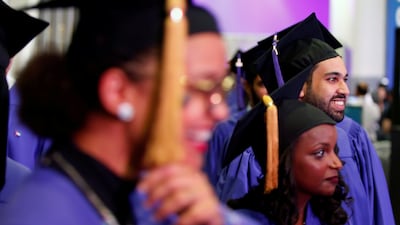

Leading UAE universities are investing in the future as they seek to capitalise on growing demand for higher education studies in the country.
Institutes unveiled expansion drives, new programmes and plans to attract more learners from across the Emirates and beyond at a flagship education fair in Abu Dhabi on Monday.
The number of students enrolled at universities in the UAE reached 218,000 in the 2025/26 academic year, a 15 per cent rise on an annual basis.

Hundreds of high-school pupils gathered at Adnec at the 20th annual Najah event on Monday, as they prepare to take the next step on their academic journeys.
Growing strong
Abu Dhabi University is to launch eight new undergraduate programmes at its Dubai campus – starting next year – to bolster its national presence.
“Dubai has become a hub for international education and we would like to be part of that market,” Bassam Murra, executive director of marketing, enrolment and registration at the university, told The National at the event.
“There is a plan to expand and to offer more programmes and to grow our population in Dubai,” he said. “Even in our planning, if it's required that we expand our facility itself, this is something we want to consider.”
The Dubai campus will offer new programmes in subjects such as artificial intelligence, engineering, international relations, law and psychology.

The continued growth in the UAE higher education landscape comes as the number of people in the Gulf choosing to study in the UK continues to decline.
Student visa application numbers have slumped due to a UK migration clampdown that has restricted visas, as well as concerns over social issues, safety and the quality of education in Britain, experts said.
'Busier than ever'
It offers an opportunity for UAE universities aiming to entice more students as they build their academic reputations internationally.
The University of Sharjah was ranked best in the UAE for medicine in the US News Best Global Universities Rankings and has also been climbing the ranks of the QS World University Rankings.
“Our goal is to be always in the top and to bring students from both outside the country and inside the country,” May Bin Hadda, admissions officer at the University of Sharjah, told The National.

The university welcomed more than 5,000 new students at the start of this academic year.
Emirates Aviation University reported a similar result, with a high intake this year especially from abroad.
A representative said admissions had been busier than ever, with strong interest from around the world. “Dubai’s position as a global aviation hub continues to be a major attraction for international applicants,” they added.
Liwa University has also recorded “significant” growth. “Both the Abu Dhabi and Al Ain campuses are packed in all specialisations,” said Adam Al Bahti, integrated marketing manager at Liwa University. “We feel there's a big demand in the market, especially for programmes in AI and in medical and health sciences.”
While primarily focused on domestic pupils, Liwa University is hoping to attract more international students in the coming years.
Making the grade
In July, the UAE launched a new higher education award aimed at shining a light on the achievements of the country's best universities and helping to “foster a culture of excellence”.
Sheikh Abdullah bin Zayed, Deputy Prime Minister and Minister of Foreign Affairs, said the UAE Higher Award for Education would support initiatives that “create a sustainable impact” and advance the nation's “readiness for the future”.
The UAE has taken significant steps in recent years to raise standards in the higher education sector, which has been reflected by impressive performances in global education league tables.
In June, Abu Dhabi's Khalifa University of Science and Technology broke new ground by being the first in the UAE to feature in the top 150 of the QS World University Rankings 2027.
The university rose 30 places to 147th, cementing its place as the country's leading institution for the ninth consecutive year.
The QS rankings evaluated 8,808 universities across 106 places, with 1,504 seats of learning named in the final list.
The university was ranked 12th worldwide for the international make-up of its faculty, reflecting its work in moulding young minds drawn from around the globe.
In January, Abu Dhabi University was named among the top 100 for business and economic studies in another global league table, outranking renowned institutions from the US, UK and China. It was placed 81st out of more than 1,000 institutions assessed in the Times Higher Education World University Rankings 2026. The list comprised universities from 91 countries.

