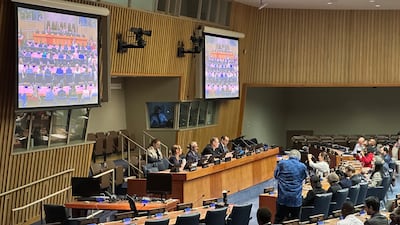

The Middle East conflict has underscored the need for societies to anticipate, adapt, and prepare for uncertainty through knowledge, said Jamal bin Huwaireb, CEO of the Mohammed bin Rashid Al Maktoum Knowledge Foundation, on Friday.
Speaking at an event on the sidelines of the UN General Assembly in New York, Mr Huwaireb described knowledge as "an essential force" that enables countries to leverage challenges to drive sustainable development.
"Recent challenges have demonstrated that returning to the status quo is not the ultimate objective," said the head of the UAE-based foundation. "What truly matters is emerging more resilient, prepared, and capable of learning," he added.
He made the remarks during a conference titled "Knowledge as a Crisis Compass", organised in co-ordination with the UN Development Programme (UNDP) Regional Bureau for Arab States and the UAE Permanent Mission for the UN. The conversation comes ahead of the Knowledge Summit 2026, taking place in Dubai in November.
The outlook from UNGA has been bleak; there has been no consensus or breakthrough on a way forward to resolve the global conflicts.
The intersection of economic, climate, geopolitical, and technological challenges has also been a reason for concern among diplomats and officials gathered in New York - with fears of further turbulence.
"The central question is no longer how we respond to crises after they occur, but how we can anticipate them, mitigate their impacts, and transform those lessons into new opportunities for development and innovation," said Mr Huwaireb.
He said: "Building resilient societies begins with building institutions that learn continuously, anticipate transformations, and adapt to them quickly".
Mr Huwaireb referenced two initiatives that he said could help advance this mission.
The first is the Future Skills Academy, developed by MBRF and the UNDP, which was launched during UNGA in 2024. It aims to equip individuals with the skills and knowledge necessary to meet labor market expectations and the rapid transformations shaping today’s world.
The second is the Global Knowledge Index (GKI), which he said can help assess the state of knowledge and its foundations in countries, while monitoring the strengths and gaps that affect their ability to anticipate and respond to transformations.
"Through the measurable data and indicators it provides, the GKI can support policymakers in identifying priorities and directing investments in knowledge, skills, education, and innovation, thereby enhancing societies’ capacity to build a more resilient and sustainable future," he added.
Mr Huwaireb said it was "a collective responsibility" to ensure that knowledge becomes a "force accessible to every individual, society, and nation".

