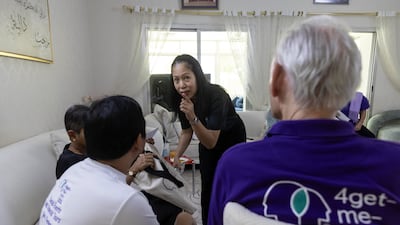

UAE footballing great Rajab Abdulrahman has a lifetime's worth of remarkable achievements – from being part of the nation's first official match to lining up against European champions Liverpool during their 1970s glory days.
Like many senior citizens, however, Abdulrahman is at risk of those cherished memories being stolen from him by dementia, a cruel and progressive brain disorder that is surging as global populations age.
The celebrated former midfielder was diagnosed with Alzheimer's disease in 2021. Yet, despite the daily challenges he has faced, football remains an enduring joy that he watches as much as he can on television.
He is also a regular at gatherings organised by 4get-me-not, a close-knit Dubai community group that has seen its members swell in recent years as more over-65s turn to the UAE for their retirement.
While The National reported this week that significant strides are being made to advance dementia treatment in the years to come, such networks of support are crucial to help patients make the most of their lives, and enjoy the spirit of comradeship and friendship of others in a similar plight.
The volunteer-led social enterprise is overseen by Desiree Vlekken, who founded the group in 2013 and says it remains Dubai’s solitary senior support service.
Inspired to help

Ms Vlekken was inspired to establish the service after witnessing the cognitive decline of her father-in-law and then her own father due to dementia-related conditions.
“We were the pioneers of this advocacy, there was absolutely no one else offering this kind of support,” said Ms Vlekken, whose background is in political science.
“I would go home to the Philippines only once or twice a year. When I saw how much my father had changed, it was a big shock. I decided I needed to understand what this disease was all about and how we missed those early signs.”
The group has grown through word of mouth and social media, and relies on businesses donating venues or corporate social responsibility programmes.
Volunteers who joined the group to help out now attend sessions due to their own old age, and take part in activities such as low-intensity sports and exercise, art classes, singing or walks in the park in the cooler winter months.
Sporting successes

Abdulrahman is a key figure in the history of UAE football, stretching back to before the country was even formed.
From 1970, he played for the embryonic Al Nasr club in Dubai for 12 years, facing the great Liverpool side of 1978 that featured Ray Clemence, Alan Hansen and captain Emlyn Hughes.
The reigning European champions won 5-0 in the testimonial to inaugurate Al Nasr’s new stadium, and the performance in front of 12,000 people left midfielder Abdulrahman a lifelong Reds supporter.
Abdulrahman would go on to win the UAE championship that year, and again in 1979, and would also meet Pele during his visit to Abu Dhabi for the Gulf Cup in 1982.

Team effort
Abdulrahman's sister, Hanifa AbuBakar, said the network of senior friends has been a source of huge comfort, particularly in recent months.
“I felt mingling with people would help him because he started forgetting,” she said. “It started slowly, with him forgetting words. As time went by, even talking became difficult for him and he would get frustrated.
“I try to remind him of things, but because we had a history of somebody in the family with dementia, I was very scared for him to get it too.
“We knew it was coming, but I was careful to warn him that he shouldn't give up,” said Ms AbuBakar.
Abdulrahman still recognises friends and reaches out a warm, welcoming hand with a broad smile when he sees a familiar face.
His experience highlights the importance of community support groups as the UAE’s older population grows. The Emirates and wider Gulf region have one of the fastest ageing populations in the world, but geriatric support services are yet to keep pace with demand. The 4get-me-not service, for instance, relies on volunteers to help at meetings that were once held every three months, but now take place twice a week.
Caring and sharing
One of those volunteers is Arche Gella, who is the full-time carer for Terry, 87, who is from Romford in the UK and moved to the UAE to be with his son and family.
Terry has severe Alzheimer's disease, but loves signing and joining in with the group’s choir.
“Every time we join, it makes him happy,” said Mr Gella, who is a qualified nurse.
“He speaks with all the seniors, and it is clear he looks forward to these days and enjoys meeting other people.”
Meet-ups take place across the country and are supported by the Ministry of Community Empowerment in Jumeirah, and government social services departments in Sharjah, Ajman and Khor Fakkan.
Family ties

Zenia Noronha has lived in Dubai for 32 years and brought her mother, Margaret D’Souza, 85, over from Canada to live with her four years ago.
After initially volunteering with the group, she now brings Margaret along to regular activity days.
“My mum used to live with my sister, but she didn't really have a lot of activity because it's winter for six months of the year in Canada,” she said.
“I was already with 4get-me-not, and it occurred to me one day that why not get mum be part of the group. I could see how it was helping people to have friends and socialise.
“The elderly population has increased since they've been giving out golden visas and everything, but there's not much to do to support them, for them to socialise or to meet up. That needs to change.”
Growing need
Currently, the UAE has a young population with an average age of about 33 years, but it is facing a major population shift.
Attractive retirement visas for existing residents who are joined by elderly family members, along with better healthcare and life expectancy, are leading the charge in an ageing nation.
A large resident workforce has led to 98 per cent of the population being aged under 65, but Help Age International says the UAE is going through a demographic transition. The number of people aged over 60 is expected to increase more than sixfold by 2050, from about 311,000 to 2 million.

