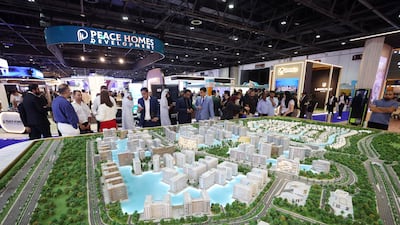
Dubai's real estate market is evolving, with demand moving towards more accessible pricing as developers report a return of investor confidence, experts at the International Property Show said.
Leading UAE developers said the appetite for ultra-luxury property above Dh10 million had softened in favour of the Dh1 million to Dh2 million bracket.
The ultra-luxury segment still attracts a pool of buyers, but “many buyers and international investors are directing their attention towards high-value properties that combine quality, comfort and luxury at more accessible price points”, Tauseef Khan, chairman and founder of Dubai developer Dugasta Properties, told The National.

He said the company's transaction data showed the typical investor's budget had risen from Dh600,000 to Dh950,000, and that a “significant share” of transactions fell between Dh1 million and Dh2 million, reflecting “stronger appetite for quality homes within the mid-range segment”.

Azizi Developments, one of the emirate's major developers, said sales had fallen by 70 per cent during the regional tensions but had since recovered to around 80 per cent of previous levels.
“The one type of product that is not in demand is very expensive price tag properties, over Dh10 million [$2.72 million] to Dh15 million [$4.08 million],” said group chief executive Farhad Azizi. Domestic demand for lower-priced homes remains strong, he added. “We have a lot of domestic buyers, people who are renting and living here, becoming homeowners.”
Figures from the Dubai Branded Residences Report H1 2026 by Morgan's International Realty show that the first half of the year marked a more “selective phase” for Dubai's branded residence market. This generally sits at higher price points than non-branded property.
Transaction volume declined 21 per cent year-on-year, and sales value decreased 47 per cent to Dh22.1 billion ($6.02 billion), according to the report.
Maturing market
Meanwhile, new buyers have been slower to make decisions and more selective about their investments.
Yousuf Fakhruddin, chief executive and managing partner of Fakhruddin Properties, said ultra-luxury buyers were taking longer to commit. However, he added: “There is definitely still a requirement for investment in the world market, and Dubai is still the safe haven for it.”
Second-quarter data from the Dubai Real Estate Market Report by DXB Interact showed that the emirate's property market recorded 38,257 transactions worth Dh110.36 billion ($30.05 billion) and volume fell 28 per cent against the same period in 2025. Value dropped 40 per cent to Dh94.17 billion ($25.64 billion), but the pullback was one of quantity, not price, as buyers demonstrated higher selectivity.
According to Savills Middle East's second-quarter Dubai Residential Market Report, transaction volumes moderated as buyers became increasingly selective amid rising supply, greater choice and the continuing regional uncertainty. However, the market's medium-term outlook remains positive.
Madhav Dhar, co-founder and chief executive of ZaZen Properties, said the market was maturing rather than experiencing a shift away from high-end property. “I don't think Dubai is moving away from ultra-luxury,” he said.
Price-conscious buyers
However, he acknowledged that alongside demand for luxury properties, demand for the mid-range segment was growing.
“There is a growing population of professionals, entrepreneurs and families putting down longer-term roots here, and there is significant demand for high-quality homes at more accessible price points. That creates a very interesting opportunity for the mid-to-high-range segment.
“Buyers still expect excellent design, good amenities, sustainability, connectivity and quality construction. They simply want those elements at a price point that makes sense to them,” Mr Dhar added.
Residential transaction volumes fell 19 per cent quarter-on-quarter in the second quarter. Officials at the Dubai Land Department nonetheless said underlying demand remained healthy
Mohammed Yahya, director of the DLD's Real Estate Transactions Department, said transaction volumes rose 7 per cent in the first quarter, while total value climbed about 30 per cent. “That's a big jump,” he said, adding that the market ranged “from affordability all the way to luxury”.
Payment plans
Developers say flexible payment structures are increasingly central to closing deals. Mr Fakhruddin cited his company's plan – no down payment and a 1.5 per cent monthly instalment – as an example of how developers are adapting to more price-conscious buyers.
Mr Khan said market fluctuations had made buyers more cautious and informed, and more focused on protecting their long-term financial interests.
“There is strong demand for flexible, extended payment plans that make home ownership more manageable and provide buyers with financial flexibility,” he said, noting that his company's 10-year payment plan now accounts for 80 per cent of its total bookings.
Organisers said the property show, held at the Dubai World Trade Centre alongside the AIM Congress and closing today, had drawn more than 35,000 attendees from 191 countries, with over 31,000 registered by the opening morning on September 7.

Dawood Al Shezawi, president of AIM and the IPS Congress, regards the turnout as a signal of the industry's momentum. “I'm sure there are hundreds of them who are buying and selling property,” he said, noting that “thousands of people are here”. He framed the event within a broader civic pitch for the city, calling Dubai “the centre of tolerance and the centre of peace”.
According to industry experts, the coming year will reward quality and execution above broad growth. “Everything is fine,” Mr Fakhruddin said. “There are logistical challenges – that's the biggest challenge really – but confidence is back.”
The coming year is expected to be “less about growth across every segment” and “more about quality and delivery”. Projects in the right locations at “sensible price points” are likely to perform well, Mr Dhar said.