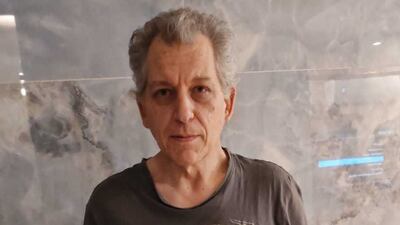

UN experts have expressed “grave concern” that a Dubai resident detained in Iraq for five years over a work contract dispute is facing a potentially life-threatening medical situation.
Australian citizen Robert Pether, 50, was released from prison in Baghdad more than a year ago. Despite that, he remains in Iraq due to a ban on his leaving the country while the possibility of further legal action hangs over him.
The office of the UN High Commissioner for Human Rights issued a statement on Monday, highlighting a “particularly alarming” situation given Mr Pether's declining health, which is compounded by a lack of access to specialist medical care and the psychological toll of his “prolonged detention and uncertainty”.

“Pether has been released from detention but is still unable to leave Iraq,” the statement said. “Restrictions linked to continuing financial claims arising from the underlying commercial dispute continue to prevent his departure.”
Mr Pether and his Egyptian co-worker Khaled Radwan, who both lived in Dubai at the time, were jailed in August 2021 and fined $12 million after a contract dispute between his employer and authorities in Iraq.
They were released from prison last year. In 2025, the Office of the US Special Presidential Envoy for Hostage Affairs pushed for his release. This followed a call from Australia's Foreign Minister Penny Wong for Mr Pether to be allowed to return home to his family.
Since his release from prison, Mr Pether has been staying either with friends or in hotels, with the cost of food and accommodation falling on him and his family.
The UN's latest statement points out that Mr Pether has a documented history of melanoma and dysplastic nevus syndrome, which places him in a high-risk category requiring specialist surveillance and treatment.
Concerns are heightened by previous skin procedures carried out while he was detained in Iraq, during which suspicious lesions were allegedly not properly assessed and treatment complications reportedly resulted in serious infection, the statement added. it was noted that medical assessments warn of the risk of progression and metastasis, and recommend urgent specialist oncological evaluation.
“No one should be deprived of access to potentially life-saving medical care because of a commercial dispute to which they are not personally a party,” the experts said. “Nor should financial claims, civil proceedings, or political considerations prevent a seriously ill individual from accessing urgent treatment and returning home.”
“We urge Australian and Iraqi authorities to act without delay to ensure that Robert Pether receives appropriate specialist medical care and that any remaining obstacles preventing his departure from Iraq are urgently resolved.”
Calls for release
Mr Pether's wife Desree told The National her husband was “declining cognitively each week”.
The UN Working Group on Arbitrary Detention issued a report in 2022 describing Mr Pether’s imprisonment as “arbitrary and in contravention of international law”.
A ruling in 2023 by the International Chamber of Commerce's International Court of Arbitration said that the central bank in Iraq was to blame for the contractual dispute.
Mr Pether and Mr Radwan were arrested when they travelled to Iraq for what they thought was a routine business meeting. Employed as an engineer in Dubai for CME, Mr Pether was contracted to work on the central bank's headquarters near the Tigris.
The men were detained during the meeting. They each received a five-year jail sentence and were ordered by an Iraqi court to pay $12 million. The dispute was over a $33 million contract awarded to CME in 2015.
The project was put on hold a year later, with plummeting oil prices and Iraq’s war against ISIS put forward as the main reasons. Work resumed in 2018, with CME working for 39 of the 48 months as set out in the contract.
Payment was received for 32 of those months before it was withheld. CME was asked by the central bank to extend the contract by three months to make up for work suspended because of the coronavirus pandemic.
The Australian government said it recognised the significant impact of Mr Pether's detention on him and his family and pledged to continue to offer consular support in an effort to allow him to finally leave Iraq.
"The Australian Government acknowledges the immense toll that Mr Pether’s detention and ongoing travel ban have taken on him and his family," a Department of Foreign Affairs and Trade spokesperson told The National.
"The Australian Government has provided extensive consular assistance to Mr Pether and his family since he was first detained and will continue to advocate for his wellbeing and for him to be able to depart Iraq to be reunited with his family.
"The Australian Government has consistently advocated on Mr Pether's behalf for many years, making more than 260 representations to Iraqi authorities and engaging at the highest levels, including the Prime Minister and Foreign Minister. These efforts were instrumental in securing Mr Pether's release from detention on 5 June 2025.
"For privacy reasons we are unable to provide further comment.
The National has also contacted authorities in Iraq for comment.