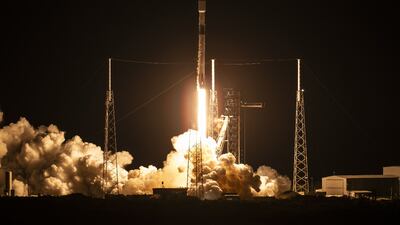
Three cutting-edge UAE satellites primed to accelerate disaster response operations and boost the fight against climate change are now fully operational.
The trio of satellites, called Foresight-3, Foresight-4 and Foresight-5, harness advanced radar technology to capture high-resolution images of the Earth's surface in all conditions, day or night.
They were launched into orbit in November 2025 by Abu Dhabi-based Space42 aboard a SpaceX rocket from Florida's Cape Canaveral and have now gone live. They expand Space42's Foresight Earth Observation constellation to five synthetic aperture radar (SAR) satellites.

With the three latest satellites now live, “we are expanding sovereign Earth observation with greater speed and consistency to governments, industries, and partners worldwide”, said Hasan Al Hosani, chief executive of Space42's Smart Solutions.
“The collaboration with [Finnish microsatellite manufacturer] ICEYE and proven operational success within the Space42 Space Systems facility has strengthened national capability to a level that competes with and scales across global markets.
“The constellation further delivers against our strategy to become the preferred partner for premium geospatial data, while growing the UAE’s position in a dynamic, mission-critical industry.”
Help from space
The three satellites are positioned in low-Earth orbit on a mission to extend monitoring of key regions of the planet where more than 90 per cent of the population live.
The Foreight network provides images to Space42’s AI-powered geospatial intelligence platform, GIQ, which processes the data to enable its use by governments, industries and other partners.
Space42 said providing a “big picture” view of the planet – including up-to-date information on disaster zones – can help teams on the ground reduce emergency response times by up to 90 per cent.
The information beamed back from space can also track environmental changes and support urban planning.
Advanced capabilities
Unlike traditional optical satellites that depend on sunlight and clear weather, radar spacecraft send out radio pulses that bounce off the ground. This allows them to “see” through clouds and collect images in complete darkness.
Each of the new Foresight satellites can capture images at 25cm resolution, sharp enough to detect the tiniest changes on the ground such as soil movement, flooding or subtle shifts in buildings and roads.
The data feeds directly into GIQ, which processes it to provide what the company calls “decision-grade intelligence”.
The system can flag changes almost in real time, helping governments, infrastructure operators and industries make faster, more informed decisions.
The technology was used during the UAE’s record flooding in 2024 and in Turkey the previous year, when radar imagery confirmed the safety of the Ataturk Dam after a major earthquake while other monitoring systems were offline.
The UAE’s first radar satellite, Foresight-1, was launched in 2024, followed by Foresight-2 in January this year.