

A vast luxury apartment on the 87th floor of Burj Khalifa has become one of the most expensive rental properties in the country, being leasing for Dh12 million ($3.2 million) a year.
The 1,000-square-metre property, which serves as an indicator of the strength of Dubai's real estate market in the wake of unprecedented attacks from Iran, is the only duplex apartment with a balcony in the famous building and has benefited from a Dh33 million renovation.
Its owner, a Dubai resident of more than 21 years, said the property shines a light on the UAE’s investment potential and insisted the country’s real estate sector will rebound strongly from current challenges.

Karl Haddad, chief executive of IRC Invest, a firm specialising in second citizenship, residency and immigration programmes, has lived in Burj Khalifa for 12 years.
Mr Haddad, who bought the apartment for Dh180 million, recently sold the Sky Palace Penthouse on the 830-metre building’s top floor.
“It took three years to merge two units upstairs to make it the only duplex in Burj Khalifa with a balcony, and Dh13 million just to build the stairs,” he said.
“We have had to reinforce the floors up and down and there is a meticulous choice of materials used.”
-
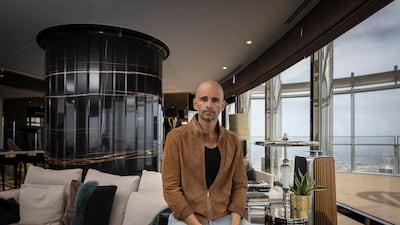
A tour of Karl Haddad's Burj Khalifa apartment. All photos: Antonie Robertson / The National -
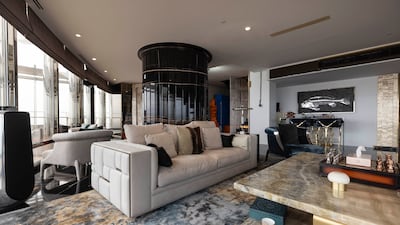
The living area -
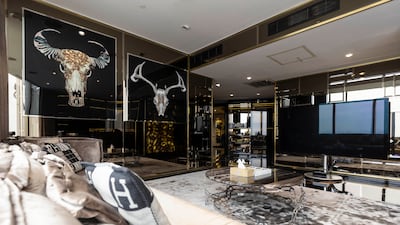
The TV room with a relaxation area next to the 'male' walk-in wardrobe -
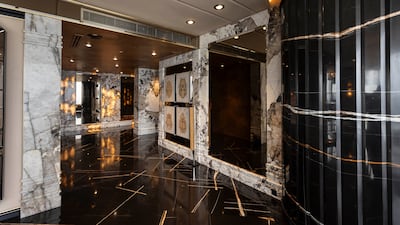
The upstairs dining area -
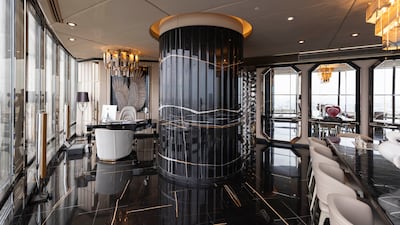
Another view of the swanky dining room -
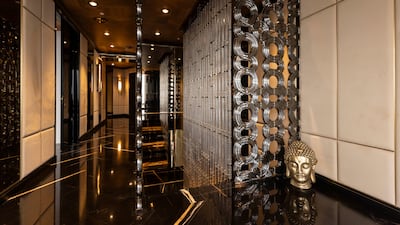
The specially installed staircase -
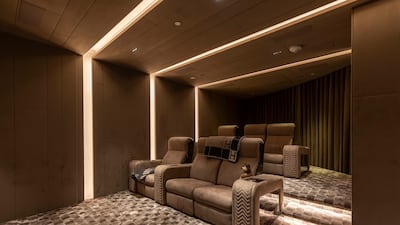
The cinema room -
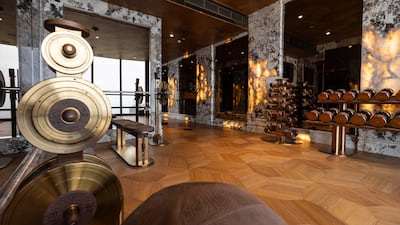
The gym with crocodile skin-covered equipment


What's inside?
Marble walls complement huge floor-to-ceiling panoramic views across Downtown and out towards the Arabian Gulf.
Furnishings alone have cost around Dh14.6 million, and include 25 unique pieces of artwork embedded with Swarovski crystal.
A gym is fitted with equipment adorned with crocodile skin, while each room is connected with a Dh3.6 million Bang and Olufsen sound system.
The home also benefits from a 93-square-metre private cinema, spa and sauna.
“For a person to come and rent this from me for $3.2 million is a testament to Dubai's infallibility of belief in the future,” said Mr Haddad, who advises governments on citizenship programmes, as well as property investing.
“A lot of people have had their doubts lately, and I think this rental proves otherwise.
“We're actually in the process of adding three more apartments to make it 1,400 square metres, that would take it to a completely different valuation. It's truly a one-of-one trophy asset with a perfect view over DIFC 2.0.”
The transaction was facilitated by Keyper, a real estate investment management platform that specialises in Dubai’s ultra-luxury rental market.
“This transaction reflects a clear shift at the very top of Dubai’s market,” said Omar Abu Innab, Co-Founder and CEO of Keyper.
“Ultra-high-net-worth individuals are prioritising flexibility without compromising on scale, privacy or prestige.
“A Dh12 million annual lease would have been unthinkable just a few years ago. Today, it signals the depth and maturity of Dubai’s ultra-prime rental segment.
“While eight-figure purchases are increasingly common, eight-figure annual leases remain exceptionally rare placing this residence among a select class of global trophy assets.
“At a time when many markets are defined by hesitation, this transaction sends a clear message: while others pause, Dubai continues to advance, demonstrating resilience, stability, and unwavering global appeal.”
What challenges lie ahead?
Dubai’s real estate market faces a challenging time, with multiple developments due to be completed this year.
Analysts said the market remained steady, despite the regional conflict that has created widespread economic uncertainty.
In the first week of the war, Dubai recorded 3,570 sales transactions worth Dh11.93 billion, Dubai Land Department data shows.
Shehzad Janab, chief financial officer of Binghatti Holding, said the full impact of war in Iran is only likely to reveal itself in the weeks and months ahead.
His company employs more than 22,000 people in construction and runs six UAE factories, facility management and real estate brokers.
That network provides Mr Janab a clear vantage point from which to assess the impact on Dubai real estate and access to steel and structural grade concrete.
“We’re sitting on a considerable amount of material stockpiles, so we have not felt any impact when it comes to building,” he said. “Our focus is clearly on the projects at hand, we are going to be handing over anywhere from 13 to 16 odd projects this year, which take up to 24 months to complete.
“These projects are over 90 per cent sold already, with more than 60 per cent already constructed.”
With Jebel Ali Port closed and access to materials restricted due to a backlog of shipping containers transiting the Strait of Hormuz, Binghatti has relied on material reserves and goods arriving by road from Fujairah.
“The litmus test will be once the new projects are launched,” said Mr Janab. “2026 was always going to be a pivotal year because of the amount of units we will be bringing to market, around 10,000 and a similar number for next year.”
Deals to be done
Meanwhile, real estate brokers said any downturn would offer value to first-time buyers, with those with cash reserves best placed to snap up any deals.
“At the moment we are seeing a lot of buyers across all price points, from as low as $272,000 all the way up to $60 million for a penthouse in Downtown Dubai,” said Asad Khan, chief executive of Invest Dubai Real Estate.
“Developers are saying 'look, if you've got a client with a serious offer, we can negotiate up to 15 per cent off the list price, and with better payment terms'.”
Payment plans are normally 80 per cent during construction, with the other 20 per cent paid on handover of the finished property.
Mr Khan said developers are now offering terms with a 30 per cent down-payment and 70 per cent on handover.
“That's really attractive for investors,” he said. “Investors looking to flip multiple properties before handover are the ones in trouble because they have overleveraged.
“The supply is going to be coming through the market but the demand is not going to be there. We might be four weeks into the war but the damage that has been done will take at least 18 months to recover from.”

