

Venezuela’s Vice President for Economy Calixto Ortega Sanchez on Wednesday revealed details in Dubai about an unusual power-sharing style arrangement with the US.
Weeks after President Nicolas Maduro was captured by US forces during a night-time operation in Caracas, Mr Ortega Sanchez, a former central bank chief, said the oil-rich country must move on but needs access to its assets to do so.
“Allow us to have access to our own assets,” he told American commentator Tucker Carlson at the World Governments Summit.
“In order to go forward on terms that help everybody, Venezuela needs to be allowed to re-enter international markets on equal terms without sanctions.”
The capture of Mr Maduro and his transfer to the US with his wife on drug-trafficking charges, followed by court appearances, marked one of the most dramatic developments in Venezuela’s modern history.
“I [come] from a Catholic family and those days are very important for us, for family reunion. So, I had in my house my mother, my father, my sister, my nieces, of course my little kids. And it was an event that is at a dark point in our history now but we try to move forward and somehow build opportunities for economy under the situation we have to face,” Mr Ortega Sanchez told the panel.
“I woke up in the middle of the night and the events were passing very fast and just following the news and the statements of the authorities. It was a very extraordinary situation but the Venezuelan people and the authorities have shown that they are ready peacefully to move forward and to build opportunities.”
-
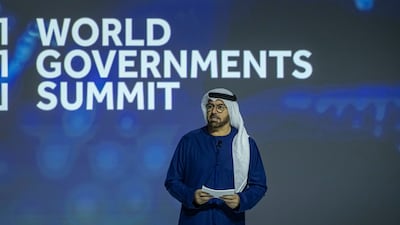
Mohammed Al Gergawi, UAE Minister of Cabinet Affairs and Chairman of the World Governments Summit, speaking at the opening of the summit in Dubai. He said AI was one of the four forces reshaping the world. Antonie Robertson / The National -
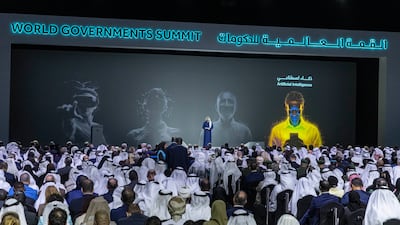
Mr Al Gergawi told the forum the next major discovery would not be in space, but in 'the realm of new capabilities within the human brain itself'. Antonie Robertson / The National -
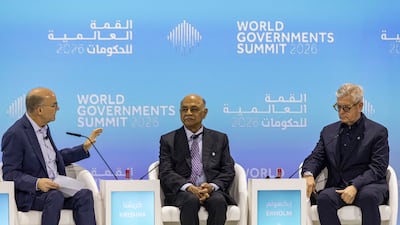
From left, Mike Allen, co-founder of American news company Axios, Arvind Krishna, chairman, president and chief executive of IBM, and Borje Ekholm, president and chief executive of Ericsson, on the first day of the World Governments Summit. Antonie Robertson / The National -
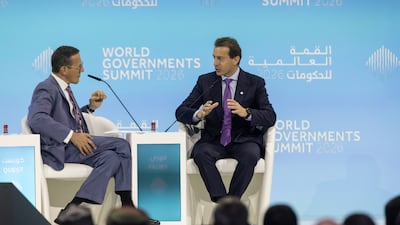
CNN journalist Richard Quest, left, talks to Airbus chief executive Guillaume Faury during a session titled How Do We Keep the World Connected? Antonie Robertson / The National -
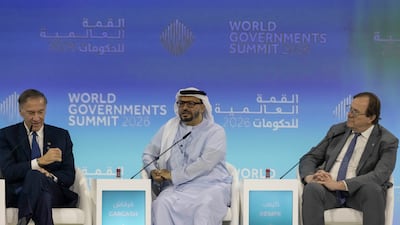
Dr Anwar Gargash, diplomatic adviser to the UAE President, with Mike Pompeo, former US secretary of state, left, and Frederick Kempe, president and chief executive of the Atlantic Council. Antonie Robertson / The National -
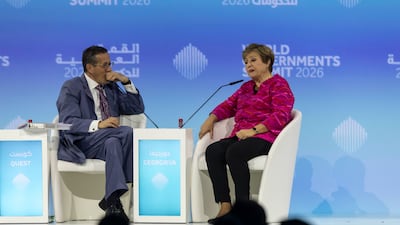
IMF managing director Kristalina Georgieva in conversation with Richard Quest. Antonie Robertson / The National -
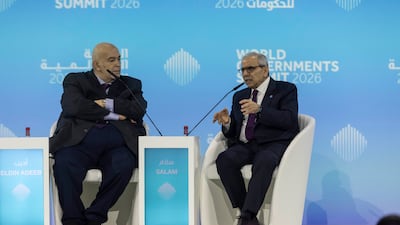
Lebanon's Prime Minister Nawaf Salam discusses the country's future with Emad Eldin Adeeb of Sky News Arabia. Antonie Robertson / The National -
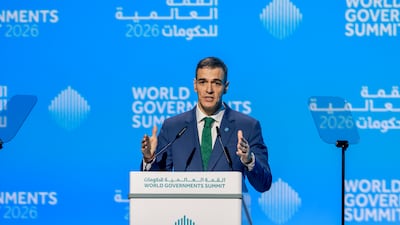
Spanish Prime Minister Pedro Sanchez speaks at the summit. Victor Besa / The National


The developments were later followed by comments from US President Donald Trump, who said Washington would take control of Venezuela’s oil sector.
The country holds an estimated 303 billion barrels of crude oil reserves, the largest in the world, but produces only about 1 per cent of global output because of years of underinvestment and neglected infrastructure.
Current production stands at about 1.1 million barrels a day, down from about four million bpd in the 1970s.
The unusual arrangement, explained by the Vice President, has stabilised the country. “There is a functional government in Venezuela. It's led by President Delcy Rodriguez,” the official said.
He said Mr Trump had stated that revenue from Venezuelan oil production would flow to the US before being allocated to the Venezuelan government and American oil companies involved in extraction.
Under the arrangement, the interim President announced the creation of two sovereign funds. One will focus on welfare, including salaries and direct assistance to help Venezuelans recover from the effect of sanctions. The other will be dedicated to infrastructure projects such as roads and public works, expected to roll out in the coming months.
Mr Ortega Sanchez sought to reassure investors and international partners that stability had returned to his country.
“There is only one functional government in Venezuela and it's led by our authorities. One example to this reality is that after the events of the last month, Venezuela is peacefully moving forward and ready to receive investment and trying to compete in the market, in the international market, like every other player.
“We know that the reference for Venezuela is that the country with the biggest oil reserve. And we want to stop being known for this – we want to be known as one of the countries with the highest production levels.”
He concluded by calling for the lifting of sanctions, the government’s highest priority.
“What we are experiencing right now is that these US institutions have a lot of experience putting restrictions, accusations and having lists and putting you in these lists. But when it comes to taking down or trying to open doors for a new relationship, then it's a process and we are working on it,” Mr Ortega Sanchez said.
“You need to pull back the sanctions, which achieved the opposite of their intended effect.”

