

The developer of an AI-powered game that provides early detection in conditions such as autism and ADHD was among the winners at the Zayed Sustainability Prize in Abu Dhabi on Tuesday.
President Sheikh Mohamed and several high-level guests attended the event at the Abu Dhabi National Exhibition Centre to recognise 11 pioneering organisations and high schools from around the world.
"The UAE believes in the importance of building bridges of co-operation between different sectors and aligning capabilities and needs in order to create a sustainable and measurable impact as a cornerstone of comprehensive progress," Sheikh Mohamed said.

"This year’s winners demonstrate the pivotal role of realistic and practical solutions in changing people’s lives for the better by improving health care and food systems and increasing access to clean energy and safe water sources. Through the Zayed Sustainability Prize, this vision is embodied on the ground by supporting innovations that put people first and create new opportunities for growth."
-
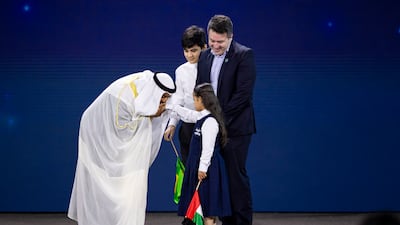
President Sheikh Mohamed presents the 2026 Zayed Sustainability Prize for Health to representatives from Jade, during the opening ceremony of Abu Dhabi Sustainability Week at Abu Dhabi National Exhibition Centre on January 13. All photos: UAE Presidential Court -

President Sheikh Mohamed attends the opening ceremony of Abu Dhabi Sustainability Week. Seen with Aleksandar Vucic, President of Serbia, Faustin Archange Touadera, President of the Central African Republic, Patrick Herminie, President of Seychelles and Ferdinand Marcos Jr, President of the Philippines -

President Sheikh Mohamed applauds during the opening ceremony at Abu Dhabi National Exhibition Centre -
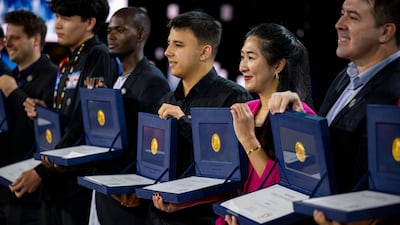
Winners of 2026 Zayed Sustainability Prize -

Performers during the prize ceremony -

Celebrations at the Abu Dhabi National Exhibition Centre -

The UAE flag is displayed on screen during the award ceremony


Brazilian company Jade won the health category for its AI-powered game that provides early detection and personalised intervention in conditions such as autism and ADHD.
When Jade was announced as a winner, its founder was standing on stage with his 12-year-old son, Lucas, who is autistic, and an Emirati pupil who uses the platform. Founder Ronaldo Cohin said it was "an amazing feeling".
“We wanted to build technology that could really help neurodivergent children," he said. "During play, we collect cognitive data that helps us understand exactly where the difficulty is – why a child is not learning to read or write, or why they struggle with attention.”
Jade moved its headquarters to the UAE after winning a technology competition in Dubai. The assessment happens naturally, without children realising they are being evaluated.
The platform is now used by about 200,000 children in 179 countries and has been adopted in more than 650 schools in the UAE, Brazil, the UK and Portugal. It is free to download, with the company focusing its work on public schools and government partnerships.
Mr Cohin said the award marked the beginning of the next phase for the company. “When you win the Zayed Sustainability Prize, it is not the end,” he added. “You win an award, but you also win a mission. Now our mission is to grow what we are doing and reach many more children.”
What is the Zayed Sustainability Prize?
The prize aims to shine a spotlight solutions addressing the climate crisis. This year, 33 finalists were selected from more than 7,760 submissions across 173 nations in six categories – health, food, energy, water, climate action and global high schools. The number of entries increased by 30 per cent compared with last year.
The winners of each category will receive $1 million in prize money. Within the global high schools category, which is divided into six regions, each school is to get up to Dh550,000 ($150,000) to start or expand their project.
Entries were submitted from the Americas; Europe and Central Asia; the Middle East and North Africa; sub-Saharan Africa; South Asia; and East Asia and the Pacific.
The winners
In the food category, Singapore's N&E Innovations was rewarded for its method of turning food waste into biodegradable packaging that extends shelf life and reduces post-harvest losses.
Switzerland's BASE Foundation picked up the award in the energy category for its pay-per-use cooling module. For the water category, Brazilian company Stattus4 scooped the top prize with its AI-powered sound and pressure sensors that help utilities to find and fix leaks in real time.
In the climate action category, Build up Nepal won for its manufacture of low-carbon, earthquake-resilient eco bricks that replace coal-fired materials and cut emissions for affordable resilient housing.
School effort
Kyanja High School was among the winners in the high schools category. It was recognised for a circular project that combines duck farming with catfish ponds to produce affordable protein while easing the pressure on nearby forests.
The idea from the school in Uganda, which won in the sub-Saharan Africa category, came directly from pupils, principal Kabanda Michael said.
“They went around the school and the surrounding community and started to see the problems people were facing,” he said. “There was a lack of food, especially nutritious food, and that was pushing people to encroach on the forest to sell firewood and charcoal so they could feed their families.”
The forest in central Uganda has been steadily shrinking as residents search for ways to earn an income, he said. “When we spoke to people living near the forest and asked them whether they would stop if they had another source of food or income, they told us they would,” Mr Michael added. “That is where the project started.”
Pupils designed a zero-waste farming system that allows ducks and catfish to be raised together. “Duck shelters are built above the fish ponds and the ducks are fed using leftover food collected from the school and nearby community,” he said. “Their droppings fall into the water and fertilise it, which allows natural organisms to grow and feed the catfish.”
Water from the ponds is regularly removed and reused to irrigate vegetables and grow plants that are fed back to the ducks, ensuring the system is circular and low-cost. The school has tested the idea on a small scale.
“We built a small prototype at the school and it worked,” he said. “It is still limited to the school for now, but the idea showed real potential, which is why it was recognised. With the funding, we can now expand it so it can benefit the wider community.”
The other winners in this category were Canada's Mamawi Atosketan Native School, Jordan's Al Rajaa School for the Deaf, Bodrum Anatolian High School in Turkey, the Faafu Atoll Education Centre of the Maldives and Thailand's Ruamrudee International School.

