
The Al Mubarakah Foundation does not make a lot of noise. It works steadily, intentionally, and that may be why it has endured.
Established in 2016 by Dr Sheikha Mouza bint Mubarak, in memory of her father Sheikh Mubarak bin Mohammed, the UAE’s first Minister of Interior, the foundation follows a philosophy he held: that protection comes through community, not fear.
Today, that legacy continues through his granddaughter, Sheikha Shamma bint Khalifa bin Hamdan, who oversees programmes designed to keep young people anchored, especially during the years when they are most likely to drift.
“We don’t work through authority. We work through identity, dignity and purpose,” Sheikha Shamma, Vice Chair of the foundation tells The National. Her approach stems from how she was raised.
“I am also a proud daughter of parents who shaped my outlook in very distinct ways. My father modelled integrity, discretion and an unwavering sense of duty. My mother instilled in me a love for community and learning. Their influence is present in every element of our work.”
Sheikha Shamma speaks quietly and with intention. She is not loud, not overly active and never forceful. There is a pensiveness to her, a way of taking in what is being said before she responds – thoughtful rather than animated.
-
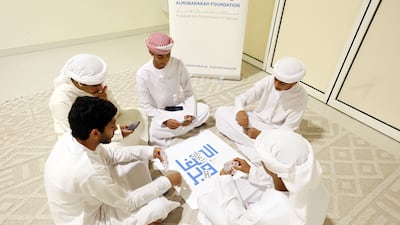
Taking part in the Al Mubarakah project in Abu Dhabi. All photos: Chris Whiteoak / The National -
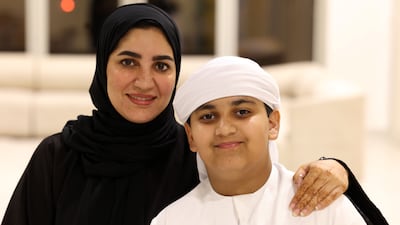
Munira Al Ketbi and her son Khalifa at the Nabdh Al Falah community centre -
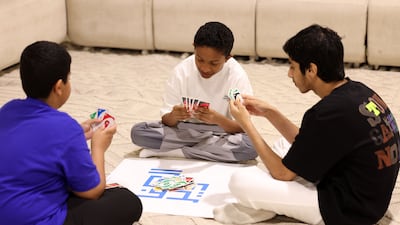
The programmes are designed to keep young people anchored -
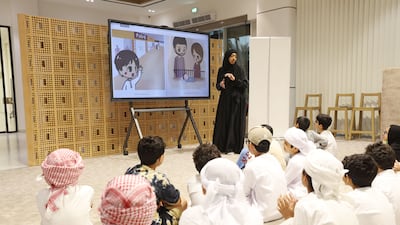
The foundation works 'through identity, dignity and purpose' -
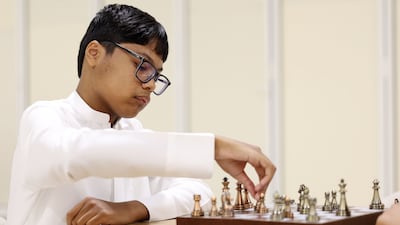
Eissa Sultan, 12, plays chess -
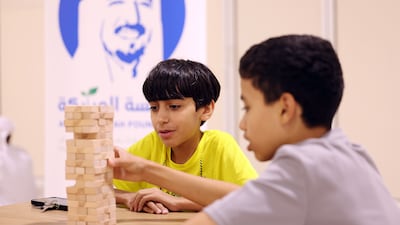
Children take part in the Al Mubarakah Foundation project. Chris Whiteoak / The National -
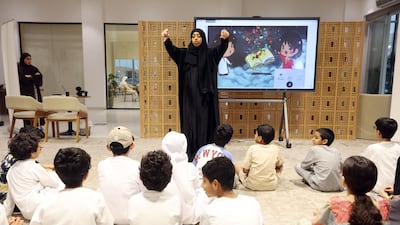
All the programmes are run by volunteers


The passion is there, but expressed through clarity and composure, not exaggeration. There is a genuine love for her community, her country and her people that sits beneath everything she does and says.
Sheikha Shamma has an MSc in Public Policy from SOAS and a master’s degree in social work from UAE University, a combination that reflects her approach: academically grounded, research-based and socially centred.
She is an avid reader of research, always up to date with scientific journals. When she speaks, it is clear she knows what she is talking about – there is depth, passion and knowledge behind it. She hopes her grandfather would be proud.
“The spirit I see in young people today is the spirit of their grandparents. They wouldn’t have made it without it,” she says.
Al Mghaweer – Warriors
The foundation’s flagship youth programme, Al Mghaweer pronounced “meh – gha – weer” works with Emirati boys aged 13 to 17. It began in 2018 after a noticeable rise in disengagement and risk-taking among adolescents, particularly in areas outside Abu Dhabi city.
It is a five-year, membership-based programme, and candidates are interviewed before joining to ensure they understand the commitment.
“We called the youth programme Warriors because we wanted something that encapsulates the UAE spirit – strength in responsibility and in everyday battles with life,” she says. “Their studies, their friendships, their decisions – that is where resilience is built.”

She says that, culturally, discipline has not always been equally applied.
“In many families, more is expected of daughters than sons. Girls are expected to be home on time, help with siblings, respect boundaries. The boys often aren’t held to the same discipline. That lack of structure can be harmful. It’s actually more important that our young men are taught limits,” she says.
“What it means to be an Emirati man hasn’t changed. Discipline, courage, the ability to take responsibility – these are the traits that built this country. That spirit still exists. We just need to give young people the opportunity.”
More than 300 boys have completed the programme and over half of the current volunteers are former participants.
“When a young man who joined at 13 returns at 18 to mentor others, that’s when you know something has taken root,” she says. She believes that young people are beginning to understand their role.
“Things are changing. Young people are starting to understand that reality won’t shift unless they work with it.”
All Al Mubarakah programmes are run entirely by volunteers. “We don’t pay volunteers because that changes the nature of the work,” Sheikha Shamma says. “When people step forward out of belief and responsibility, they thrive.
“I believe God created us to grow the world around us. When you give people the opportunity to improve their community, they thrive.”
Built to last
Growth is gradual by design. “We promised ourselves we wouldn’t expand too quickly. We take it step by step,” she says. “Community work cannot be rushed. We grow slowly and intentionally. Community initiatives don’t respond to scale – they respond to trust.”
The foundation has been operating for a decade. “That’s longer than many others. Fast growth may work for large entities. For organisations like ours, it’s better to grow within the community itself.”
“It’s not something I’ll do today because it sounds good and will be in the press, and then next year I’ll have something new to play with. We take this seriously. It’s ingrained in us,” she adds.

“This wasn’t done because we thought this would be a fun idea,” Sheikha Shamma says. “It was done because of a deep-seated belief that something needs to be done, and that as community members we are responsible for the communities around us.”
The programme's five-year cycle includes weekly sessions, weekend sports challenges and community work activities in Abu Dhabi and surrounding areas. Participants meet at the Nabdh Al Falah Community Centre. Sessions are paused during exam periods to ensure academic commitments remain a priority.
Salem Bin Beshr, head of the programme, says: “This programme is crucial for this age group. The aim is to give them a space to meet, be active and adopt positive habits, instead of spending their time on screens or sitting in cafes.” The programme is free of charge.
Early intervention through reading
The foundation’s second core programme, also held at the community centre in Al Falah, is Reading Fluency. Started in 2019, it is for children aged eight to 10.
“When children struggle with their mother tongue, they risk becoming disconnected from their cultural roots,” Sheikha Shamma says. “That disconnect can grow into a crisis of belonging.”
More than 260 children have taken part, with reading accuracy increasing from about 30 per cent to 99 per cent, based on assessments every two weeks. “Language is identity,” she says.
Youth and responsibility
“The biggest threat facing our community is ambivalence, when people stop caring about their country, their families, their responsibility, their future,” she says. “The opposite of that isn’t rage or excitement. It’s responsibility.”
“Our youth don’t lack resources, they lack purpose. When they feel they belong, they step up. As communities, we have to take responsibility – not just for our own children, but for our neighbours’ children and those who have no one looking out for them.
“Sheikh Zayed laid the foundations and steered the country’s course, with the men of his generation building forward under his vision” she says. “If it wasn’t for their sense of religious responsibility, staying true to values, and following his vision, this country would not be what it is.”
Future direction
The foundation is preparing to expand to the Al Dhafra region in partnership with the Mohamed bin Zayed University for Humanities, but remains committed to growing only with depth, not reach. “We take it step by step,” she said.
The name Al Mubarakah carries deeply personal meaning. “It is both a personal tribute and a public message,” says Sheikha Shamma.
“It honours Sheikh Mubarak bin Mohammed Al Nahyan – whose life was rooted in service, wisdom and nation-building. It also draws from the Quranic image of a blessed tree that gives fruit in every season. That is what we strive for: nurturing quietly and consistently, offering benefit that is steadfast, renewing and far-reaching.”
“This is not a project. It is a responsibility,” she concludes. “As long as I am breathing, I will not let it fade.”

