
The UAE has unveiled plans to equip future rover vehicles on the Moon with advanced AI-powered navigation systems in the next phase of exploration efforts.
The Mohammed bin Rashid Space Centre has joined forces with the Technology Innovation Institute (TII) and Aspire to enable a rover to “perceive and interpret its surroundings in real time” – effectively giving the vehicle eyes to guide its journey on the treacherous lunar surface.
The collaboration with the two companies – both subsidiaries of the Abu Dhabi’s Advanced Technology Research Council – is being heralded as one of the country's most sophisticated spacecraft subsystems to date.
It will consist of a radiation-tolerant computer and AI-driven software to give a rover self-driving capabilities on the lunar surface, using cameras and AI to see its surroundings and navigate obstacles by itself.
“MBRSC’s collaboration with TII and Aspire is a significant step forward in our commitment to building technologies that elevate the scientific value and safety of future missions,” said Dr Hamad Al Marzooqi, project manager for the Emirates Lunar Mission at MBRSC.
“Enabling a rover to perceive and interpret its surroundings in real time is a capability that will define the next phase of exploration on the lunar surface.
“It strengthens our long-term vision for contributing meaningful, high-impact systems to international deep-space efforts.”
The navigation system effort also supports the UAE’s wider national ambition to build AI-based technologies for space exploration.
Growing ambitions
The partnership, announced on the final day of the Dubai Airshow, will bolster the UAE's long-term quest to unravel the mysteries of the Moon.
It was confirmed this month that development and testing of the Emirates Lunar Mission’s Rashid Rover 2 is now complete.
The MBRSC said the rover had been sent to the US after comprehensive environmental and functional tests in the UAE.
Sheikh Hamdan bin Mohammed, Crown Prince of Dubai, Deputy Prime Minister and Minister of Defence, previously announced the UAE was to attempt to become only the second nation to land on the far side of the Moon.
The rover is undergoing the next stage of preparation, with US-based Firefly Aerospace, for the Emirates Lunar Mission scheduled for next year.
Rashid 2 will travel into space on board the Blue Ghost 2 lander, scheduled for launch in early 2026 for a landing attempt on the Moon’s far side – the unlit part – for a 10-day mission.
UAE in space – in pictures
-
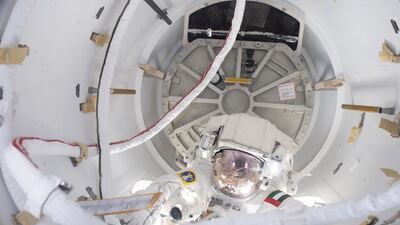
Emirati astronaut Sultan Al Neyadi posted new pictures of his April 28 spacewalk. Photo: @Astro_Alneyadi / Twitter -
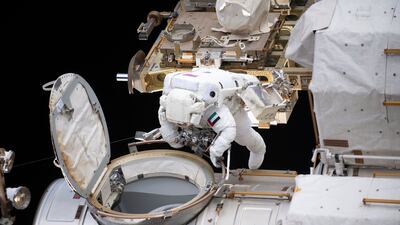
Dr Al Neyadi made history by becoming the first Arab to walk in space. Photo: @Astro_Alneyadi / Twitter -
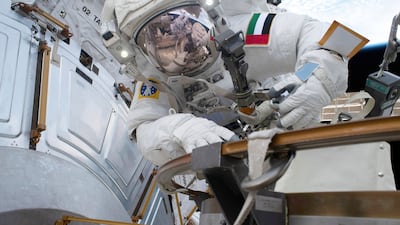
He was assisted by American astronaut Stephen Bowen. Photo: @Astro_Alneyadi / Twitter -

The spacewalk lasted six and a half hours. Photo: @Astro_Alneyadi / Twitter -

Dr Al Neyadi prepares for the spacewalk. All subsequent photos: Nasa -
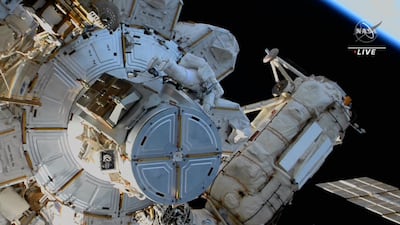
Dr Al Neyadi steps out of the International Space Station -
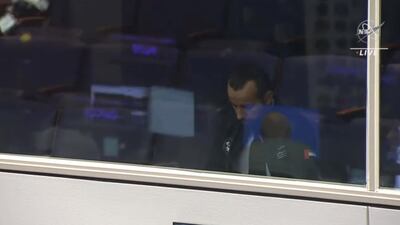
Fellow UAE astronaut Hazza Al Mansouri, increment lead of Expedition 69 on Earth, monitoring the mission from the Johnson Space Centre -
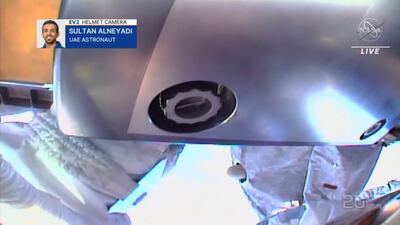
The view from Dr Al Neyadi's camera -
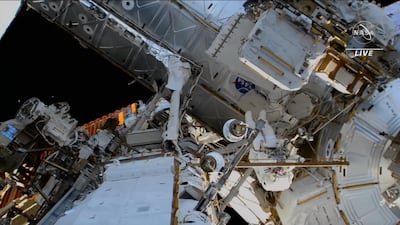
The astronauts outside the space station -
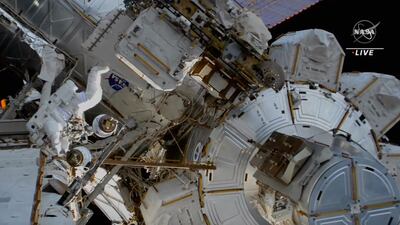
The astronauts carry out maintenance work on the International Space Station -

Dr Al Neyadi, top, carries out repairs outside the ISS -
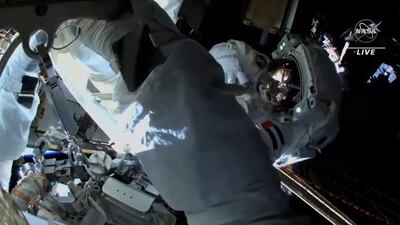
The pair exited the space station at 5.41pm GST -
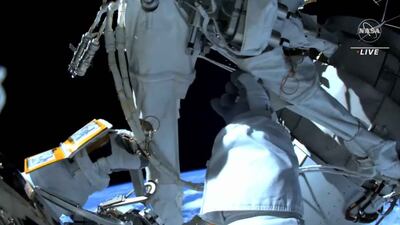
The spacewalk officially began at 5.11pm when their spacesuits switched to battery power -

While the spacesuits weigh 127kg, astronauts cannot feel this weight in space -
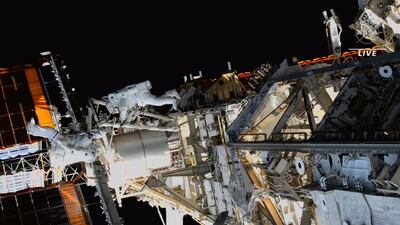
The astronauts are tethered to the station while floating in microgravity more than 400km above the Earth -
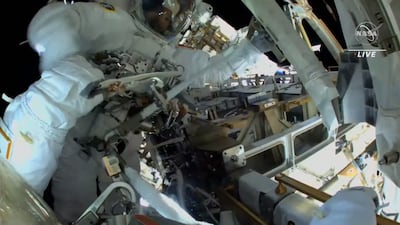
Dr Al Neyadi carries out repairs


It will be the space centre’s second attempt to land a rover on the Moon following the unsuccessful Rashid 1 mission in April 2023. The first rover, part of Japan’s Hakuto-R Mission 1, was lost when the lander crashed into the lunar surface.
The Emirates also has set its sights set on placing an Emirati astronaut on the surface of the Moon within 10 years.
Salem Al Marri, director general of the MBRSC, said at the World Governments Summit in Dubai in February that activities on the Moon would help pave the way for Mars missions.
“What drives me, and I think drives a lot of people at the MBRSC, is that we want to see an Emirati on the surface of the Moon within the next 10 years,” Mr Al Marri said.
“And I think we will do everything that we can to make sure that happens.”
The Emirates has made significant strides in the global space race in recent years.
Hazza Al Mansouri made history in September, 2019 by becoming the first Emirati to venture into space, while Sultan Al Neyadi broke new ground in March 2023 when chosen to be the first Arab astronaut to carry out a long-duration journey through space and to complete a spacewalk.

