
A band of Emirati farming “sisters” are embracing advanced technology to help cultivate a more sustainable future and support the nation's ambitious plans to promote growth in agriculture for decades to come.
Eight women recently graduated from the first female-only course on the UAE's Farmer Field Schools programme, which aims to equip them with the knowledge and expertise to make the most of the fruits of their labour.
The wider initiative – which featured 48 men and women drawn from Abu Dhabi, Ras Al Khaimah, and Fujairah at a series of schools – focused on the management of date palms including the red palm weevil, a deadly pest which blights palm trees and the production of the UAE's beloved dates.
However, it also served as an opportunity to recognise the important contribution of women in agriculture and showed they are making their mark in a sector more commonly associated with men.
It was one of five such programmes launched in May by the Abu Dhabi Agriculture and Food Safety Authority in co-operation with the Ministry of Environment and Climate Change, under the guidance of the UN's Food and Agriculture Organisation.
-
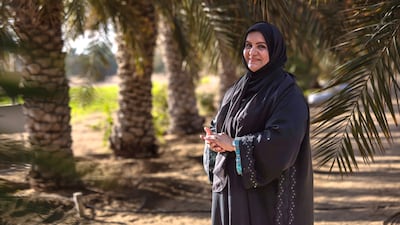
Salima Al Shamsi has managed her farm in Al Ain for 25 years. All photos: Victor Besa / The National unless stated. -
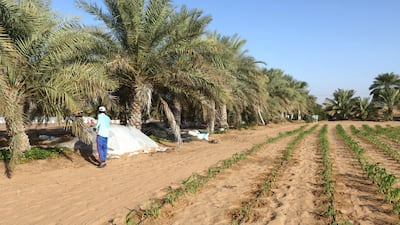
Her farm has 300 palm trees, producing sought-after date palms -

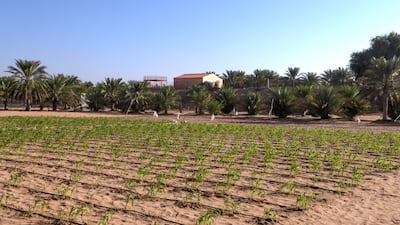
Some of the produce cultivated at Ms Al Shamsi's farm -

Ms Al Shamsi also grows a wide variety of produce, such as aubergines, courgettes, tomatoes, pomegranates, figs, onions and peppers. -
She is proud of her achievements in the agriculture sector. -
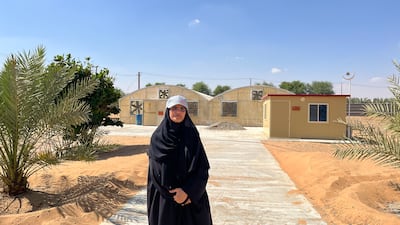
Kadija Al Qubaisi named her farm 'Nad Al Dhab', which translates to 'Dune of Gold'. Photo: Janelle Meager / The National -
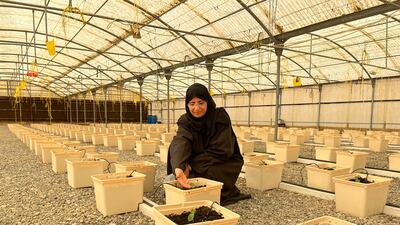
She has laid the groundwork for a thriving business, producing and selling honey and dates. Photo: Janelle Meager / The National -

Some of the branded goods produced on the farm. Photo: Janelle Meager / The National -

Reda Saqer with her son, Ahmed Aldhaheri at her cucumber farm in Al Rawdah, Al Ain. -

Agriculture has shaped her life for many years -
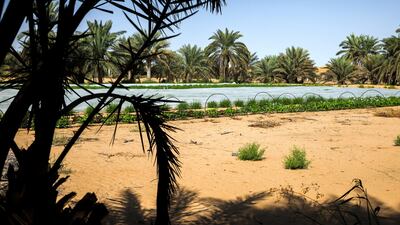
Ms Saqer's greenhouses now yield up to seven tonnes of cucumbers a day -
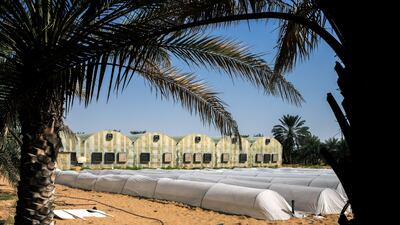
Every three months, she plants about 5,000 seeds and grows them via a hydroponic system -
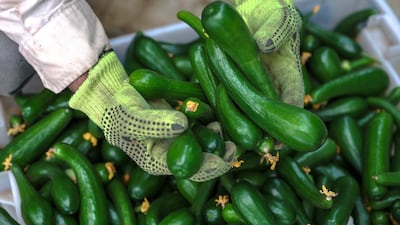
Some of the large cucumbers that have been grown at the farm.


More than 2,300 farms in Abu Dhabi are owned by women, most of which are either purchased from previous owners or granted by the government. Many of these women have a deep connection to their farms, referring to them as their “child”.
The National spoke to three of the farming graduates helping lay the groundwork for the country's food security.
Salima Al Shamsi, a mother of six who received her farm in Al Ain in 1999, relished the opportunity to meet other women who have made their mark in agriculture.
“We were all like sisters. Each one of us had ideas,” said Ms Al Shamsi. “I didn’t miss a single day. It added so much to my knowledge. It gave me confidence and incentive to focus more on my farm and to keep learning.”
The plant whisperer
Ms Al Shamsi is affectionately known as the “plant whisperer”. It is said everything she touches not only grows but is juicier, plumper, and sweeter than anything else.
She co-owned her farm with her husband, who passed away a little over a year ago and is determined to ensure it continues to thrive.
Her farm has 300 palm trees, producing some of the most sought-after dates in the market, and Ms Al Shamsi is one of the few farm owners with both male and female trees.
Beyond palms, her farm produces eggplants, courgettes, tomatoes, pomegranates, figs, onions, peppers, and so much more. “When people ask me how my produce is so juicy and sweet, I have no answer. I use the same soil and the same fertilisers. It’s from God,” she said.
“I grew up on a farm, and my whole life revolves around agriculture,” she said. Her goal is to expand further, with hopes for support to grow more crops and add livestock.
“This farm means the world to me. It is in my veins. I would love to develop it more and for that, we need financial and emotional support,” she said. “We want solutions and more options like the Farmer Service Centre to help solve the challenges we face.”
A history of agriculture
One of the graduates, Reda Saqer, is a 61-year-old widow and mother of five. Her journey with farming began in her early twenties after she lost her husband to cancer.
At only 24, with her youngest child Adel just a few months old and not yet walking, Ms Saqer travelled from Al Ain to Abu Dhabi to request a farm from the government.
“I think I was the only woman standing at the diwan asking for a farm. Women were more reserved back then,” she said.
Describing the moment she received her farm in Al Rawdah, Al Ain, in 2000, she said: “I had never owned anything before,” she recalls. “I was so happy.”
Her plot of land, which extends more than 160km, started the beginning of Ms Saqer's love affair with nature. With her children by her side, she began by building a wall around the site and then started planting everything she could until she specialised in cucumbers.
Ms Saqer's greenhouses now yield up to seven tonnes of cucumbers per day. Every three months, she plants about 5,000 seeds and grows them through a hydroponic system before selling her best produce to a distribution company she works with. Any imperfections left behind are either sold independently or pickled and kept by Ms Saqer.
The government provides Dh6,666 per month to support farm management for government-owned farms, but it isn’t enough to make farming significantly profitable.
Still, Ms Saqer remains devoted. “I will never sell it. This is my love. Would you sell any of your children? This farm is my soul.”
From a sand dune to a recognised brand
Kadija Al Qubaisi named her farm “Nad Al Dhab,” which translates to “Dune of Gold.” The name came to her when she went out one day in 2015 and saw a farm lying next to a sand dune that glittered like gold. “That’s when I knew I had to have it,” she said.
Today, Nad Al Dhab, situated in Ramah, Al Ain, has grown into a brand. From selling honey and dates, her logo now appears on hats, flasks, and notepads.
Ms Al Qubaisi’s farm is impressive: including seating areas for family gatherings; a greenhouse; a food truck; bee hives; a rare breed of male and female deer; a coffee shop; a prayer room; an expansive meeting room; a barbecue pit; a bakery; a live cooking station; and a traditional house made from palm fronds.
Most impressive, however, is her chemical room, where Ms Al Qubaisi has become a “potions master.” Here, two large 800-litre industrial containers, labelled Solution A and Solution B stand to one side, while weighing machines, beakers, and wooden spoons line the table.
This is where Ms Al Qubaisi spent over two years developing a hydroponic solution that helps her grow healthier and larger crops. “It’s my secret recipe, but if anyone asks, I’m happy to help them out,” she said.
Hydroponics is the technique of growing plants using a water-based nutrient solution rather than soil. Her solution includes zinc, potassium, and other chemicals, which she constantly adjusts and monitors for the right pH level to use on her crops.
“I always want to discover, to learn, and innovate, so I worked hard to make my crops better by improving the solution that helps them grow.” Currently, she grows cucumbers and plans to grow more varieties of fruit and vegetables in the future.
Her farm is monitored by 36 cameras, and her greenhouses are equipped with electronic sensors to track temperature and humidity.
Like Ms Saqer, she considers financial constraints a key issue. “Agriculture in the UAE is very rich,” she said. “But what we need most is financial support.”
In a recommendation to the Farmer Service Centre, she proposed the creation of an agricultural bank that would give loans to farmers, with the condition that the funds go directly into farm development.
She was grateful for the chance to attend the farming school programme, being happy to learn new methods even after years of experience.
“I thank our teachers. I have so much respect for them,” she said. They’re almost as old as my children. “Yes, we have the experience, but they added so much knowledge to us – information we didn’t realise we were missing.
The farmer field school cycle
Each FFS cycle, a model first established in the 1980s, follows a seasonal schedule beginning when seeds are first sowed and concluding at harvest. This approach is especially valuable in the UAE’s arid climate, where understanding environmental factors is crucial.
While this first round focused on palm tree care, future courses may address other crucial areas in Emirati agriculture, adapting to meet the needs of local farmers and responding to industry challenges.
“The programme starts when the first seeds are sowed and ends at harvest, adapting to the seasonality of each crop,” Mohamed Ali Alabdouli, ADAFSA’s lead extension officer and one of two lead engineers responsible for the female-only FFS, told The National.
The courses were held directly on the participants’ farms, creating an open-air classroom where farmers could apply sustainable practices to their palm trees immediately.

