

You might think the biggest threat to forests in the UAE would be construction or climate change. But in the mountains of the UAE, goats are the immediate concern, as the animals eat the foliage before it has the chance to regenerate.
“In the past, the way goats were managed was different,” said Dr Andrew Gardner, associate director of biodiversity conservation at Emirates Nature-WWF, which is working on a reforestation project in the Hajar Mountains.
“Somebody from the community would go out to the village with the goats in the morning and herd them, and they knew where the goats were going. Areas could be set aside as reserves and that would allow us to regenerate. But that system has broken down and now goats tend to wander wherever, unsupervised, and there are a lot of feral goats.”

The problem is that the mountains should be much greener than they are, Dr Gardner told The National. The main reason goes back to the UAE’s history of copper smelting, as the Hajar Mountains were a rich source of the metal for Mesopotamia in the Bronze Age. Copper was mined from pockets of ore and smelted locally, then exported.
“That smelting required large amounts of charcoal and that was produced from felling the trees,” he said. “I think the trees have never really recovered from that, particularly because in more recent times there has been very little regeneration because of the large numbers of goats that eat any baby trees.”
Bringing greenery back to the mountains
In a bid to restore these habitats, Emirates Nature-WWF wants to pilot and scale up a project to replant native tree species in some of the mountain wadis and on the lower hillsides. It is looking to restore four types of species in these areas: sidr, umbrella thorn acacia, ghaf and shua, also known as moringa peregrina.
“All of these trees really have a whole load of values for the ecosystem,” said Dr Gardner. This includes providing shelter for invertebrates, as pollinators and honey production, for ecotourism and landscape value.

But it wants to replant these species without irrigation. “We’re not looking to take water tanks and pipes and pumps into the wild,” he said. “We want to plant the trees where we know they can grow naturally. There are still trees growing there but they need to get protection and a head start so they can become established.”
The team is looking at various arid zone planting methods, including water cocoons – small plastic reservoirs that can be reused up to 10 times and are buried in the ground to fill up with rainwater or condensation.
“It’s got a wicking system, so you plant the tree in the middle of the ring-like reservoir [and it] wicks a little bit of water to keep the young sapling alive, but not too much that it just makes a shallow root system, which would happen if you were doing surface irrigation," he said. “It then has to put its roots deep down to get to water because we’re not giving it enough to really grow well.”
Other methods include micro catchments, or semi-circular walls of local stone, that catch water for trees planted there, and using polymer that holds water and releases it slowly, along with nutrients, encouraging the plants to grow.
The goats must be kept at bay, so fencing or a steel cage will be needed around the saplings until they get big enough, which Dr Gardner said makes the process more expensive.
“But once the trees are really established, they can then provide fodder for the goats," he said.
Mangroves: the lungs of the coastline
Efforts to restore the UAE’s precious mangroves are perhaps better known than those to reforest the mountains. These include an ambitious plan by the Ministry of Climate Change and Environment to plant 100 million across the country by 2030.

The area in the Gulf covered by mangroves has declined by about 14 per cent since 1996, a recent report by the International Union for Conservation of Nature found. Mangroves across the Arabian Gulf and surrounding regions could shrink by 45 per cent over the next half century if current trends continue, scientists have warned.
Mangroves are known to absorb and capture carbon in vast quantities – up to five times more than tropical rainforests. They also play a key role in protecting coastlines from erosion and extreme disasters such as flooding, as well as in ecotourism, but they also provide a home for numerous species, both fauna and flora, from birds to bees and beetles, as well as crabs, invertebrates and flowers.
Emirates Nature-WWF has strict protocols on where it plants mangroves, so these sites can benefit from the restoration and are not turned into developments. The team then monitors any that are planted over five years, to document survival rates, and the non-profit group is working alongside the Environment Agency Abu Dhabi to produce best-practice guidelines for mangrove restoration in the UAE.
“We’re looking at the whole lagoon as a kind of living system where there are interactions between the mangroves, the seagrass beds, the salt marches, oyster beds and so on,” said Dr Gardner.
“We’re particularly looking at the carbon sequestration in these different habitats and what we find is that by having a mosaic of habitats, you increase the carbon storage more than you’d expect.”
A whole ecosystem
The agency is a significant piece in the puzzle of habitat restoration in the UAE, as it spearheads projects across the country, alongside wildlife repopulation efforts.
As the agency chooses locations in which to release animals into the wild, for example, it must ensure the sites are suitable, otherwise the creatures might starve and die. Vegetation is planted to increase biodiversity in the area for food, water and shelter.
“You need to be so smart to know what species to plant in which area, so that if after one year when you remove the irrigation, they will be able to adapt and succeed,” said Ahmed Al Hashmi, executive director of the terrestrial and marine biodiversity sector at the agency. “This is where most people fail.”
The agency also uses drone technology and satellite imagery to learn more about vegetation cover and document the successes and failures of replanting programmes.
“We believe if you increase the vegetation cover, it's nature, it's an ecosystem," Mr Al Hashmi said. "Insects will increase, invertebrates will increase, also mammals will start to increase.”
From above ground to under the sea
Coral reefs also play a crucial part in the UAE’s ecosystem, providing habitats for important species of fish and critically endangered marine wildlife such as the hawksbill sea turtle.
Rising sea temperatures, however, are putting such habitats in danger. It was reported this month that corals across the southern Arabian Gulf have been affected by a major bleaching event, with near “total bleaching” from Abu Dhabi to Umm Al Quwain, with about 40 per cent of reefs bleached in Ras Al Khaimah and off Khor Fakkan.
-
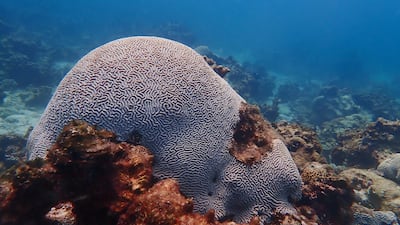
Corals in the south Gulf and on the UAE's east coast have been affected. All photos: Rebekka Pentii / NYUAD -
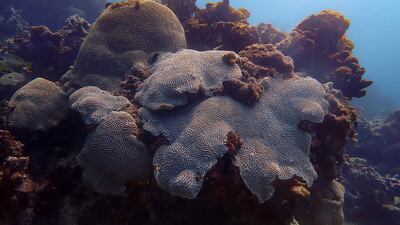
There is total bleaching in some parts although there is still a chance of recovery. -
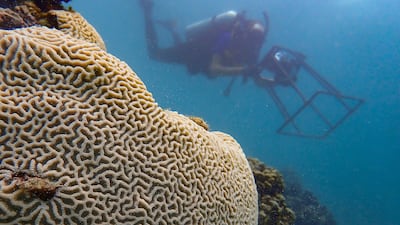
Bleaching happens when heat stress forces a coral lose their algae - which provides colour and most of their energy -

Corals can stay alive after bleaching but if cooler temperatures do not return they will die -

Coral reefs support the well-being and livelihoods of close to 1 billion people -

Corals in the Arabian Gulf have proved to be able to survive at significantly higher temperatures but they are operating at the edge of their limits


Bleaching happens when heat stress forces a coral to lose its algae – which provides colour and energy – and it turns white. Corals in the Arabian Gulf can survive at significantly higher temperatures but they are now at the edge of their limits and highly vulnerable.
Several initiatives are taking place across the country to protect them. The Ministry of Climate Change and Environment, for example, has successfully planted 559,057 coral fragments over the past five years and launched the Fujairah Cultured Coral Reef Gardens in 2019. This partnership between the ministry, Fujairah Municipality, Dibba Al Fujairah Municipality and the Fujairah Adventure Centre aims to cultivate 1.5 million corals across more than 300,000 square metres over five years.
In 2021, Sheikh Hamdan bin Zayed, Ruler’s Representative of Al Dhafra Region and the chairman of the board of directors of the environment agency, launched the largest coral reef rehabilitation project in the region, with a mission to restore one million coral colonies through a replanting programme.
The team has achieved more than 90 per cent of that goal so far, Mr Al Hashemi confirmed to The National.
‘We need nature’
Thankfully, people are beginning to properly understand the value of natural landscapes and biodiversity in the UAE, said Dr Gardner.
“The younger generation can be very, very dedicated,” he said, adding that Emirates Nature-WWF is receiving increasing public interest in its Leaders of Change membership programme.

“[The public] are really happy to come out and help plant trees, or restore falaj systems in some of the villages, or help us build heritage and nature trails.”
Mr Al Hashemi said the agency is registering similar rising levels of interest through its volunteering platform, Naha, which offers training programmes and certification, so members of the public can help in a more professional capacity across all its projects. These could include tracking or monitoring animals, diving in the coral reefs or even operating drones to plant mangrove seeds.
“The interaction from the public is much, much more now than any other time,” said Mr Al Hashemi.
Ultimately, we need nature, said Dr Gardner. “We can’t live in a world where nature is not valued sufficiently … and I think that is where we’ve turned the tide.”
UAE conservation drive – in pictures
-
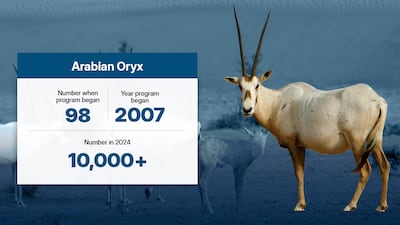
The UAE has the biggest population of Arabian oryx in the world -
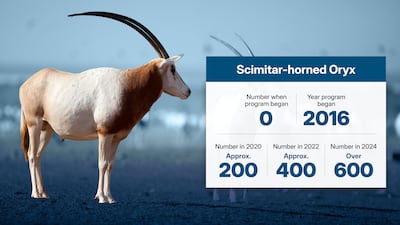
The scimitar-horned oryx has been reclassified by the International Union for Conservation of Nature as endangered, instead of extinct, in the wild -
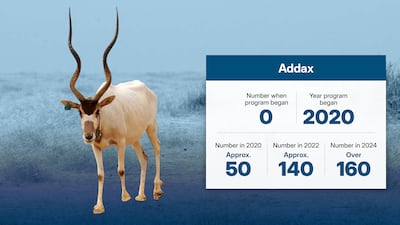
The addax antelope is being repopulated in Chad -
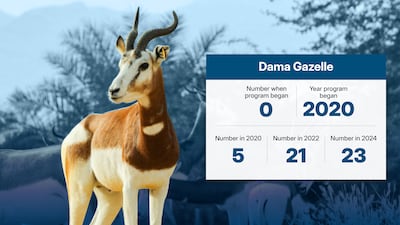
Dama gazelles were released into the wild again for the first time in 2024



