



Corals across the southern Arabian Gulf have been affected by a major bleaching event, raising concern among environmental experts.
It is believed there is near “total bleaching” of corals from Abu Dhabi to Umm Al Quwain, with about 40 per cent of reefs bleached in Ras Al Khaimah and off Khor Fakkan.
It took place when winds that have cooling capacity calmed from mid-August allowing sea temperatures to climb to at least above 36ºC but it could be higher when the data is collated.
“We were hopeful that we may have dodged the bullet and managed to be spared the brunt of the extreme temperatures due to decent winds keeping the sea temperatures cool earlier this summer,” said John Burt, a marine biologist and professor of biology at New York University Abu Dhabi.
NYU Abu Dhabi
“[But] over the past week and a half we have been getting reports of bleaching from all over the UAE. There is near total bleaching of corals from Abu Dhabi to Umm Al Quwain, and even in RAK and Khor Fakkan – where conditions are typically cooler because of flushing with deep nearby water – we are seeing around 40 per cent of corals bleached,” said Prof Burt, who is an expert on the corals of the Arabian Gulf. “This is a significant bleaching event and one we are concerned about and actively monitoring.”
Coral critical to marine life
Coral reefs support the well-being and livelihoods of close to 1 billion people, provide up to $9.9 trillion in ecosystem services, such as coastal protection, by dispersing wave energy and reducing erosion, as well as boosting jobs and food provision, tourism and recreation.
They are also estimated to support close to 25 per cent of marine species, according to the International Coral Reef Initiative, a global partnership dedicated to their preservation worldwide.
Bleaching happens when heat stress forces a coral to lose its algae – which provides colour and most of their energy – and they turn white. The coral is still alive at this point but if cooler temperatures do not return to normal they will die.
Corals in the Arabian Gulf have proved to be able to survive at significantly higher temperatures but they are operating at the edge of their limits and are still highly vulnerable.
Bleaching hit off the coast of Muscat in Oman and around the popular diving spot of the Daymaniyat Islands in July but now it has spread to the Gulf and the central and northern Red Sea.
Experts from NYUAD’s Mubadala Arabian Centre for Climate and Environmental Sciences are now out in the field surveying dozens of long-term reef monitoring sites.

Despite the severity of the situation, Prof Burt said he hoped the return of windier conditions could allow the corals to recover.
“These winds have powerful cooling capacity and a few days of decent winds would provide the corals with some respite and allow them to recover.”
Prof Burt said this is the fourth global mass bleaching event after 1998, 2010 and 2014 to 2018 and they are becoming more frequent, meaning corals have less time to recover.
“2023 was the hottest year on record for Earth and we are on the tail-end of that experience,” he said.
Scientists believe man-made climate change is imperilling their future not only in the Gulf but across the globe.
Feeling the heat
Weather event El Nino has also contributed to warmer temperatures, although there are signs it is now weakening.
“There is increasing clarity that bleaching events are closely associated with large-scale, anomalously high sea surface temperatures with increases of only 1ºC to 2ºC triggering mass bleaching events as corals already live close to their maximum thermal limits,” said Tom Dallison, strategic adviser with the ICRI Secretariat.
The Global Coral Reef Monitoring Network, an operational network of the ICRI, reported a 14 per cent loss of the world’s coral reefs from 2009 to 2018, driven by climate change and anthropogenic stressors such as pollution and habitat destruction.
“Coral reefs can recover from bleaching events that result in mortality from prolonged stress, with coral cover reaching pre-bleaching levels,” said Mr Dallison.
“However, as the frequency and intensity of marine heatwaves increases, coral reefs have less time between events to recover, inhibiting recovery to pre-bleaching levels and resulting in a continuous decline in hard coral cover,” who said they had to be “hopeful, committed and determined” to ensure that coral reefs do not become the first functional extinct ecosystem in our generation.
Efforts to support reefs, he said, include protecting reefs, building resilience and studying heat-tolerant corals.
Safeguarding crucial corals
The UAE Ministry of Climate Change and Environment told The National it was “committed to protecting the UAE’s fragile coral reefs, which are vulnerable to climate impacts but vital to our biodiversity ecosystems”.
“To effectively safeguard our precious coral reefs, our approach centres on three key components: protecting and replenishing, research and innovation, and global collaboration,” a representative for the ministry said.
It highlighted its efforts in successfully planting 559,057 coral fragments over the past five years and, furthermore, the launch of the Fujairah Cultured Coral Reef Gardens in 2019. This partnership between the ministry, Fujairah Municipality, Dibba Al-Fujairah Municipality, and the Fujairah Adventure Centre, aims to cultivate 1.5 million corals across more than 300,000 square metres over the next five years.
The ministry has also undertaken studies into finding “super corals” from common species in the Gulf and is embracing techniques such as micro-fragmentation – using smaller pieces – to boost coral growth.
“Finally, coral rehabilitation is a global challenge faced by many nations across the world,” the representative said. “The UAE is committed to working in partnership with international organisations and nation states to ensure the long-term health of our global coral ecosystems.”
The more immediate prognosis for the Gulf’s corals, meanwhile, depends on the mercury falling or the winds picking up. Prof Burt said there are “active intervention strategies” being employed but the “speed and the scale” of this event was worrying.
“The corals are in a state of heightened vulnerability at the moment, so this is a bit of a knife-edge moment for those of us working on regional reefs,” he said.
“While many people will be complaining about the heavy humidity of the past few days, this is largely water that has been drawn off the Gulf by wind, a process that is helping to reduce temperatures.
“So, from my perspective, a few muggy days would be good news, as it means things are going in the right direction.”
UAE coral reefs studied by researchers - in pictures
-
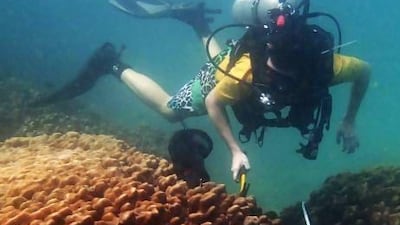
John Burt, associate professor of biology at New York University Abu Dhabi, has studied the region’s seas for the past 15 years. Photo: Joerg Wiedenmann -
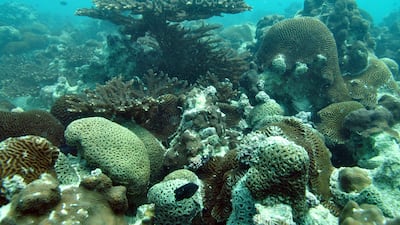
Table coral, such as the kind seen on the top left in Ghantoot, are among the heat-sensitive Acropora species. Photo: John Burt -
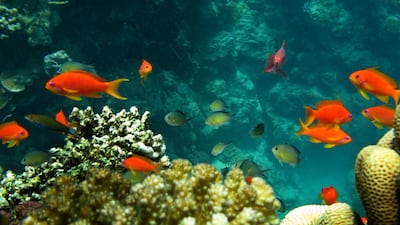
Researchers from NYU Abu Dhabi are looking for clues that could one day help coral reefs around the world survive the onslaught of global warming. Photo: John Burt -
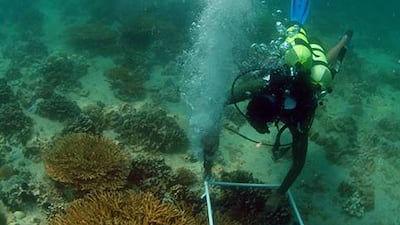
John Burt using a pneumatic drill to install coral monitoring equipment on the sea-bottom at Ras Ghanada reef in Ghantoot, UAE. Photo: John Burt -
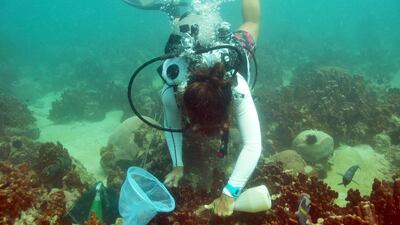
A scientist collects samples from a coral reef in Abu Dhabi, which scientists say have suffered a 'catastrophic event' because of warming waters. Photo: John Burt -
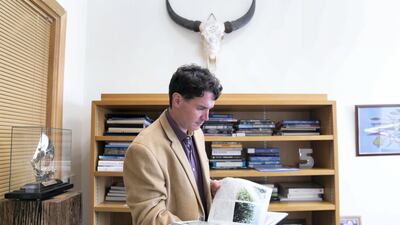
In 2017, John Burt, associate professor of biology at NYU Abu Dhabi calculated that 73 per cent of corals across all of the southern Gulf were lost. Reem Mohammed / The National -
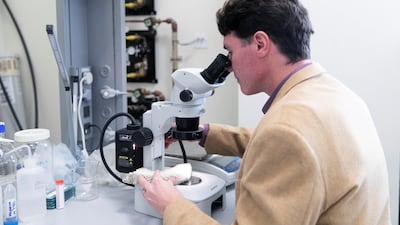
John Burt studied the corals from the Gulf waters for the far-reaching global report on warming waters and their affect on coral reefs. Reem Mohammed / The National -

High sea temperatures cause coral to bleach and die. Reem Mohammed / The National



