


Minimum tariffs for electric vehicle charging stations across the UAE can boost the industry and lead to more private investment in new installations, easing range anxiety among motorists.
Increasing financial incentives for the private sector to invest in superfast charging stations can help encourage more people to switch to electric vehicles, experts said.
Range anxiety, when drivers fear running out of charge before finding a place to top up, and a dearth of charging points could be consigned to the past as the private sector looks to cash in on a new minimum pricing structure.
Although the exact cost is not yet clear, Cabinet documents suggest a minimum fee of Dh1.20 ($0.32) plus VAT per kilowatt hour will be levied for an express service, and a minimum of Dh0.70 plus VAT per kWh for a standard charge.
Current charging rates vary by provider, with some even being free, meaning the new rules could mean some motorists paying more.
But industry figures believe the standardised pricing will ultimately benefit the electric vehicle market and make travel more convenient for drivers currently facing a shortage of options to charge up.
Fares Al Mazrooei, co-founder of Volt, a company in the UAE providing customised installation of EV charging stations and renewable energy solutions, said the legislation was a significant industry development.

“This will aid entities like Dewa [Dubai Electricity and Water Authority] in creating local regulations for charging providers, although we are still uncertain about their specific plans,” he said. “This announcement is expected to accelerate the deployment of chargers throughout the UAE.”
Mr Al Mazrooei said charging stations in the country currently met about a third of the demand of electric vehicles.
The development of new mobile battery solutions could ease infrastructure challenges and create jobs. While the development offers new opportunities for investment and revenue for hotels and malls, set up costs could be prohibitive for smaller providers.
Installation costs
A party that wants to install a fast charger in major parking areas needs to register with the local power provider, select a certified contractor and consultant, and obtain approval from several government entities, including the Department of Transport, the Roads and Transport Authority and Dubai Municipality. Installation costs could reach tens of thousands of dirhams.
“Even before the concrete is poured, costs can reach thousands, so to accurately calculate ROI [return on investment], many variables need consideration,” Mr Al Mazrooei said.
“It would be beneficial if there were a fast track or incentives for these smaller initiatives. For the malls, hotels and some private areas, I believe it’s going to give an opportunity to them to charge customers.”
A Tesla Model Y takes about eight hours 15 minutes to fully recharge from empty on a standard charge. The same vehicle can reach 80 per cent charge in as little as 30 minutes using a supercharger.
Tesla superchargers are free to use, but it would cost about Dh35 to fully recharge a Tesla Model Y using a Dewa charger. It could cost about Dh7 to charge the smaller Fiat 55e.
On average, a 400-minute charge outside a mall costs about Dh30 for 64kWh.
Under the new pricing structure, a slow charge from a public station would cost about Dh60. It would cost about Dh100 using a fast supercharger.
The cost to charge each electric vehicle can vary on the model and battery size. Raj Krishnan, director of business development at EV charging specialists Amps Electron, said developing an expanded charging network could accelerate the industry.
“Dubai Vision 2030 has a specific vision for electric vehicles, and more electric mobility in general by 2050,” said Mr Krishnan, who owns a Tesla Model Y.
“I'm sure this is something that will increase the usage of electric vehicles and make that vision a reality. We have been receiving quite a few calls and inquiries on how this can be taken further.
“With more of these charging points around the country, it would encourage more people to invest in electric vehicles. The number of charging points is definitely going to increase, and this will definitely help with range anxiety when it comes to owning an electric vehicle.”
Statiq is India’s largest network of EV charging stations. It operates more than 7,000 across the country. Home charging in India can cost from 180 Indian rupees to 500 Indian rupees per unit ($2.14 to $5.95), which is cheaper than petrol and diesel in the country.
Home charging
EV users in India spend about $0.95 for 100km of travel, Statiq said. In Denmark and Italy, EV users spend about $7 for every 100km.
"Universal charging prices have the potential to revolutionise the electric vehicle industry,” said Akshit Bansal, Statiq’s founder and chief executive.
“The benefits are multifaceted, as universal pricing encourages the growth of public charging infrastructure. While home charging remains cost-effective, publicly accessible chargers are crucial, especially in dense urban areas where home charging options are limited.
“Charging an EV at home is typically cheaper than using public chargers. But these chargers play a pivotal role in encouraging EV adoption."

At the end of 2022, there were 2.7 million public charging points around the world, after a surge in installations compared with previous years.
Sales boost
The first EV charging network owned by the UAE government launched this year. UAEV aims to install about 100 charging stations nationwide.
Adnoc Group has also announced plans to install more than 500 new superfast chargers.
An increase in chargers could boost the car manufacturing industry, as demand for EVs increases. Jack Uppal, president and managing director of General Motors Africa and Middle East, said a recent company survey found 73 per cent of consumers in the UAE were attracted to the long-term affordability of EVs.
“Based on our Morning Consult survey published last year, 70 per cent of UAE consumers are strongly considering purchasing an EV and are calling for enhanced EV infrastructure and ownership experiences,” he said.
“The recent regulatory update on EV charge price standardisation is a positive step towards the UAE's electrification goals, with a focus on improving the user experience. Despite the announced set prices, EVs will remain competitive compared to internal combustion engine vehicles with regards to ownership costs.”
Electric vehicles - in pictures
-
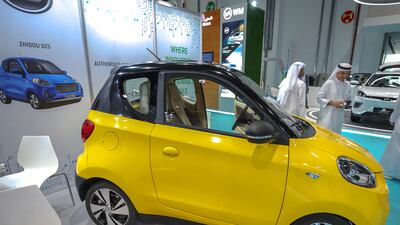
A host of vehicles are on display at the Electric Vehicle Innovation Summit -
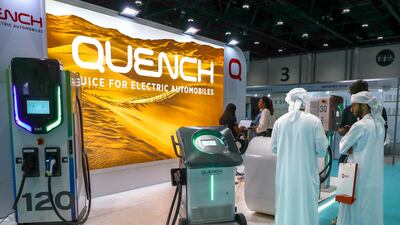
Quench, who produce electric vehicle chargers. The UAE plans to increase the number of EV charging stations to 800 by the end of the year. -
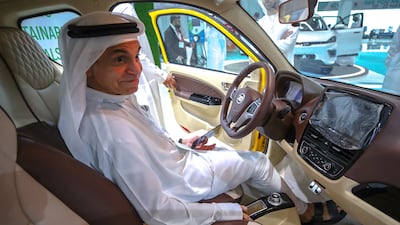
A visitor looks at the interiors of the Zhidou D2s EV on display at the Electric Vehicle Innovation Summit, ADNEC. Victor Besa / The National -

Visitors look at the interior of a Tesla EV on display. All photos: Victor Besa / The National -
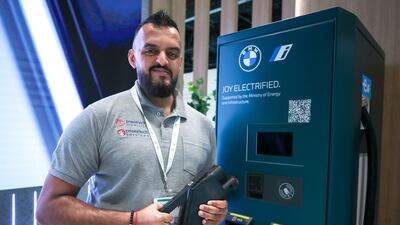
Vinay Premachandran, director of Powertech Mobility, at the Electric Vehicle Innovation Summit -
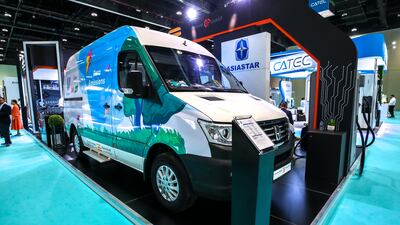
Asiastar, a Chinese bus company, and their EV display at the Electric Vehicle Innovation Summit -
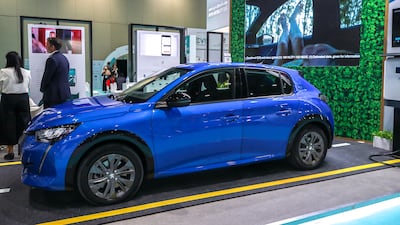
The demand for EVs in the UAE is on the rise -
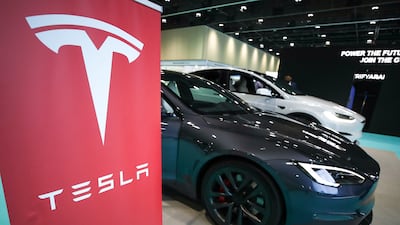
Key players and influential business leaders have converged at the summit. -
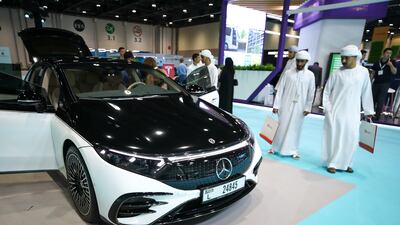
More than 5,000 professionals representing leading companies in the EV industry are in Abu Dhabi -
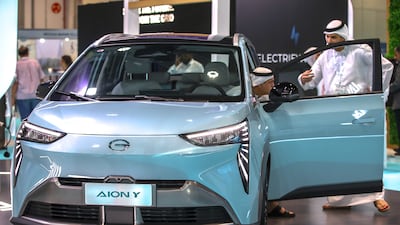
The UAE was ranked eighth in the world when it came to readiness for electric mobility -
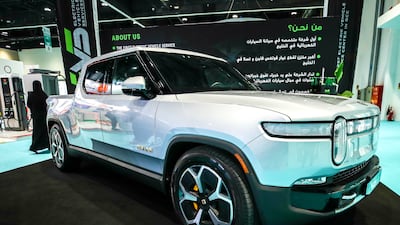
The Electric Vehicle Innovation Summit aims to bring industry leaders together. -
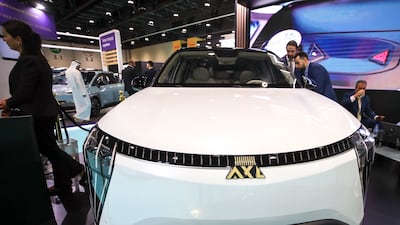
Experts are attending the Electric Vehicle Innovation Summit in Abu Dhabi -
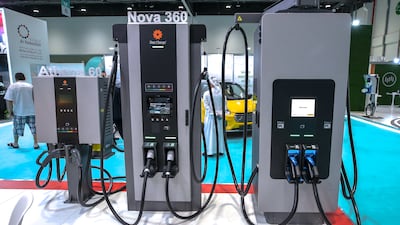
The demand for EVs in the UAE is on the rise, with a projected annual growth rate of 30 per cent until 2028.



