
An online booking system set up to deal with the huge demand to visit the Baps Hindu Mandir in Abu Dhabi has gone live.
Organisers have warned that people who fail to register their trip on the temple's website could be denied entry.
Abu Dhabi Police helped to manage traffic flow on Tuesday as tens of thousands of worshippers descended on the site to celebrate the festival of Ugadi, the equivalent of New Year's Day in the Hindu calendar.
Workers in the Emirates are currently enjoying a week-long break for Eid Al Fitr, with the UAE's first Hindu temple proving a popular port of call for many with extra leisure time to spend.
How to book
Those planning trips to the temple can do so through the Baps Hindu Mandir website here.
On the booking page, users are asked to submit their name, email address, country and city of residence, state how many people are in the visiting party and select a preferred date and time for the trip.
An OTP – one-time password – is then sent to the email address provided to complete the booking.
A further email will then be sent to the user to confirm their visit has been registered.
Visiting parties of more than 10 are asked to fill in a separate registration form on the website.
The temple is open from Tuesday to Sunday, from 9am to 8pm. It is closed to the public on Mondays.
Boosting visitor experience
-

About 65,000 people turned out at the BAPS Hindu Mandir temple in Abu Dhabi on March 3, the first Sunday it was open. All photos: Pawan Singh / The National -
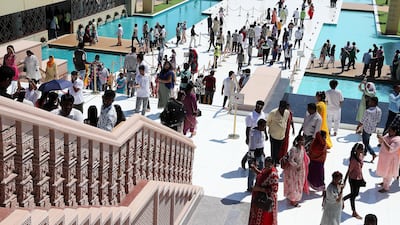
The temple was inaugurated by Indian Prime Minister Narendra Modi in February -

Now, 30,000 people on average visit the complex every Sunday with weekend waiting times of up to 90 minutes -

When the Baps Hindu temple formally opened on February 14, people began queuing almost immediately -
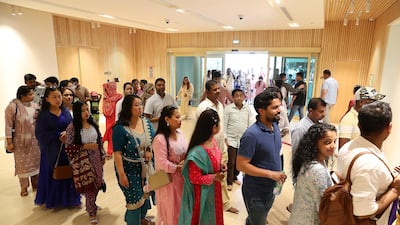
Hindus also expected to converge in large numbers to celebrate the Ram Navami and Hanuman Jayanti festivals -
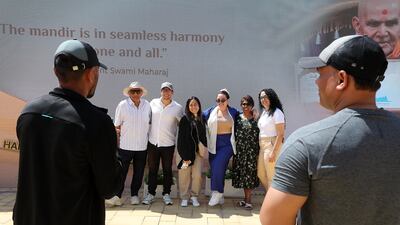
Elaborate carvings of deities are an integral part of the temple -

Temple officials are bracing for high numbers of visitors while maintaining a festive atmosphere -

The Baps Hindu Mandir, in the Abu Mureikha area off Sheikh Zayed Road, is open to people of all faiths -

Abu Dhabi’s first Hindu temple is gearing up to welcome tens of thousands of people for several festivals this month -

April is a packed month in the Hindu calendar with celebrations centred around Hindu new year and the spring season
The online portal has been established as the temple prepares for a busy period, featuring a number of key religious festivals.
Officials said the decision had been made to ensure the safety of visitors, avoid overcrowding and make the visitor experience more enjoyable.
"With the growing popularity of the Baps Hindu Mandir for spiritual seekers and tourists alike, managing visitor flow and ensuring a seamless experience have become a priority," read a temple statement.
A spokesman said the impressive stone temple has only grown in popularity since its inauguration in February.
"Since the grand opening of Baps Hindu Mandir, the number of visitors have significantly grown," he said.
"The daily numbers have been consistently growing and are astronomical on weekends and special days."
When the Baps Hindu temple formally opened on February 14, people began queuing almost immediately to enter the structure made from hand-carved stone and marble.
About 65,000 people turned out at the temple on the first Sunday, March 3, that the shrine opened its doors to the public, weeks after its inauguration by Indian Prime Minister Narendra Modi.
Now, 30,000 people on average visit the complex every Sunday, with weekend waiting times often stretching to 90 minutes, temple authorities said.

Tributes from the UAE's personal finance community
• Sebastien Aguilar, who heads SimplyFI.org, a non-profit community where people learn to invest Bogleheads’ style
“It is thanks to Jack Bogle’s work that this community exists and thanks to his work that many investors now get the full benefits of long term, buy and hold stock market investing.
Compared to the industry, investing using the common sense approach of a Boglehead saves a lot in costs and guarantees higher returns than the average actively managed fund over the long term.
From a personal perspective, learning how to invest using Bogle’s approach was a turning point in my life. I quickly realised there was no point chasing returns and paying expensive advisers or platforms. Once money is taken care off, you can work on what truly matters, such as family, relationships or other projects. I owe Jack Bogle for that.”
• Sam Instone, director of financial advisory firm AES International
"Thought to have saved investors over a trillion dollars, Jack Bogle’s ideas truly changed the way the world invests. Shaped by his own personal experiences, his philosophy and basic rules for investors challenged the status quo of a self-interested global industry and eventually prevailed. Loathed by many big companies and commission-driven salespeople, he has transformed the way well-informed investors and professional advisers make decisions."
• Demos Kyprianou, a board member of SimplyFI.org
"Jack Bogle for me was a rebel, a revolutionary who changed the industry and gave the little guy like me, a chance. He was also a mentor who inspired me to take the leap and take control of my own finances."
• Steve Cronin, founder of DeadSimpleSaving.com
"Obsessed with reducing fees, Jack Bogle structured Vanguard to be owned by its clients – that way the priority would be fee minimisation for clients rather than profit maximisation for the company.
His real gift to us has been the ability to invest in the stock market (buy and hold for the long term) rather than be forced to speculate (try to make profits in the shorter term) or even worse have others speculate on our behalf.
Bogle has given countless investors the ability to get on with their life while growing their wealth in the background as fast as possible. The Financial Independence movement would barely exist without this."
• Zach Holz, who blogs about financial independence at The Happiest Teacher
"Jack Bogle was one of the greatest forces for wealth democratisation the world has ever seen. He allowed people a way to be free from the parasitical "financial advisers" whose only real concern are the fat fees they get from selling you over-complicated "products" that have caused millions of people all around the world real harm.”
• Tuan Phan, a board member of SimplyFI.org
"In an industry that’s synonymous with greed, Jack Bogle was a lone wolf, swimming against the tide. When others were incentivised to enrich themselves, he stood by the ‘fiduciary’ standard – something that is badly needed in the financial industry of the UAE."
HWJN
GULF MEN'S LEAGUE
Pool A Dubai Hurricanes, Bahrain, Dubai Exiles, Dubai Tigers 2
Pool B Abu Dhabi Harlequins, Jebel Ali Dragons, Dubai Knights Eagles, Dubai Tigers
Opening fixtures
Thursday, December 5
6.40pm, Pitch 8, Abu Dhabi Harlequins v Dubai Knights Eagles
7pm, Pitch 2, Jebel Ali Dragons v Dubai Tigers
7pm, Pitch 4, Dubai Hurricanes v Dubai Exiles
7pm, Pitch 5, Bahrain v Dubai Eagles 2
Recent winners
2018 Dubai Hurricanes
2017 Dubai Exiles
2016 Abu Dhabi Harlequins
2015 Abu Dhabi Harlequins
2014 Abu Dhabi Harlequins
Tightening the screw on rogue recruiters
The UAE overhauled the procedure to recruit housemaids and domestic workers with a law in 2017 to protect low-income labour from being exploited.
Only recruitment companies authorised by the government are permitted as part of Tadbeer, a network of labour ministry-regulated centres.
A contract must be drawn up for domestic workers, the wages and job offer clearly stating the nature of work.
The contract stating the wages, work entailed and accommodation must be sent to the employee in their home country before they depart for the UAE.
The contract will be signed by the employer and employee when the domestic worker arrives in the UAE.
Only recruitment agencies registered with the ministry can undertake recruitment and employment applications for domestic workers.
Penalties for illegal recruitment in the UAE include fines of up to Dh100,000 and imprisonment
But agents not authorised by the government sidestep the law by illegally getting women into the country on visit visas.
Cryopreservation: A timeline
- Keyhole surgery under general anaesthetic
- Ovarian tissue surgically removed
- Tissue processed in a high-tech facility
- Tissue re-implanted at a time of the patient’s choosing
- Full hormone production regained within 4-6 months
Timeline
2012-2015
The company offers payments/bribes to win key contracts in the Middle East
May 2017
The UK SFO officially opens investigation into Petrofac’s use of agents, corruption, and potential bribery to secure contracts
September 2021
Petrofac pleads guilty to seven counts of failing to prevent bribery under the UK Bribery Act
October 2021
Court fines Petrofac £77 million for bribery. Former executive receives a two-year suspended sentence
December 2024
Petrofac enters into comprehensive restructuring to strengthen the financial position of the group
May 2025
The High Court of England and Wales approves the company’s restructuring plan
July 2025
The Court of Appeal issues a judgment challenging parts of the restructuring plan
August 2025
Petrofac issues a business update to execute the restructuring and confirms it will appeal the Court of Appeal decision
October 2025
Petrofac loses a major TenneT offshore wind contract worth €13 billion. Holding company files for administration in the UK. Petrofac delisted from the London Stock Exchange
November 2025
180 Petrofac employees laid off in the UAE
Fight card
Preliminaries:
Nouredine Samir (UAE) v Sheroz Kholmirzav (UZB); Lucas Porst (SWE) v Ellis Barboza (GBR); Mouhmad Amine Alharar (MAR) v Mohammed Mardi (UAE); Ibrahim Bilal (UAE) v Spyro Besiri (GRE); Aslamjan Ortikov (UZB) v Joshua Ridgwell (GBR)
Main card:
Carlos Prates (BRA) v Dmitry Valent (BLR); Bobirjon Tagiev (UZB) v Valentin Thibaut (FRA); Arthur Meyer (FRA) v Hicham Moujtahid (BEL); Ines Es Salehy (BEL) v Myriame Djedidi (FRA); Craig Coakley (IRE) v Deniz Demirkapu (TUR); Artem Avanesov (ARM) v Badreddine Attif (MAR); Abdulvosid Buranov (RUS) v Akram Hamidi (FRA)
Title card:
Intercontinental Lightweight: Ilyass Habibali (UAE) v Angel Marquez (ESP)
Intercontinental Middleweight: Amine El Moatassime (UAE) v Francesco Iadanza (ITA)
Asian Featherweight: Zakaria El Jamari (UAE) v Phillip Delarmino (PHI)
Real estate tokenisation project
Dubai launched the pilot phase of its real estate tokenisation project last month.
The initiative focuses on converting real estate assets into digital tokens recorded on blockchain technology and helps in streamlining the process of buying, selling and investing, the Dubai Land Department said.
Dubai’s real estate tokenisation market is projected to reach Dh60 billion ($16.33 billion) by 2033, representing 7 per cent of the emirate’s total property transactions, according to the DLD.
Mercer, the investment consulting arm of US services company Marsh & McLennan, expects its wealth division to at least double its assets under management (AUM) in the Middle East as wealth in the region continues to grow despite economic headwinds, a company official said.
Mercer Wealth, which globally has $160 billion in AUM, plans to boost its AUM in the region to $2-$3bn in the next 2-3 years from the present $1bn, said Yasir AbuShaban, a Dubai-based principal with Mercer Wealth.
“Within the next two to three years, we are looking at reaching $2 to $3 billion as a conservative estimate and we do see an opportunity to do so,” said Mr AbuShaban.
Mercer does not directly make investments, but allocates clients’ money they have discretion to, to professional asset managers. They also provide advice to clients.
“We have buying power. We can negotiate on their (client’s) behalf with asset managers to provide them lower fees than they otherwise would have to get on their own,” he added.
Mercer Wealth’s clients include sovereign wealth funds, family offices, and insurance companies among others.
From its office in Dubai, Mercer also looks after Africa, India and Turkey, where they also see opportunity for growth.
Wealth creation in Middle East and Africa (MEA) grew 8.5 per cent to $8.1 trillion last year from $7.5tn in 2015, higher than last year’s global average of 6 per cent and the second-highest growth in a region after Asia-Pacific which grew 9.9 per cent, according to consultancy Boston Consulting Group (BCG). In the region, where wealth grew just 1.9 per cent in 2015 compared with 2014, a pickup in oil prices has helped in wealth generation.
BCG is forecasting MEA wealth will rise to $12tn by 2021, growing at an annual average of 8 per cent.
Drivers of wealth generation in the region will be split evenly between new wealth creation and growth of performance of existing assets, according to BCG.
Another general trend in the region is clients’ looking for a comprehensive approach to investing, according to Mr AbuShaban.
“Institutional investors or some of the families are seeing a slowdown in the available capital they have to invest and in that sense they are looking at optimizing the way they manage their portfolios and making sure they are not investing haphazardly and different parts of their investment are working together,” said Mr AbuShaban.
Some clients also have a higher appetite for risk, given the low interest-rate environment that does not provide enough yield for some institutional investors. These clients are keen to invest in illiquid assets, such as private equity and infrastructure.
“What we have seen is a desire for higher returns in what has been a low-return environment specifically in various fixed income or bonds,” he said.
“In this environment, we have seen a de facto increase in the risk that clients are taking in things like illiquid investments, private equity investments, infrastructure and private debt, those kind of investments were higher illiquidity results in incrementally higher returns.”
The Abu Dhabi Investment Authority, one of the largest sovereign wealth funds, said in its 2016 report that has gradually increased its exposure in direct private equity and private credit transactions, mainly in Asian markets and especially in China and India. The authority’s private equity department focused on structured equities owing to “their defensive characteristics.”
Who's who in Yemen conflict
Houthis: Iran-backed rebels who occupy Sanaa and run unrecognised government
Yemeni government: Exiled government in Aden led by eight-member Presidential Leadership Council
Southern Transitional Council: Faction in Yemeni government that seeks autonomy for the south
Habrish 'rebels': Tribal-backed forces feuding with STC over control of oil in government territory
Inside%20Out%202
Crime%20Wave
JOKE'S%20ON%20YOU
Groom and Two Brides
Director: Elie Semaan
Starring: Abdullah Boushehri, Laila Abdallah, Lulwa Almulla
Rating: 3/5
BEETLEJUICE BEETLEJUICE
Starring: Winona Ryder, Michael Keaton, Jenny Ortega
Director: Tim Burton
Rating: 3/5
While you're here
Samanth Subramanian: Imposing Hindi could undermine India's linguistic diversity
Phil Mercer: Aboriginal musicians are struggling to be heard
Gavin Esler: What we lose when we allow languages to die
KILLING OF QASSEM SULEIMANI
National Editorial: Suleimani has been killed, now we must de-escalate
Mina Al Oraibi: Air strike casts a long shadow over the decade ahead
Jack Moore: Why the assassination is such a monumental gamble
Matthew Levitt: Iran retains its ability to launch terror attacks
Damien McElroy: A CEO tasked with spreading Iran's influence
Hussein Ibish: Trump's order on solid constitutional ground
Simon Waldman: Cautious Israel keeping a low profile
Rashmee Roshan Lall: Sound of silence in South Asia
Fanar Haddad: The Iranian response will be gradual
The%20specs
A Cat, A Man, and Two Women
Junichiro Tamizaki
Translated by Paul McCarthy
Daunt Books
Also on December 7 to 9, the third edition of the Gulf Car Festival (www.gulfcarfestival.com) will take over Dubai Festival City Mall, a new venue for the event. Last year's festival brought together about 900 cars worth more than Dh300 million from across the Emirates and wider Gulf region – and that first figure is set to swell by several hundred this time around, with between 1,000 and 1,200 cars expected. The first day is themed around American muscle; the second centres on supercars, exotics, European cars and classics; and the final day will major in JDM (Japanese domestic market) cars, tuned vehicles and trucks. Individuals and car clubs can register their vehicles, although the festival isn’t all static displays, with stunt drifting, a rev battle, car pulls and a burnout competition.

