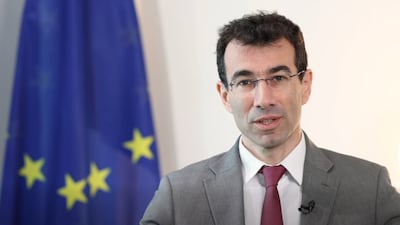

The European Union pours hundreds of millions of euros into Jordan each year to help the government pay for public salaries and deal with fiscal pressure.
While Europe’s leaders sometimes differ on the Middle East, they have developed a consensus on providing substantial aid to the kingdom, regarded widely as a bastion of stability in the region.
In the past three weeks, the killing of nine Christians in a rural area followed by the fatal stabbing of a policeman in Amman have undermined official assertions of Jordan as a bulwark against militancy. The authorities deemed both incidents terrorist attacks.
However, Jordan’s geopolitical importance rose after the country became part of regional plans to find alternative routes to the Strait of Hormuz for transporting goods, especially oil and gas. Plans now envisage bypassing the waterway through overland links across Jordan and Syria.
Capacity to absorb shocks
Now Europe wants to move beyond its traditional assistance and help Jordan to capitalise on the newfound interest and attract international investment, said Pierre-Christophe Chatzisavas, the EU's ambassador in Amman.
“Jordan is demonstrating a unique sense of self-preservation and capacity to absorb shocks,” Mr Chatzisavas told The National in an interview ahead of an EU-Jordan investment conference on the shores of the Dead Sea on Thursday.
Logistics and transport will be among $15 billion worth of projects that Jordan’s government will present to investors at the forum. The proposed ports, roads, rail and logistics hubs aim to “leverage Jordan's position as a regional corridor”, said Global Law Experts, an organisation that links businesses to lawyers.
Mr Chatzisavas said the kingdom has become a port for Iraq and Syria and a “good place” to conduct regional business, highlighting increased traffic at Jordan’s only port of Aqaba on the Red Sea coast as evidence.
More goods have been transported by road from Aqaba to the two countries since the start of the Iran war. The Aqaba container terminal handled 60,178 twenty-foot equivalent units (TEU) in transit in the first half of this year, three times more than the same period last year. However, shipping companies say they have faced bottlenecks and delays at the land crossings with Syria and Iraq.
The terminal is run by a division of Danish shipping conglomerate AP Moller–Maersk. It is one of the largest western investments in the kingdom, together with a concession held by a French consortium to run and expand Jordan’s main Queen Alia Airport in Amman.
Other projects to will be presented on Thursday cover green energy; water and sanitation; health; information technology and data centres; tourism; and property, Global Law Experts said.

Bumper $5.8bn funding
Some of the projects are designed around “long-term contractual arrangements with a public counterparty, common in water, health care and transport”, the report said. Others involve “privatisation and acquisition of equity in existing state-linked assets or enterprises”.
Jordanian authorities have been buoyed by securing $5.8 billion of mainly western funding this year for a major infrastructure project in Aqaba, comprising a desalination plant and a pipeline to transfer the water to Amman. King Abdullah II is expected to lay the project's cornerstone on Wednesday. In 2024, the government awarded the project to an international consortium controlled by French asset company Meridiam, which holds the major stake in the consortium running Queen Alia Airport.
The Aqaba–Amman Water Desalination and Conveyance Project could become one of the largest infrastructure developments in the kingdom since the US financed the East Ghor Canal – now called King Abdullah Canal – in the 1950s.
The European Investment Bank and the European Bank for Reconstruction and Development are the major financiers, together with the government-run US International Development Finance Corporation.
The project could usher a move “away from traditional development assistance to a new model of bilateral co-operation with Jordan,” Mr Chatzisavas said. Representatives of the two European banks will be at the investment conference, he added.
Mr Chatzisavas said EU budgetary support and other funding to improve Jordanian state finances will continue. However, he pointed out that about half of a €3 billion ($3.3 billion), three-year assistance package to Jordan announced last year by the EU comprises financing for infrastructure and other projects.
About €600 million was allocated as grants to support the budget and pay for relatively small projects, some of which benefit communities that host refugees. Another €500 million in loans were tied to fiscal and other reforms.
The package aims to “transition away from a donor-recipient approach” to a model “focused on the resilience of Jordan”, and on innovation, entrepreneurship and investment in “strategic development projects”, he said.
“It's in fact something that we would like to replicate with other minimum income countries and partners of the EU,” Mr Chatzisavas said. “The objective is to move away from a model of small lending to larger joint ventures and industries, interested in research and innovation, and in adding value to the raw materials.”
The EU envoy said the Aqaba project could provide up to 8,000 jobs in Jordan, where between 100,000 and 150,000 young Jordanians enter the labour market each year. Unemployment was 21 per cent in 2025, a rate unchanged from the year before, according to the International Monetary Fund (IMF). Jordan also has one of the highest levels of public debt compared to the size of its economy, which has been stagnant for the past 15 years. Gross public debt comprised 107 per cent of the kingdom's gross domestic product by the end of last year, IMF data shows.
However, the authorities have kept the country stable since ousting the Palestine Liberation Organisation in a 1970 civil war. In 1994, Jordan signed a peace treaty with Israel and in 2021 a defence pact with Washington. US aid inflows and cash injections into the budget have helped keep the Jordanian dinar, which is pegged to the dollar, stable for the past three decades – unlike in Syria and Lebanon. This has helped to maintain living standards.
Strong trade flows
And unlike other parts of the Middle East, Jordan has not become a source of refugees heading into Europe since the 2010 to 2011 Arab uprisings.
Mr Chatzisavas, who is a French-Cypriot dual citizen, said the continuing stabilisation of Syria had contributed to increased trade flows from Jordan to Europe by land, which could help Jordanian agri-businesses to recover from the effects of the Syrian civil war.
Increased demand for fertiliser on the continent has driven an 11 per cent rise in Jordanian potash exports to Europe, which are transported by ship. The Arab Potash Company, which has a monopoly in Jordan, signed a deal this month with Belgian company Euroports to handle and store 60,000 tonnes of products at Antwerp.
However, European companies considering investment in Jordan need assurances that “the rules of the game would be respected” amid the current political volatility in the region, Mr Chatzisavas said. Jordanian authorities could foster more confidence in the country by avoiding sudden introduction of new regulations or new taxes, he added.
The government has stayed on “the course of reforms despite the difficult environment”, Mr Chatzisavas said, referring to a 2022 plan to activate the economy, followed by a blueprint for administrative reform supervised by King Abdullah. However, investors look at other factors, such as licensing, taxes and legal safeguards, he said.
The investment conference on Thursday will “offer an avenue for Jordan to present the state of play” and hear from potential investors about what they expect and “what could convince them to bet on Jordan”, he said.

