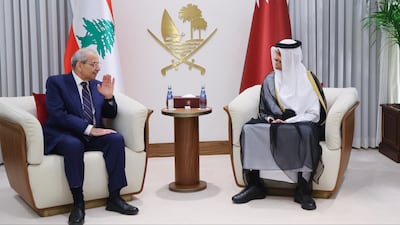
Lebanon's Prime Minister Nawaf Salam announced "significant progress" towards an energy agreement with Qatar on Sunday as he visited Doha to discuss a potential 20-year supply deal.
A Qatari gas deal would be a boost to Lebanon's ailing energy sector, which struggles to produce more than a few hours of electricity per day. Many Lebanese rely on expensive private generators.
Qatar has offered to finance an electricity project. Mr Salam's office said proposals being discussed included projects to generate more electricity in Lebanon, import energy via Syria, and build a terminal to receive gas by sea.
It said Mr Salam and Energy Minister Joe Saddi were also in Qatar to "negotiate a 20-year agreement to supply liquefied natural gas from Qatar, in addition to renewable energy projects".
After meeting Qatar's Prime Minister, Sheikh Mohammed bin Abdulrahman, Mr Salam said he was grateful for the Gulf state's support in "difficult circumstances".
"We have made significant progress in preparing an agreement between the two governments," Mr Salam said. He said Lebanese energy officials had arrived in Doha on Sunday evening to discuss technical aspects.
Qatar is one of the world's biggest gas producers. Some of its production has been curtailed by Iranian attacks, causing state revenue to fall by 42 per cent in the first half of this year.
But the economy is forecast to rebound with 15 per cent growth next year. The picture is less promising in Lebanon, which is in a state of war and occupation due to Israel's conflict with Hezbollah.
The war has compounded a financial crisis in Lebanon. State power provider Electricite du Liban (EDL) this month began cutting electricity to public institutions that have failed to pay their bills.
The embattled state electricity provider, the headquarters of which were torn apart in the 2020 Beirut port blast, is believed to be owed millions of dollars. Lebanon's only international airport, in Beirut, was among the institutions at risk of having its power cut off until it reached a late agreement with the EDL over a payment plan.
The import-dependent country is also particularly sensitive to inflation and fuel price hikes stemming from the US-Iran war.

