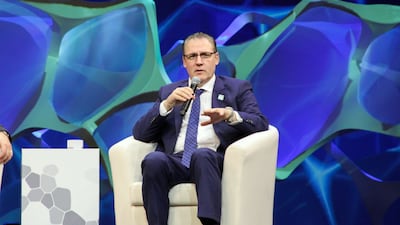

The Iran war and the stand-off in the Strait of Hormuz have upended life across the Middle East, forcing governments and people to adapt to a higher cost of living at a pace that would normally take decades, a UN official has warned.
Abdullah Al Dardari, UN Assistant Secretary General and director of the Regional Bureau for Arab States at the UN Development Programme, told The National how the conflict had rapidly reshaped priorities across the region.
He was speaking on the sidelines of the annual Manama Dialogue in Bahrain. The forum has focused on the far-reaching implications of the US-Iran conflict amid growing fears of another full-scale war.

People across the region will have to adjust to rapid changes as their governments try to rebuild what was destroyed and navigate the standoff in the strategic strait, the UN official said.
“People now have to adapt to less subsidies, higher prices and more taxation – transformations that take decades are now happening in a few months,” he explained.
The war with Iran has delivered the deepest oil and gas shock in modern history, more severe than the crises of 1974 and both Gulf wars. Yet its effect on prices and markets has been far milder than in previous episodes, the International Monetary Fund has said.
However, Mr Al Dardari said countries in a new categorisation of “rich but fragile” have shifted priorities after suffering the consequences of the Iran war.
“We're used to the former classification of oil rich or oil poor … but now we have a new category called rich but fragile and that is a category which is still better situated than countries like Lebanon and Syria, so they still have financial buffers,” he added.
Mr Al Dardari said a decades-long “over-reliance” on the Strait of Hormuz, through which a quarter of global shipping usually flows and which has been disrupted by a double blockade by Iran and the US, made countries “complacent”.
Some, he suggested, fared better than others, but overall the Middle East suffered a significant shock, losing seven per cent of GDP annually. “So the entire growth of 2025 was lost,” he added. This has caused the “rich but fragile” states to rethink their priorities, focusing inward rather than on middle-income countries that had relied on cash injections for survival.
He gave Lebanon and Syria as examples that were already struggling. “The problem is that the countries that used to have the money to inject have to worry about themselves and rebuild what was destroyed.”
Widening gap
Fears of a return to a war between the US and Iran, despite efforts at repaving the road to diplomacy, have resulted in US travel advisories to nearly all the countries in the region. They have also led to the withdrawal of US officials from places such as Saudi Arabia, which has been under regular Houthi attacks in recent weeks.
Meanwhile, US President Donald Trump has claimed that the war will be “wrapped up soon”.
Mr Dardari said he shared the worry that the war could return, but said this would only dramatically deepen existing problems that have resulted in four million people falling into poverty and four million others becoming unemployed in the region, according to UN data.
The UN official said Gulf states had shown a “high level of responsibility and seriousness” in improving regional connectivity to circumvent the impacts of the closure of the strait.
In June, the GCC and the UNDP held a round table in Riyadh, which focused on strengthening resilience and deepening co-ordination between the states and their neighbours. Further meetings were held on the sidelines of the UN General Assembly (UNGA) last month. Mr Al Dardari said the EU had also expressed interest in joining, and Turkey already agreed to join. “So we’re hoping more arteries open more opportunities, competition, productivity and technology.”
With the gap widening between the “haves” and the “have-nots' given the Iran war, technological advancements and the lasting impact of conflicts in the region, the question is whether some countries will be left behind.
Mr Al Dardari argued that that was not the case. “During the UNGA [General Assembly], you’ll be surprised by the high importance of Palestine and Gaza in behind-closed-doors meetings – always, not just sometimes, ahead of Hormuz,” he said. “So, the region realises that the essence of the problem [in the Middle East] is still in Palestine.”
He alluded to the Arab Human Development Report coming out next year, 25 years after its previous issue, which found that the region has completely changed since the start of the war in Gaza, in which 74,000 Palestinians have been killed and 80 per cent of the territory lies in ruins as aid continues to be largely blocked from entry.
“And this is before the war with Iran. I think recent events just confirmed that,” he said.

