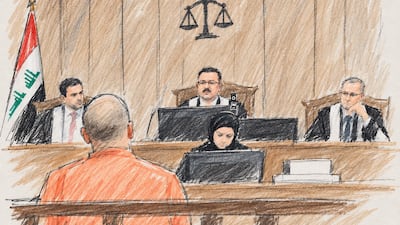

An Iraqi court on Thursday sentenced three more French nationals to life in prison for being part of ISIS, bringing to 10 the number of French citizens convicted this week.
The three men were sentenced by the Karkh Criminal Court in Baghdad under Iraq’s anti-terrorism law. Under Iraqi law, a life sentence is equivalent to 20 years in prison and is subject to an automatic review by the Court of Cassation within 30 days.
The verdicts come after the same court sentenced seven other French nationals on Tuesday, in the first rulings in the trials 47 French citizens transferred from north-eastern Syria to Iraq in July 2025.

On Tuesday, six men received life terms, while a seventh was given 15 years.
Judge Mohammed Salman presided over the hearings. “The court found that the evidence is sufficient to convict you,” he told each defendant. “The charge carries the death penalty, but because you are a young man at the beginning of your life, I have decided to give you a chance to reform yourself and change the course of your life.”
Court-appointed defence lawyers and representatives of the French embassy were present at the hearings.
Among those sentenced on Thursday was Charly Sun Raymond, 32, of Vietnamese origin. He took the name Abu Sufyan Al Faransi while in ISIS.
During his hearing on Tuesday, Raymond told the court he had no intention of going to Syria and had travelled to Turkey for a holiday at his sister's invitation.
He said his sister, who converted to Islam in Paris in 2011, was in a relationship with a man in Syria who convinced her to come, and they travelled to the Turkish city of Urfa. He claimed he only agreed to cross the border to accompany her and then return, but that ISIS militants convinced him to stay once inside Syria. He enrolled in a two-week Sharia course that he did not understand because it was in Arabic, and he pledged allegiance to Abu Bakr Al Baghdadi.

He first joined the Islamic police and then Diwan Al Jund, where he was assigned to military posts, first in the northern countryside and later in Raqqa. He rejected intelligence reports that identified him as a sniper.
He was later moved to a civilian prison where detainees were held for violations such as smoking and theft. He was paid $100 a month, married in Syria and had two children, and suffered an injury to his left hand in an air strike.
His account was challenged several times during the hearing. When he said he was arrested in Baghouz while trying to flee, Judge Salman interrupted. “You took part in Baghouz fights in 2019 and you were injured,” Judge Salman said. Similarly, he was confronted with information that authorities found extremist ideology on his phone in France and videos supporting terrorist organisations.
He claimed to have abandoned ISIS in 2017 but remained in Syria for his sister. The court noted that the ISIS data sheet identifies him as a “Mujahid”.
He pleaded guilty, telling the court at the end of his hearing, “I am remorseful”.
“This is something that happened in the past and I cannot fix it,” he said. “For eight years my mind was brainwashed; now everything is clear.”
Kamal Habib Ahmed bin Mubarak, 42, was also sentenced on Thursday. He said his path to Syria began with the 2011 Arab uprisings.
“Seeing the [uprisings] brought anger into my heart regarding injustice,” Mr bin Mubarak told the court during his hearing on Tuesday.
“Afterwards I became angry because of the violations of the Syrian regime. At that time I felt that Muslim blood had no value.
“The propaganda of the organisation was very strong in the beginning, I didn't find anyone to advise me, I wish there had been prevention on the matter from the beginning.”
In Syria, he said he entered a Sharia camp and later worked in the internal police, whose task was arresting ISIS members accused of bribery and corruption.
“ISIS used part of religion and left some,” he said, reflecting on the group.
“I am not only regretful but regretful and upset at myself. I confess that I am guilty.
“I disavow the organisation and these crimes and I apologise to the victims and their families. Their acts were from another era.”
The court also opened the trial of Ibrahim Khalil Azhaf, presenting evidence and charges, and heard two others.
Najeeb Fatimi Abdul-Qadir, 38, is a French citizen of Algerian origin with a pharmacy degree. He introduced himself to the court as a former top student who made what he called the “stupidest” decision of his life.
“I studied pharmacy and I was among the best students and I was a smart student, but I did the stupidest thing in my life, which is joining ISIS,” he told the court.
He arrived in Syria in early 2014, months before the group declared its caliphate. His brother had gone before him. In ISIS his name was Abu Suleiman Al Jazairi and he was paid $160 a month.
According to his testimony, he never fought. He worked as a pharmacist and nurse in hospitals and in medical warehouses distributing medicine. He was married in late 2014 and had a son and a daughter in Syria.
He told a story of gradual disillusionment.
“I was following the news in Syria and I was affected by it and at that time I deluded myself that I was protecting the Syrian people and that going to Syria contributed to protecting the nation, but I committed the biggest mistake in my life,” he told the judge.
“In the beginning everything was beautiful and new for me in helping Syrians and I thought I was in the right place, and with time I knew the truth of the terrorist organisation and that the dream I was living had fallen.
“In the beginning I was lying to myself because I left everything behind me, my friends and my money, and I was saying that I did the good and right thing.”
The judge said he would have known what ISIS stood for from reports in France.
Mr Abdul-Qadir said: “They claimed to defend the Syrian people and restore their rights and therefore it became clear that this was a slogan they raised so that people would come to them.”
By the end, his rejection was absolute. “ISIS is a terrorist organisation and jihadi Salafism is a criminal approach,” he said.
He said he tried to flee in 2017 but was arrested.
“I am very regretful. I destroyed my life. My only goal now is to get my life back and return to my family and my children and raise them,” he said. He pleaded guilty.
The court also questions Noor Al Din Abdul-Qadir Al Mansouri, a French citizen of Moroccan origin. Before the trial began, the judge presented him with a French government statement revoking his citizenship.
In France, he had worked in food distribution. He said he decided to join ISIS in 2014, drawn by the images coming out of Syria.
“At that time the media promotion was very strong for events in Syria. I saw jihad and the mujahideen as resistance then. The road to Syria was easy and there were many muhajireen [foreign fighters],” he said.
“I was sympathetic to the Syrian people; that's why I joined the organisation. When we saw that people were joining easily to go to Syria I said that the matter is normal and acceptable.”
Once in Syria, he said, he went through a military camp and then a Sharia course. He was then assigned to administration in Manbij, working in maintenance, communications and computers. He was paid $100 a month.
He had been married since 2004, and his wife went with him to Syria.
He claimed he stopped working for the group “after I discovered the truth of the organisation” and moved to Raqqa. After a military operation in Raqqa, he left the city with his wife and remained unemployed.
“I am regretful and sorry for everything that happened. After all this, I discovered that they were brainwashing us and I lost the blessing of freedom,” he said.
He pleaded guilty before the court.

