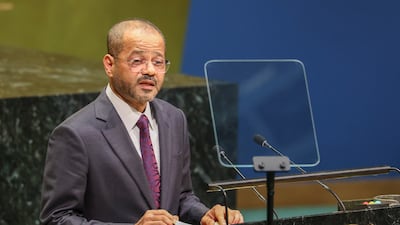

Oman's Foreign Minister Badr Al Busaidi has called for a peace agreement between the Arab Gulf states and Iran, which would see the countries collaborating on security and the regional economy.
The agreement would take the form of a security pact that includes Iran, as well as Iraq and Yemen, where Tehran has active armed proxies, he said during a visit to the UK on Wednesday.
The US should continue to play an economic role in the Gulf and Iran, rather than a military one, he added.
"The idea of a Gulf security architecture that doesn't include Iran is inherently unstable, structurally unsound," Mr Al Busaidi told the BBC's Radio 4.
"Iran is an objective fact and closing our eyes doesn't make it go away. I want to fully engage it and bring it to the fold, I want to see peace in the Gulf," he said.
Mr Al Busaidi first made the proposal on Monday, during a lecture at the University of Cambridge, where he said that the effective closure of the Strait of Hormuz had become "impossible to resolve" because "external powers continue to define the terms of engagement".
“What holds us back is that issues, which ought to be handled at a regional level by the states of the Gulf themselves, are made more complex, more intractable and sometimes simply impossible to resolve because the region’s security arrangements are insufficiently developed," he said.
“They are insufficiently developed because they have relied for too long on the involvement of external powers.”
But on Wednesday, he sought to give assurances that a security pact would not mean that the Gulf was seeking less US involvement in the region. "The US and other friends can still be involved and can invest substantially more in the economic promise of the region. They can be real partners," he told the BBC.
"It is time for a change of emphasis, a transition from the military only to the more lucrative economic sphere for all of us," he said.
Mr Al Busaidi blamed the US air strikes on Iran in February for sparkling the war and greater instability in the region.
Iran has repeatedly attacked energy sites across the Gulf, and its Yemeni armed proxy the Houthis have attacked infrastructure and civilian airports in Saudi Arabia.
"All these recent events [are] as a result of the war that was waged against Iran by the United States," he said.
Oman has good relations with Tehran and the Iran-backed Houthis in Yemen, and has typically served as a mediator for the US and western allies. But it is not involved in the current ceasefire negotiations between the US and Iran, which are being led by Pakistan and Qatar.
Earlier this year, US President Trump reportedly threatened to bomb Oman, claiming the country was getting "in the way" by seeking an alternative agreement with Iran on reopening of the Strait of Hormuz.
There was a historical precedent for a regional agreement such as the one he proposed, Mr Al Busaidi said.
"We have been there before in 1976 when all the eight countries gathered to try and forge that," he said, referring to meeting in Muscat, in November that year, of foreign ministers from the eight Gulf countries.
"Except, then, major events took place subsequently, including the Iranian revolution, the Iran-Iraq war, the invasion of Afghanistan."
But the circumstances that had postponed the possibility of a pact were "no longer there," Mr Al Busaidi said.
"Today we want to reconvene a proper inclusive process between all the countries in the region."