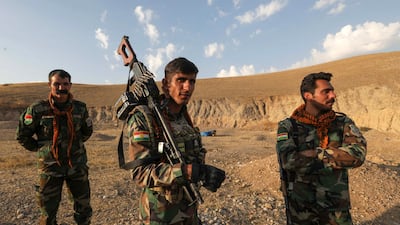
Iran's ambassador to Baghdad on Tuesday said Iraq has agreed to either expel Iranian Kurdish opposition groups based in the Kurdistan region or hand them over to Tehran.
The claim by Mohammad Al Sadegh came after he had attended a meeting of the Iraq-Iran joint security committee in Baghdad on Monday. Qasim Al Aboudi, the National Security Adviser, led the Iraqi delegation, which also featured representatives of the semi-autonomous Kurdistan region.
In a statement on X, Mr Al Sadegh said both sides had agreed “to remove elements of Iranian separatist terrorist groups from the Kurdistan region of Iraq or hand them over to Iran”.

There was no immediate comment from the Iraqi government or the Kurdistan region, nor from Mr Al Aboudi.
An official Iraqi readout of the meeting said both sides had discussed implementing the joint security agreement and the “outstanding files and problems”, and identified the “appropriate solutions”.
The apparent deal came only days after Iraq's parliament endorsed Yassir Al Maliki, the son-in-law of the pro-Iran State of Law Coalition leader and former prime minister Nouri Al Maliki, as Interior Minister.
Iraq and Iran signed a bilateral security agreement in March 2023, under which Baghdad committed to disarming Iranian Kurdish opposition groups and relocating them from the border area, and preventing Iraqi territory from being used to launch attacks on Iran.

Groups such as the Kurdistan Democratic Party of Iran, Komala, the Free Life Party of Kurdistan and the Kurdistan Freedom Party were to hand over their heavy weapons and move to camps farther from the border. Iraqi officials said at the time families would be relocated to five designated camps in the Kurdistan region while the UN refugee agency would process asylum claims.

The groups, some of which have been based in northern Iraq since the 1980s – after the Islamic Revolution and during the Iran-Iraq war – are seeking greater rights for Iran's Kurdish minority. Tehran accuses them of terrorism and of fuelling unrest, such as the 2022 protests that followed the death of Mahsa Amini.
In a sign of growing pressure on Baghdad and Erbil, the capital of the Kurdistan region, over the presence of these groups, Nechirvan Barzani, President of Kurdistan Region, said last week: “Unfortunately, the [Iranian] Kurdish opposition forces acted in a highly irresponsible manner and placed the Kurdistan region in an extremely difficult position.
“An armed force cannot view the Kurdistan region as a safe haven and then operate from its territory to threaten a neighbouring country,” he said, in reference to reports that the groups were planning to move into Iran, with US backing.
Implementation of the security agreement has been uneven. Baghdad says it has moved fighters from border areas and closed some headquarters, while Tehran has repeatedly called the measures insufficient and continued to carry out drone and missile strikes on opposition camps in Erbil and Sulaymaniyah provinces.
Expelling these groups or handing them over to Iran would mark a significant hardening of Iraq's position if confirmed, raising legal and humanitarian questions given that thousands of Iranian Kurdish refugees live in Iraq, most in the Kurdistan region.
The Kurdistan Regional Government has previously opposed forced return, calling for a peaceful resolution that respects Iraq's constitution, which bars armed groups from threatening neighbours, while also protecting refugee rights.

