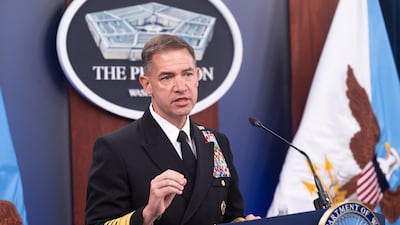
The US and its regional allies are deploying the “largest air-defence umbrella in the world” to deter Iranian attacks, US Central Command chief Adm Brad Cooper said, describing the effort as part of an “enduring security architecture” in the Middle East.
The senior US commander was speaking in a recorded message at Trends Global's sixth annual conference in Abu Dhabi on Monday, days after a Houthi attack on Riyadh’s main airport killed 13 people and wounded more than 300 others.
Adm Cooper said the combined missile defence effort throughout the Iran war, which once seemed a “distant goal”, was now “military partnership in action”.
“It was a vision we discussed with our regional allies and partners,” he told the audience at the Ritz-Carlton. “Earlier this year, during Operation Epic Fury, we validated at full scale and in actual combat the Middle East Air Defence network known as Mead.
“Through our combined efforts, we transformed a concept into the most sophisticated and largest air-defence umbrella in the world,” he added.
“For the first time in history, US air defenders stood shoulder-to-shoulder with allies and partners across the Middle East, linking national systems in real time. And so together we intercepted thousands of Iranian attack drones and missiles with an integrated shield built on mutual trust. This is partnership in action.”
Collective security
Military partnerships between the US and its regional allies were key to achieving sustainable security in the Middle East, said the Centcom chief.
“Sustainable security is not the absence of conflict. It is having robust systems, partnerships and interoperability in shared leadership firmly in place to manage threats before they escalate into a crisis,” he said.
Adm Cooper said the US forged military partnerships through “training, working shoulder-to-shoulder and operating alongside regional partners because we're stronger together and sustainable security requires strength”.
US ambassador to the UN
“Modern threats like advanced missiles and drones, as well as attacks from space and cyber, don't respect geographic boundaries or national borders, meaning no nation alone can counter these threats effectively,” he added.
While the US positions itself as a pillar of the Middle East's security architecture, Iran is facing growing isolation, said Mike Waltz, US ambassador to the UN.
“Iran wanted a ring of fire around Israel and instead it sealed its own fate,” Mr Waltz said at Trends in a recorded message. Countries in the Middle East such as Lebanon, Iraq and Syria “refuse to ever again be treated like Tehran's pawns on an Iranian chessboard”.
The US officials' remarks come amid growing signs that Tehran and Washington are bracing for a renewed confrontation after weeks of fragile calm.
Back to war?
The Iran war, which erupted in late February, has engulfed the Middle East for almost eight months, with no immediate end in sight.
Iran and the US have exchanged proposals in recent weeks aimed at ending the conflict and reopening the Strait of Hormuz. However, President Donald Trump rejected Tehran's latest offer and warned military operations could intensify after the US midterm elections.
The conflict's regional spillover has also widened, with the latest escalation between Saudi Arabia and the Iran-backed Houthis in Yemen adding to mounting instability across the Middle East.
Mr Trump said this week he was considering joining Saudi Arabia in retaliating against the Houthis following deadly attacks on King Khalid International Airport in Riyadh, despite initially declining Saudi requests for military intervention, according to reports.
When asked whether the Houthi strike on Riyadh's airport would change his previous decision not to attack Iran until after the midterms, Mr Trump said: “Well, we're going to take a look.”
The situation reflects the US administration’s reluctance to open another front, as efforts to end the Iran war prove elusive and the Strait of Hormuz crisis persists. Yet the appetite for war appears to be growing on both sides.
The head of Iran's Supreme National Security Council, Mohsen Rezaei, said Tehran was no longer responding to the US amid stalled negotiations, describing Washington's response to its proposals as “insufficient”.
Meanwhile, Mike Pompeo, former CIA director and US secretary of state, said the only solution was to “crush the Iranian regime … there is no solution short of that.
“We could not all be foolish to think that the regime in Iran is going to comply with any agreement,” he said at the Abu Dhabi event.