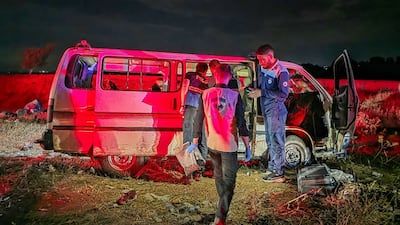
Gunmen killed at least seven people in an attack on a minibus carrying factory workers near Alawite villages in central Syria, members of the minority community said on Thursday.
The vehicle was attacked late on Wednesday as it crossed the Masyaf Bridge in the western countryside of Homs province, killing seven people and wounding four, the official Sana news agency reported. An investigation has been launched to identify the perpetrators and “bring them to justice”.
The authorities said the victims were being driven home after finishing work at a factory. First responders took the wounded to hospitals in Homs city. Photos on state media showed bloodstains and broken glass inside the minibus.
Homs Internal Security Forces Commander Brig Gen Bassem Mohammad Shaaban vowed that the crime “will not go unpunished” and described the attack as aimed to undermine “security we have worked on to consolidate”.
The area has been the scene of several revenge killings against Alawites since the ousting of Bashar Al Assad's regime in December 2024. Members of the minority sect, to which Mr Al Assad belongs, dominated power in Syria from 1963 until his downfall after a 13-year civil war.
During the civil war, Alawite militias carried out massacres against Sunnis in the area, including the 2012 Houla massacre, in which more than 100 people were killed.
The new authorities have also struggled to curb lawlessness. The attack on the minibus followed an explosion in a gas pipeline at the Tishreen plant, south-east of Damascus. A Damascus resident said he was travelling back to the capital overnight and saw the fire from Al Qutayfah, about 40km from the power plant.
“The fire rose high in the sky,” he said. Another resident of Damascus said that electricity cuts, which occur randomly in the capital, had increased since the explosion. The Syrian Civil Defence said the fire had been brought under control.
It was the second gas line explosion after one on Monday in the eastern province of Deir Ezzor, which the authorities blamed on sabotage. A local oil official told The National that thieves trying to steal gas had caused the explosion.
Two people were injured in the Tishreen plant explosion, according to state media. Oil Minister Mohammed Al Bashir said the facility needed an overhaul but it was not clear what had caused the explosion, which led to the shutdown of three electricity plants and increased the number of power-rationing hours.

Fragile security
The Syrian government says it has foiled several planned attacks by cells made up of ISIS members or remnants of the old regime. However, shortages and a rise in energy and fuel prices have also prompted more attempts to break into the pipeline network, officials say.
Against that backdrop, continuing security issues have been accompanied by deadly violence.
Mahmoud Eisa, a lawyer and ex-political prisoner, said that almost all of those killed in Wednesday's minibus attack were Alawites from the villages of Fahel and Al Shenniyeh. They worked at a plastics factory south of Homs and had nothing to do with the crimes committed in the Assad era, he added.
“We're in this situation because the authorities have not moved against those who have been committing revenge attacks, or made an effort to disarm them,” said Mr Eisa, who was a political prisoner for more than 11 years under Assad family rule.
“At the same time there has been no comprehensive process to deliver justice for the civil war transgressions,” Mr Eisa said.
Ethnic and religious minorities comprise about a quarter of the population of the Sunni-majority country, their members wary of the prospect of Islamist rule being imposed under the new order.
The popular revolt broke out against Assad family rule in March 2011, metamorphosing into a civil war by the end of the year. However, the regime was ousted by militant forces led by the current President Ahmad Al Shara.

