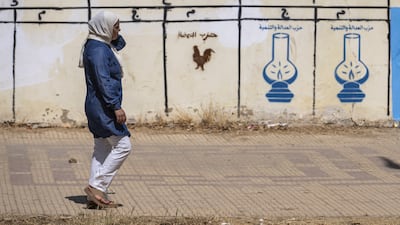
Morocco heads to the polls on Wednesday for a parliamentary election, with parties eager to entice young voters after protests and a border crisis revealed signs of discontent.
The vote is the country’s fourth since the 2011 Arab uprisings led King Mohammed VI to share more power with parliament before moving to reinforce the monarchy's position.
Two ruling parties close to the palace, the National Rally of Independents (RNI) and the Authenticity and Modernity Party (Pam), have both put youth employment at the centre of their campaigns, pledging to create about a million jobs during the next term.

A rush on the Spanish enclave of Ceuta last month was blamed in part on economic hardship among young people. While manufacturing, ports and railways have helped to lift living standards in Morocco's major cities, progress is seen as uneven.
They have also touted roughly $20 billion of infrastructure investment ahead of the 2030 World Cup, which Morocco will co-host with Spain and Portugal, and streamed rallies on social media to draw the attention of young voters.
“We reject the idea that young people simply want an easy life,” the Pam's campaign manifesto says, listing housing, regular income and “dignified work” as policy priorities.
Analysts say the challenge of engaging young voters was illustrated by deadly, Gen-Z-led protests last year, and by the massive border rush on Ceuta in July. About 80,000 people entered the Spanish enclave, most of whom have since returned to Morocco.
“The Ceuta mass migration attempt was a new form of social protest in which many citizens demonstrated a physical exit from Moroccan politics altogether,” Mohamed Masbah, head of the Moroccan Institute for Policy Analysis, told Reuters.

Just a third of Moroccans between 18 and 35 years old say they trust parliament, the Prime Minister or political parties, according to a survey published in March by Afrobarometer, a research non-profit.
Under Morocco’s system, the monarchy retains control of the country’s overarching policy direction. In recent years, it has also consolidated power over major portfolios, including the foreign and interior ministries.
An Islamist party ran the government for about a decade but suffered a crushing defeat in the last vote five years ago, ceding its place to the two coalition parties.
In recent years, authorities have leaned heavily on their economic strategy. Already one of Africa’s most diversified and industrialised economies, Morocco’s growth targets are ambitious.
The country’s “New Development Model”, a national economic plan launched about five years ago, aims to double gross domestic product per capita by 2035. The country has seen billions pour into sectors such as deepwater ports, phosphates, green energy and railway lines.

