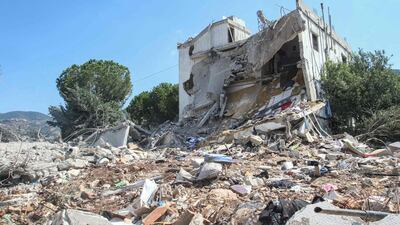

Lawyers for a French-Lebanese citizen on Tuesday filed a complaint with France’s National Anti-Terrorism Prosecutor’s Office over alleged Israeli war crimes involving the destruction of his property in southern Lebanon.
The complainant, whose name was not disclosed, lives in France. His house and olive trees in southern Lebanon were destroyed by Israel during its war with Hezbollah, according to his lawyers William Bourdon and Nicolas Busin, of the law firm Bourdon & Associes.
“This is a French citizen asking the justice system of his own country to establish the full truth and deliver justice for the war crimes committed against him, in line with a broader context in southern Lebanon that appears to amount to ethnic cleansing,” Mr Busin said at a conference on corruption and accountability in Beirut on Tuesday.
The conference, organised by the reformist political party Lana, was attended by opposition MP, Halima El Kaakour.
Mr Busin said the complainant's family had no connection to Hezbollah, which he argued shows “the complete absence of any military objective” in what happened to his property. He described it as “an act of destruction, damage or even theft”, which he said constituted a war crime.
He said the complaint was filed to uncover the truth, identify the perpetrators and prosecute them.
According to Mr Busin, more than 6,000 French citizens serve in the Israeli military. “It is unacceptable for French nationals to commit war crimes in southern Lebanon,” he said.
There have been at least three complaints filed in France this year over alleged Israeli war crimes in Lebanon. The first was filed in Paris in April by Ali Cherri, whose parents were killed in an Israeli strike on the eve of the November 2024 ceasefire that ended a round of fighting between Hezbollah and Israel.
The second was filed in June by a French-Lebanese man who lost several members of his family in an Israeli strike on a residential building in Tyre in April, a month after Hezbollah and Israel had resumed fighting.

The French judiciary has jurisdiction in these cases because the complainants are French. Several Lebanese citizens with dual nationality have initiated legal proceedings outside the country because there are no avenues in Lebanon to seek accountability for alleged international crimes.
Lebanon is not party to the Rome Statute and has yet to accept the jurisdiction of the International Criminal Court (ICC), despite repeated calls from human rights organisations.
A clause in the Israel-Lebanon framework agreement signed in June, aimed at paving the way for an end to hostilities between Israel and Hezbollah, has raised further concerns about Lebanon's ability to seek accountability through international courts.
Article 13 of the agreement commits both sides “to take good-faith measures that demonstrate positive intent, including the cessation of all hostile or adverse actions in international political or legal forums”.
Mr Busin said the proceedings abroad could build momentum for domestic efforts to secure accountability.
“Proceedings that are being pursued today in France and in other jurisdictions could tomorrow also have a positive impact in Lebanon, where the demand for accountability is also very strong,” he told The National.
Financial crimes
Mr Bourdon, a prominent French human rights lawyer, has initiated a string of legal proceedings related to Lebanon in recent years, leading to three separate investigations in France.
He has represented several victims and groups seeking to hold Lebanon’s banking and political elite accountable following the 2019 financial collapse.
Much like crimes against humanity, international corruption is an “existential threat for democracy”, Mr Bourdon said. speaking at the Beirut conference.
In 2021, two anti-graft organisations – Sherpa, founded by Mr Bourdon, and the Collective of Victims of Fraudulent and Criminal Practices in Lebanon (CVFCPL) – filed a complaint against Riad Salameh, the former governor of Lebanon’s Central Bank.
The proceedings led to the freezing of assets in Europe and the issuance of an international arrest warrant for Mr Salameh.
Mr Bourdon said the case has benefited from “considerable judicial momentum”, resulting in 10 entities or individuals being placed under formal investigation so far, including the Swiss subsidiary of the banking giant HSBC.
A trial could begin as early as 2028, he said.
Mr Salameh is also the target of several domestic proceedings over alleged corruption, which led to his detention in July in Lebanon. He has repeatedly denied any wrongdoing.
Last year, France’s financial crimes office opened an investigation into former Lebanese prime minister and billionaire Najib Mikati and his brother over alleged financial wrongdoing, following another Lebanon-related complaint filed in 2024 by Sherpa and the CVFCPL. The Mikati family has denied the allegations.
Mr Bourdon said he expects “increased momentum” in the Mikati case in the coming months.
More recently, Paris financial prosecutors in April opened an investigation into suspected financial wrongdoing involving the French subsidiaries of two Lebanese banking groups, SGBL Group and Bank Audi, as well as their executives.
The investigation followed two complaints related to Lebanese banks filed by Sherpa and CVFCPL in 2025.
The probe, which is now being handled by a financial crimes unit, also targets specific alleged acts of illicit enrichment concerning controversial banker Antoun Sehnaoui, SGBL's chairman, according to Mr Bourdon.
“Grand corruption is a form of outrage against humanity. It is a spit in the face of the general interest,” Mr Bourdon said.
Both banks have denied wrongdoing, while Mr Sehnaoui has not publicly commented on the accusations against him.

